






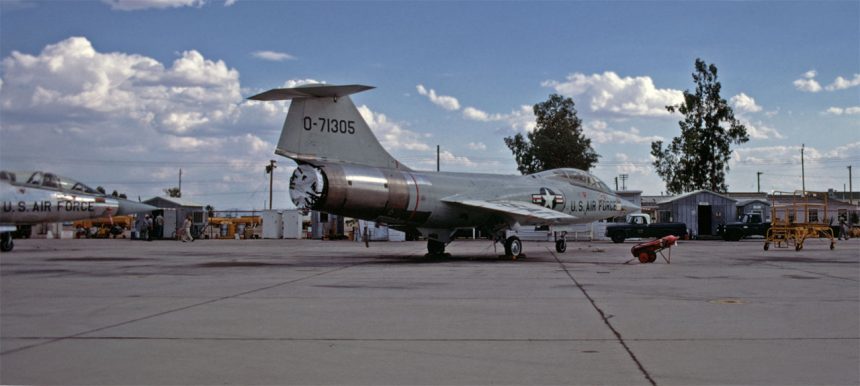

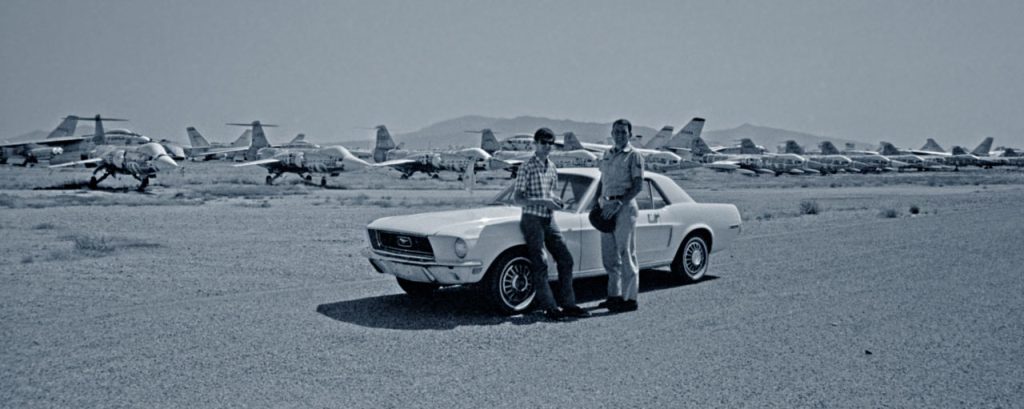
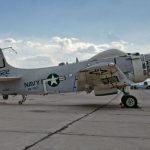
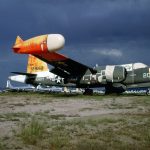
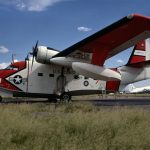
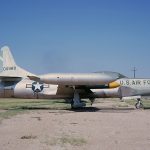
As we continue the Boneyard Files series, which showcases some of the retired aircraft resting at Davis-Monthan Air Force Base in Tucson, Arizona, in the late 1960s, today’s story features the Lockheed F-104 Starfighter through the lens of Neil Aird’s “Monthan Memories” photos. Nicknamed the “missile with a man in it” due to its long fuselage and short wings resembling a missile, the Lockheed F-104 Starfighter was the first interceptor aircraft in the U.S. service to reach Mach 2 speeds. The Starfighter featured an unconventional design for its time. It was a small aircraft with straight wings, unlike most other planes that were larger and had swept-back wings. The wingspan was only 21.11 feet, and they had a 100-degree negative dihedral angle. The sharp leading edge of the wings needed a special cover when the plane was on the ground to protect the ground crew. The F-104 Starfighter’s narrow body wrapped tightly around the engine, and the front section curved down slightly to give the pilot a better view.
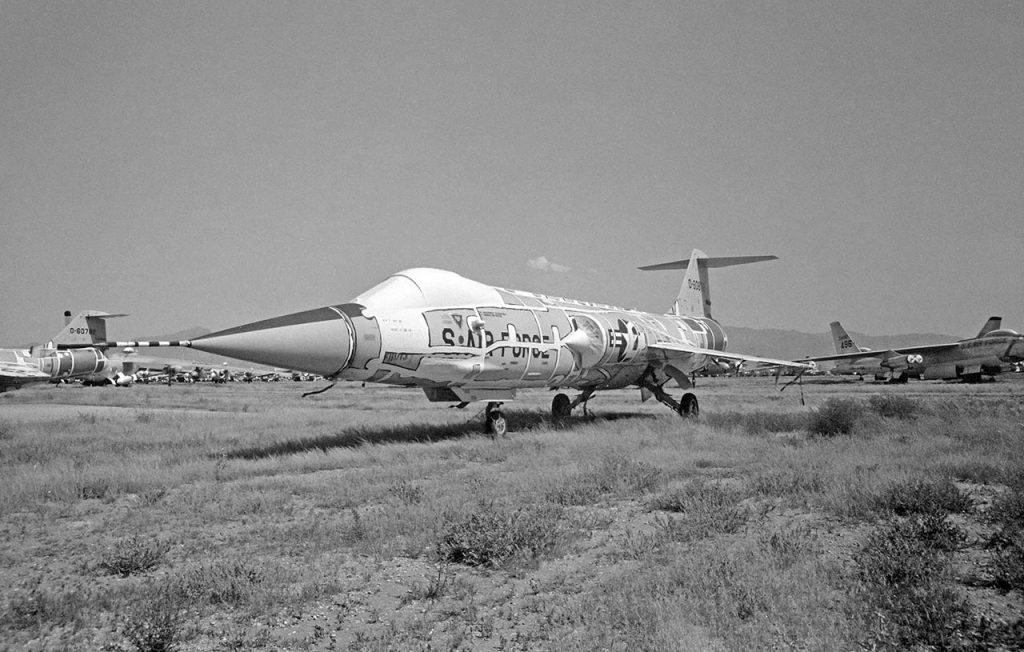
The Lockheed F-104 Starfighter was powered by a General Electric J79 turbojet engine, producing 10,000 pounds of dry thrust and 15,600 pounds of thrust with afterburner. The engine occupied more than half the length of the fuselage. Most of the remaining space was used for fuel tanks and the cockpit, leaving little room for the electronics systems. To solve this, developers created self-contained electronics packages that could be easily connected based on the mission needs. The basic armament included an M-61 Vulcan 20-mm gun in the fuselage and a Sidewinder GAR-8 missile on each wingtip. The M-61 is a Gatling-type gun with several rotating barrels, allowing for a very high rate of fire. Lockheed started designing the F-104 in November 1952 because the US Air Force needed a better day fighter. In March 1953, the Air Force ordered two Lockheed F-104 Starfighter prototypes powered by the Wright J65 engine. On March 4, 1954, Lockheed test pilot Tony Le Vier flew the first XF-104. The Air Force also ordered 15 YF-104A aircraft for testing, powered by the GE J79 engine.
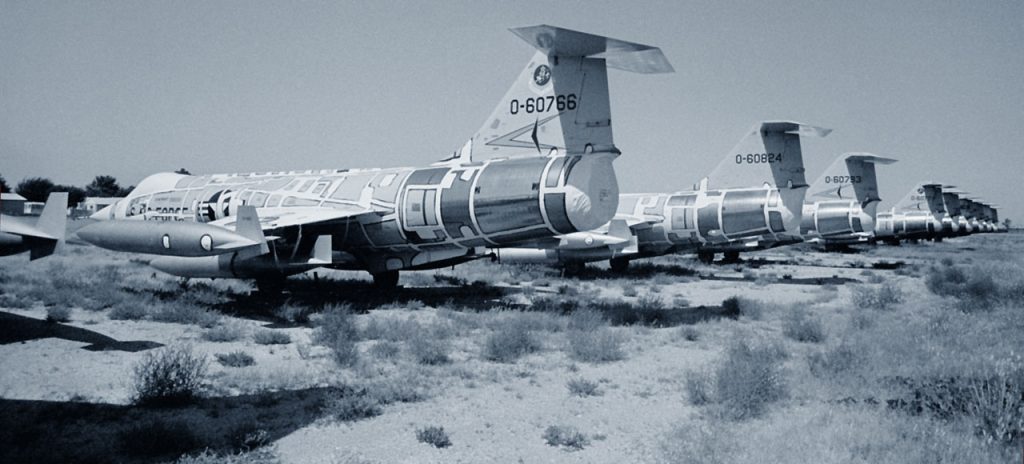
The first preproduction YF-104A was also used at the High-Speed Flight Station at Edwards in August 1956 for various research programs. Over the next 38 years, NASA operated 11 Lockheed F-104 Starfighters, logging more than 18,000 flights in research, chase, simulation, and aerodynamic experimentation. The US Air Force received its first F-104A jets on January 26, 1958, which were delivered to the 83rd Fighter-Interceptor Squadron at Hamilton Air Force Base in California. Soon after, pilots from this squadron broke world speed and altitude records. On May 7, 1958, Major Howard C. Johnson set a world altitude record of 91,249 feet. Then, on May 16, 1958, Captain Walter W. Irvin set a speed record of 1,404.19 mph. The Lockheed F-104 Starfighter also set seven climb-to-height records, with four of them replacing previous records to climb at 15,000 meters, 20,000 meters, and 25,000 meters. The main variants of the Lockheed F-104 Starfighter included the F-104B, a two-seat version used for training; the F-104C, used by the Tactical Air Command with in-flight refueling capability; and the F-104D, a two-seat version of the F-104C.
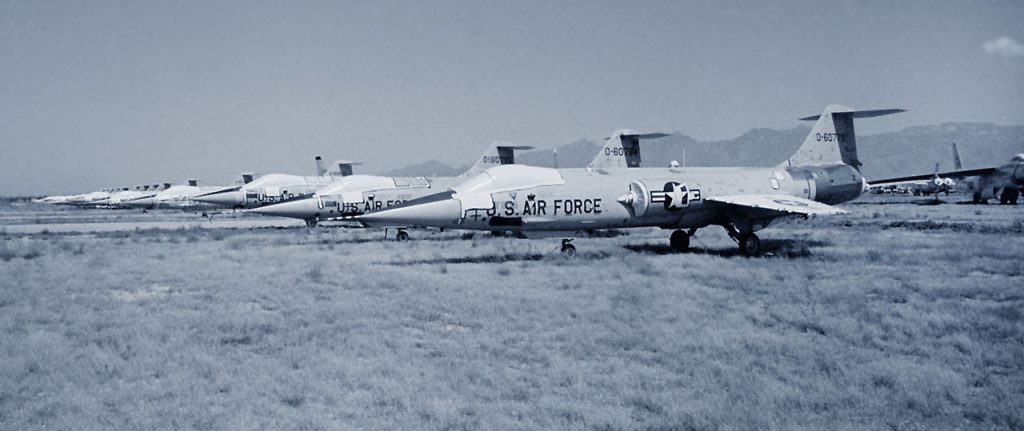
Most Lockheed F-104 Starfighters were used in other countries, including the F-104 G, F-104J, and CF-104, which were produced in NATO and SEATO member countries. The F-104G was 54.8 feet long, 13.6 feet high, with a wing area of 196.1 square feet. The empty weight of the aircraft was 14,000 pounds, and the maximum takeoff weight was 29,027 pounds. The maximum speed of the aircraft was 1,528 mph (Mach 2) with a combat range of 420 miles. The ferry range was 1,630 miles, and the service ceiling was between 50,000 feet and 60,000 feet, depending on weight and configuration. The basic Starfighter was later upgraded to a multi-mission fighter by adding a stronger structure and new operational equipment. On October 12, 1959, the Lockheed F-104 Starfighter project won the prestigious Collier Trophy for achieving the greatest achievement in aeronautics. Starfighters served in the US Air Force until the early 1960s, with a few seeing action in Vietnam. Some countries even used the aircraft later, with Italy being its last operator till 2004. After retirement, some Lockheed F-104 Starfighters were seen at Davis-Monthan Air Force Base, commonly known as “The Boneyard.” Read more Boneyard Files articles HERE.








The Starfighter also had a movie, called The Starfightets, which starred future Congressman Robert Dornan. It was featured in an episode of Mystery Science Theater 3000.
The F-104’s service calling wasn’t 73,000 feet, instead the maximum hight that the F-104 could reach for its service calling was 65,000 feet, because, if the service calling was 73,000 feet, then the J79 wouldn’t be able to run. This is because the J79 wasn’t designed to operate above 65,000 feet, unless it underwent a modification program that reengineered it to operate at altitudes of 70,000 feet, and higher. So, inspite of some sources quoting 73,000 feet as the F-104’s service celling, that is actually incorrect.
The F104 also made an appearance in the Star Trek Original Episode “Tomorrow is Yesterday”. SE 01 EP 19.