
When the North American P-51 Mustang first lifted off on April 23, 1941, it was not meant to be an experiment; it was meant to fight. The early Mustangs went to the Royal Air Force, where they were used for low-level reconnaissance and ground attack. At those altitudes, they were quick and efficient, but higher up, above 15,000 feet, performance began to fade. Everybody knew it was one of the most important long-range escort fighters of World War II, but no one knew it would spend its days not chasing enemy aircraft, but chasing data over the California desert. The Mustang belongs in the Flight Test Files not only because of what it did in combat, but because of what engineers learned from it. P-51 was renowned for its wings. Earlier fighters used airfoils that placed the point of lowest pressure close to the leading edge. The Mustang’s wing was different. Designed with help from NACA, which later became NASA, it used a laminar-flow airfoil. The idea was to shape the wing so that smooth, orderly airflow would remain attached over a greater portion of the wing’s surface before turning turbulent. Less turbulence meant less drag, more speed, and more range. On paper, drag could be reduced by 25 to 50 percent compared to older designs. In practice, things were never that clean, as laminar flow demanded an almost perfect surface. Rivet heads, panel seams, uneven paint, dust, rain, and even insect residue could disturb the boundary layer and cause early transition to turbulence.
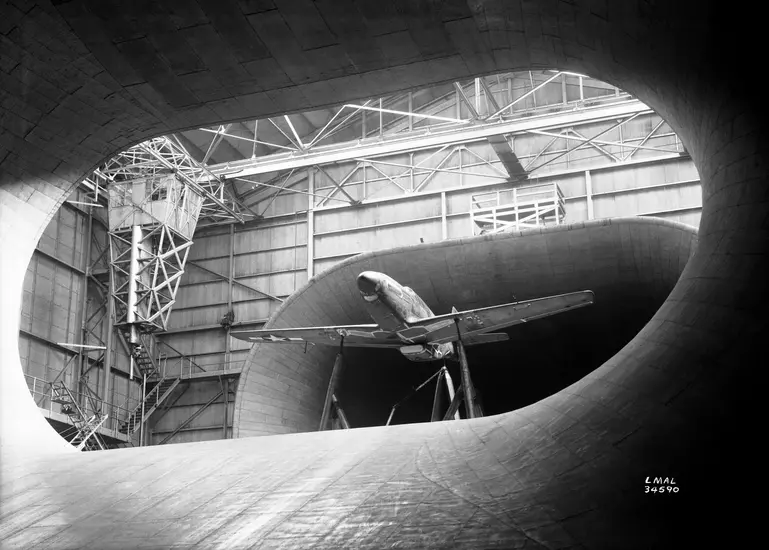
In the 1940s, the transonic region, the space just below the speed of sound, was still poorly understood. Wind tunnels capable of reproducing those conditions were limited. Engineers needed real data, and the P-51 became part of that effort. NACA mounted small experimental airfoil sections on top of the Mustang’s wing. As the airplane accelerated in dives toward Mach 0.8, the air over the curved upper surface sped up even more. In certain spots, it briefly reached transonic or near-supersonic speeds. In other words, the airplane created the conditions engineers wanted to study simply by flying. Pressure readings and flow behavior recorded during these flights helped researchers understand shock formation, boundary-layer separation, and compressibility effects. The Mustang’s design encouraged engineers to look closely at every source of drag. In NACA’s Full-Scale Wind Tunnel, the airplane underwent “drag cleanup” studies. Canopy edges were refined, surface alignment was checked, cooling inlets were analyzed, and even small imperfections were examined. Laminar flow was difficult to achieve, as even a minor rough surface could lead to failure, so flush riveting and smooth panel joints became aerodynamic necessities. These incremental refinements contributed directly to increases in top speed and range during wartime service.
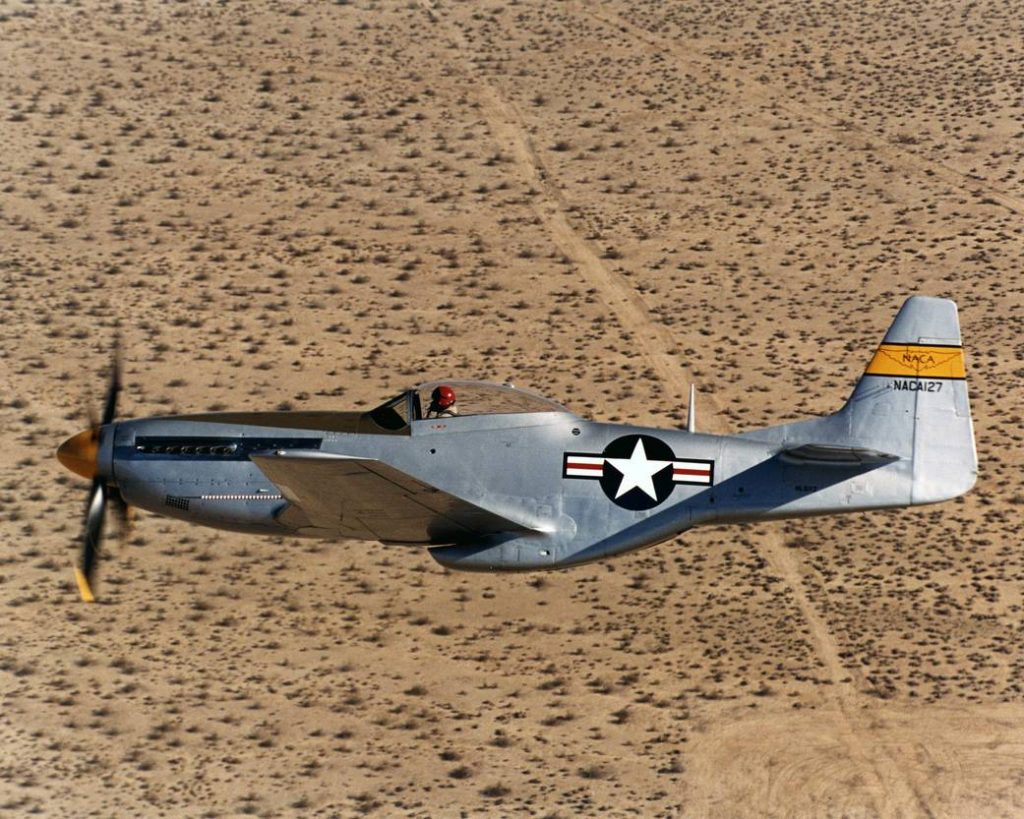
The “radiator rumble” was another aerodynamic issue identified early in the development of the P-51 Mustang. To rectify this, engineers at Ames Research Center placed a pilot in the cockpit during wind-tunnel testing to observe flow behavior. It was determined that the original P-51 radiator intake was too close to the fuselage skin. It was ingesting the turbulent, slow-moving boundary layer of air, which caused unstable airflow and separation within the duct, leading to the rumble. In addition, the long, complex ducting required for the belly-mounted radiator system was prone to pressure issues that caused the air to vibrate. Engineers discovered that moving the radiator scoop about 1.5 to 3 inches further away from the fuselage allowed the scoop to bypass the turbulent boundary layer, taking in cleaner air, which eliminated the rumble. Later versions, including the P-51H, were used to examine stability and control at higher speeds and altitudes as the US was transitioning from piston fighters to jet aircraft. Engineers compared tail configurations and measured directional stability in flight. Data gathered from the Mustang’s flights helped engineers understand high-subsonic handling and compressibility effects that would carry into the jet age.
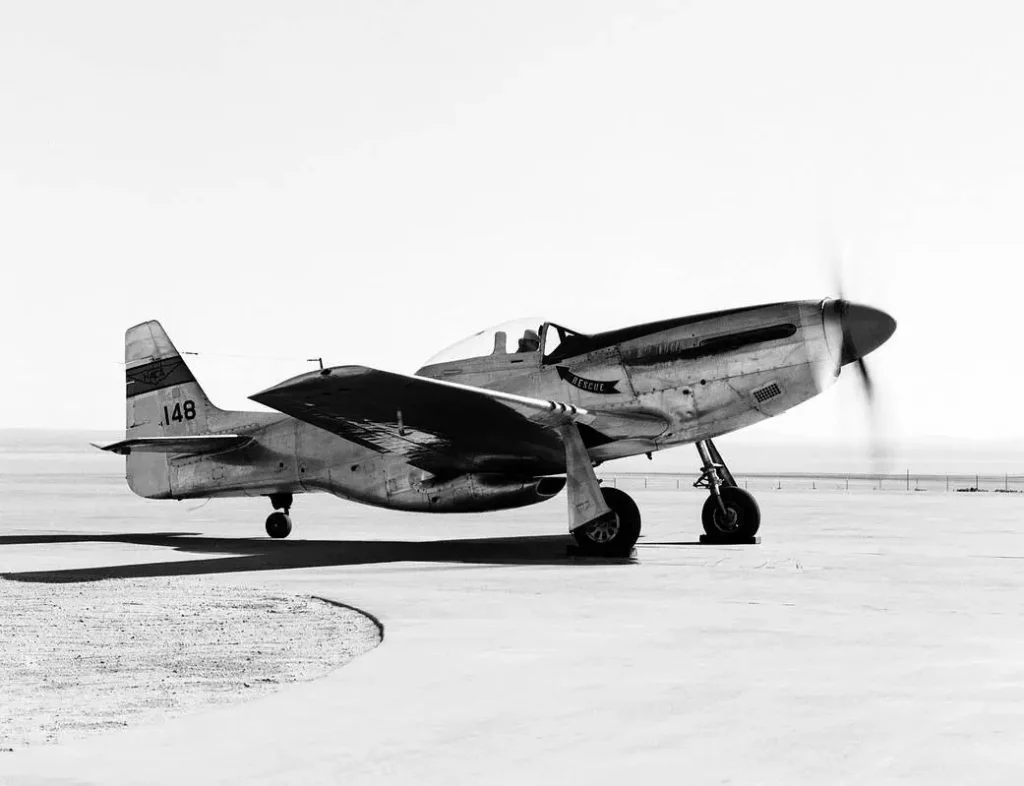
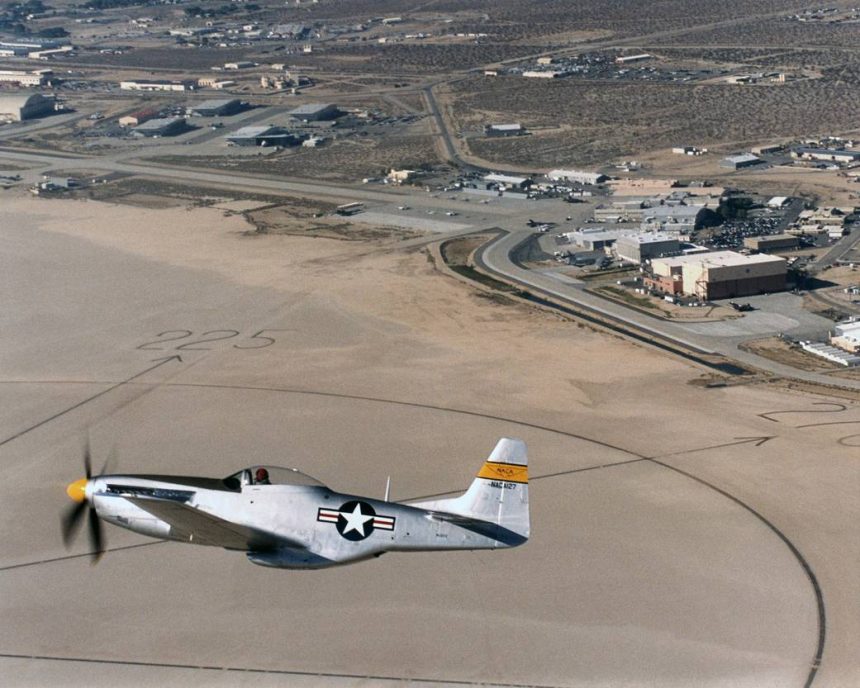
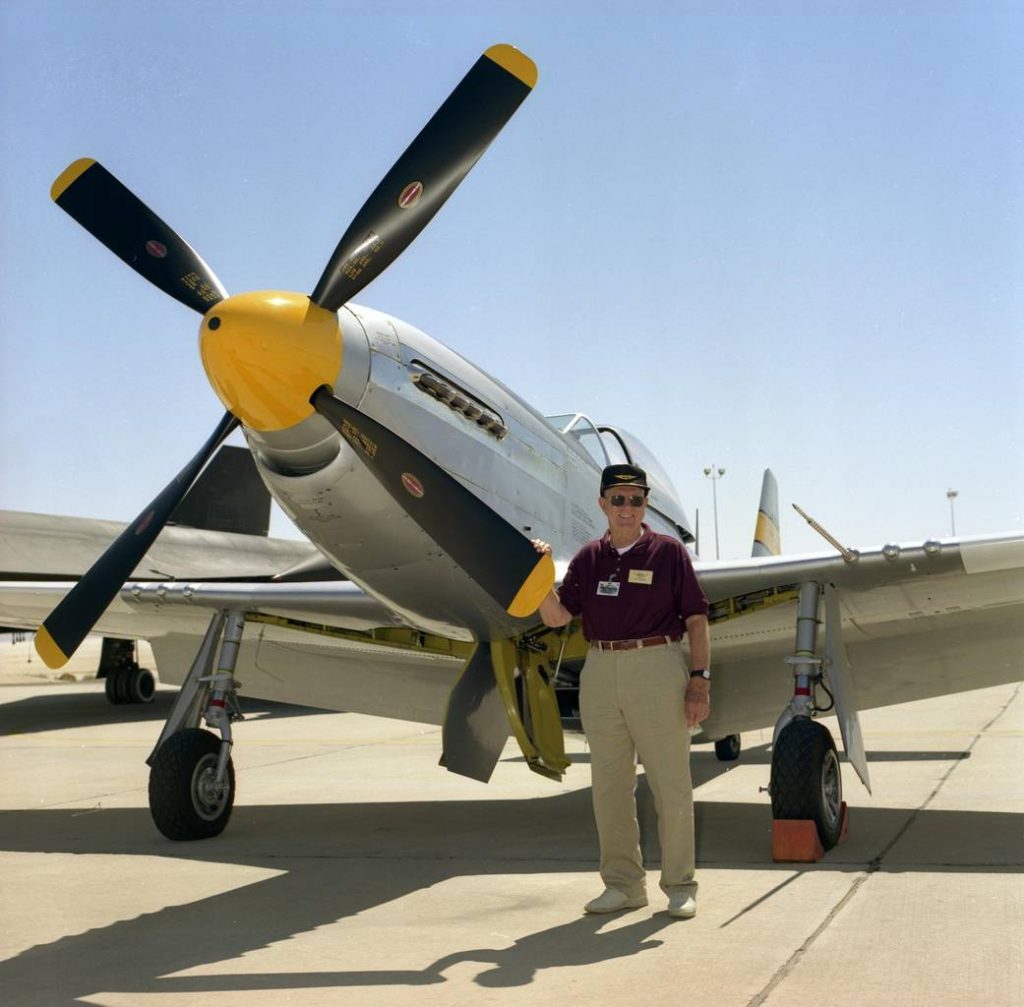
Later, in 1950, a P-51D, redesignated F-51, arrived at the NACA High-Speed Flight Research Station at Edwards, California. It had already served in wing-flow research at Langley, and now it would fly in support of experimental programs in the Mojave Desert. Records show that the aircraft was used as a chase and support aircraft 395 times. Neil Armstrong was among the pilots using it to chase some of the X-planes. For a time, piston and rocket shared the same airspace. The Mustang remained in service until 1959, when a taxiing accident ended its career. By then, NACA had become NASA, and supersonic research aircraft like the Bell X-1 and X-15 had taken center stage. But the Mustang had done its part. The P-51D Mustang was the first aircraft to employ the NACA laminar-flow airfoil design and could dive to around Mach number 0.8. It helped researchers study transonic behavior before supersonic tunnels were available, and prepared the US to fly jet aircraft. Finally, as an F-51, it was used as a proficiency aircraft at the High-Speed Flight Station. In war, it escorted bombers home, and in peace, it escorted engineers toward the jet age. Check out more Flight Test Files articles HERE.