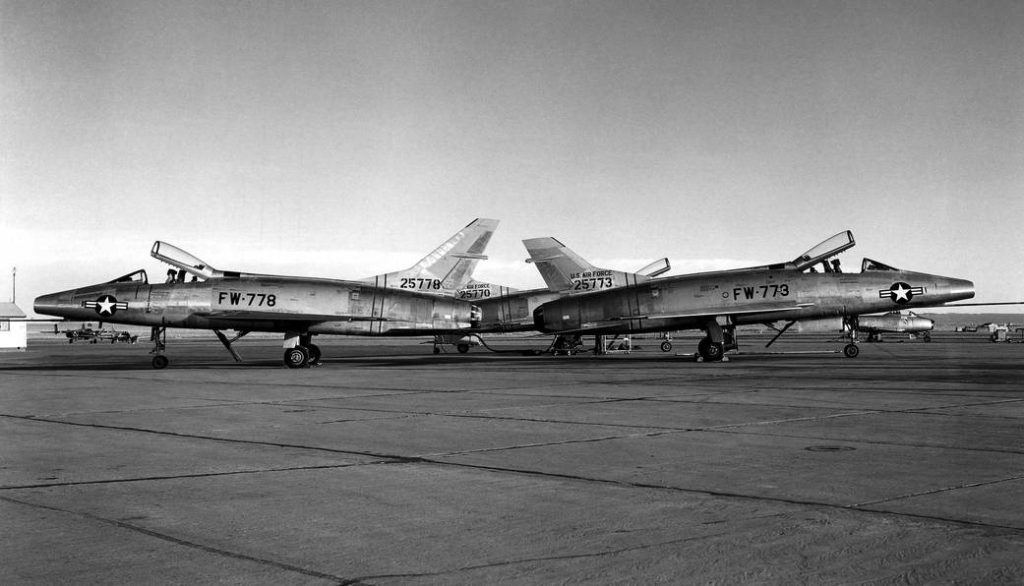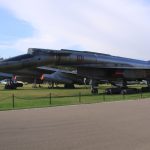
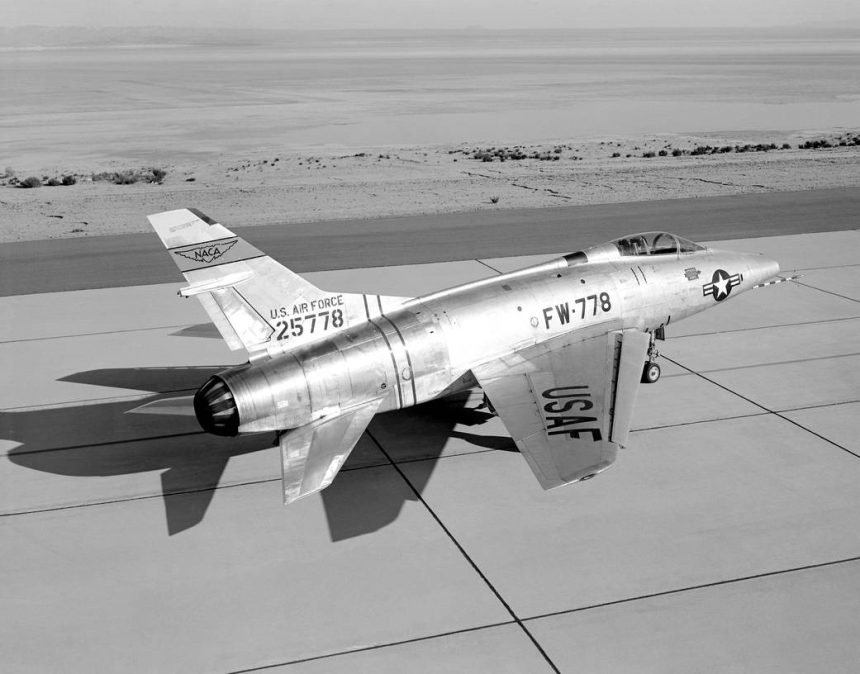

When the United States Air Force entered the era of supersonic flight in the early 1950s, engineers discovered that breaking the sound barrier once was very different from living beyond it every day. The North American F-100 Super Sabre was the first operational fighter designed from the outset to cruise supersonically, and it did not merely represent a new airplane but an entirely new aerodynamic environment where control response and pilot workload behaved in ways designers had not previously encountered in service aircraft. The National Advisory Committee for Aeronautics (NACA), now known as NASA, brought one of the early F-100A aircraft to its High-Speed Flight Station at Edwards in 1954 to understand why the airplane could suddenly become uncontrollable even when flown correctly. Early Air Force and company tests had revealed directional instability and a violent coupling motion in which roll and yaw fed into each other until the aircraft departed controlled flight. The phenomenon soon gained grim credibility when North American test pilot George Welch was killed during evaluation flights. At the same time, pilots reported a high-angle-of-attack pitch-up that could trap the aircraft in what they called the “Sabre dance,” a deep stall where recovery required altitude that combat operations would not always provide.
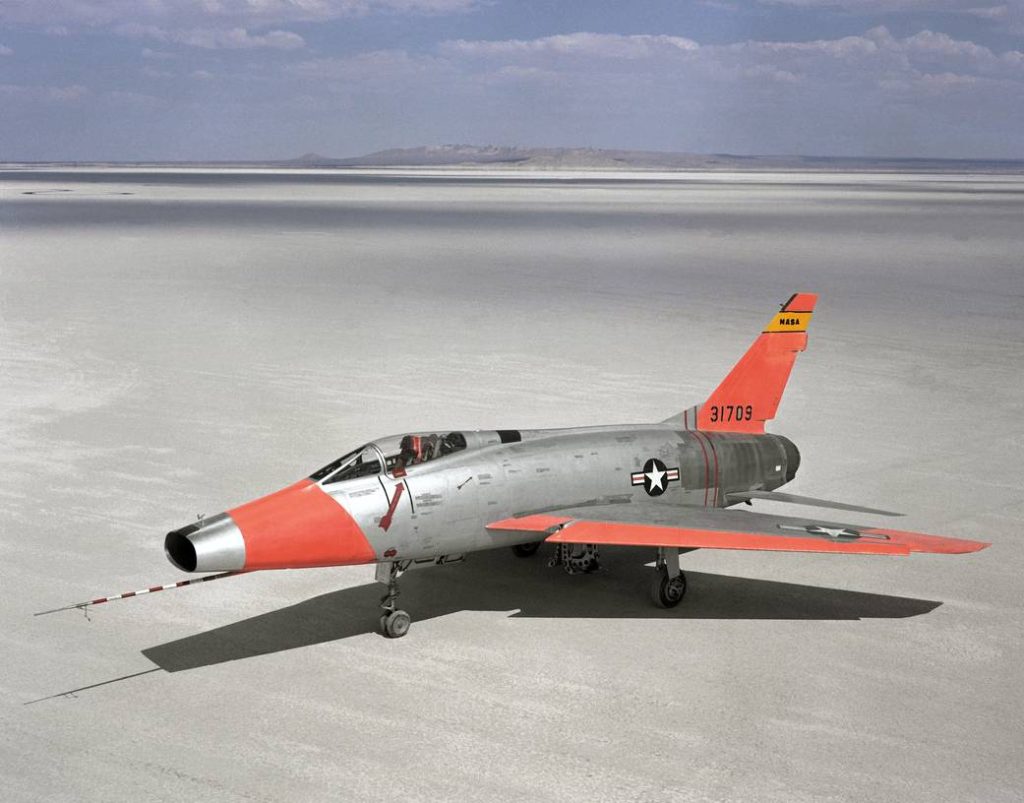
NACA approached the problem, and instead of treating the airplane as a finished weapon system, the engineers treated it as an aerodynamic laboratory. The first research flights examined stability margins, control effectiveness, and response lag while carefully expanding the envelope. On its first research mission, pilot Scott Crossfield even had to glide the aircraft to a powerless landing after an engine fire warning. The F-100 lacked flaps and approached at unusually high speed, something many company pilots believed could not be safely managed without power. Crossfield completed the landing but ran out of braking force and rolled the aircraft through the hangar wall. It was a valuable lesson because it demonstrated the aircraft’s real landing characteristics under extreme conditions rather than theoretical assumptions. Data soon pointed toward insufficient directional stability at supersonic speeds. Engineers modified the aircraft with a larger vertical tail, increasing its area by roughly 10%, and later, North American extended the modification further with a much taller fin and wingtip extensions. These were attempts to restore aerodynamic damping so that small disturbances would naturally decay instead of amplifying. The changes worked as inertial roll coupling, a resonant divergence in pitch or yaw when roll rate equals the lower of the pitch or yaw natural frequencies, decreased, and the aircraft’s violent departures became manageable. The solution influenced future supersonic fighters as well.
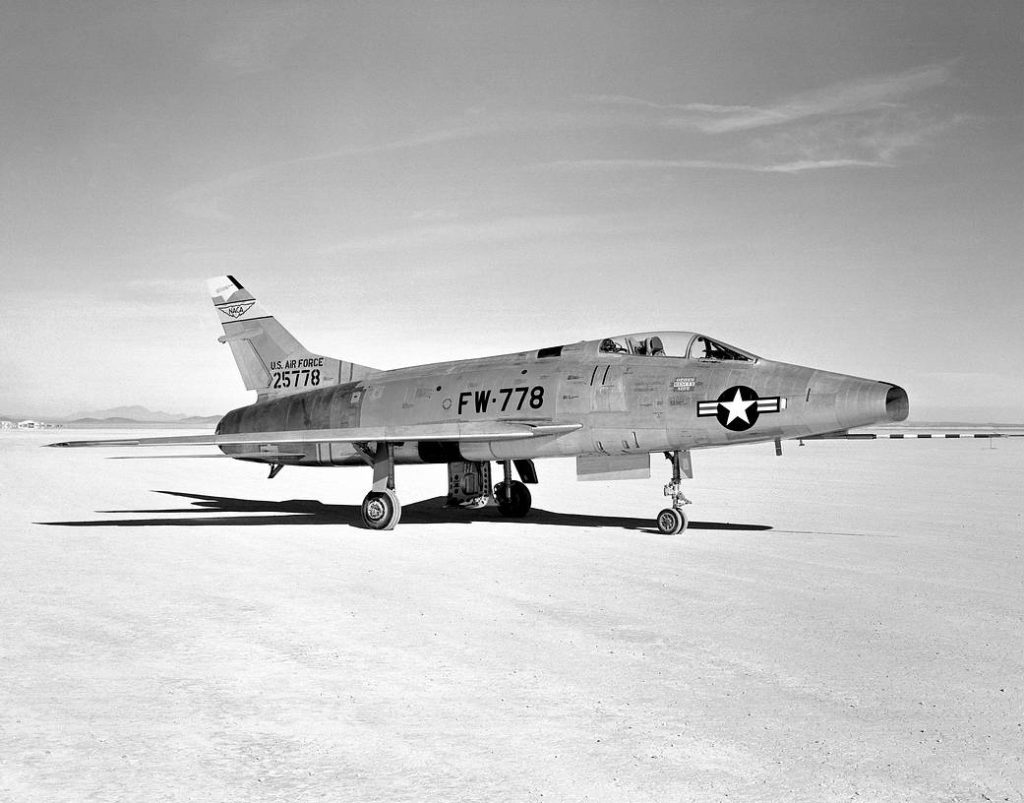
Once stability research concluded, the same aircraft moved to secondary programs, including gunnery operations at Nellis Air Force Base, as part of NACA’s “Century Series.” Under the series, NACA compared several supersonic fighters to identify general aerodynamic rules rather than aircraft-specific fixes. By the late 1950s, the organization understood that low horizontal tail placement and increased vertical area were essential features to control supersonic swept-wing aircraft, and these lessons applied to later designs across the Air Force inventory. A later phase of research used a modified JF-100C configured as a variable-stability simulator, effectively turning the aircraft into a flying laboratory for future airplanes that did not yet exist. Instead of only measuring natural handling qualities, engineers deliberately degraded stability electronically so pilots could experience borderline controllability while still having altitude to recover. After takeoff, the pilot engaged the experimental control system with a side-stick, then flew precise maneuvers to determine the minimum stability and control power a pilot could tolerate while still completing a mission.
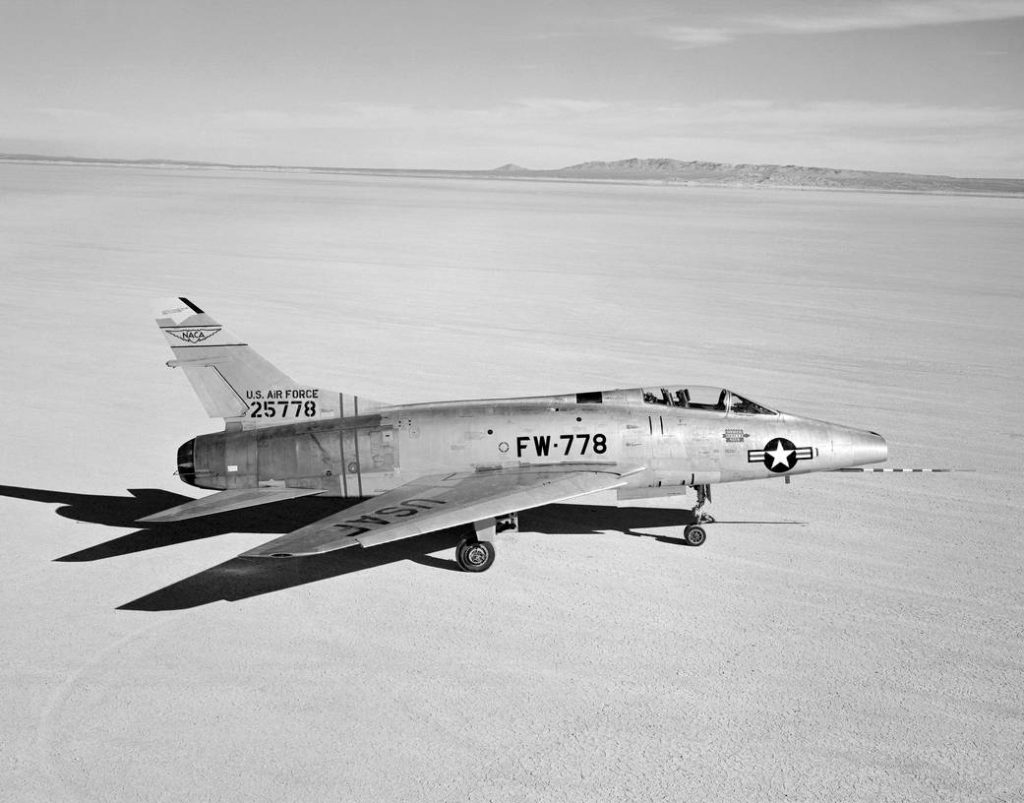
At about 35,000 feet, the controls suddenly stopped responding. Then they came back, but backwards, so pushing the stick made the nose go up instead of down. The jet could still be flown, but only if the pilot kept reminding himself to move the controls the opposite way. Later, an investigation found that the electronics box wasn’t properly pressurized, and the thin air at altitude made it malfunction. Another problem showed up during landings. The nose wheel shook so violently that at first it was called a nuisance, until the vibration actually broke equipment inside the nose of the aircraft. A closer inspection finally revealed worn landing-gear pivots. Once those parts were replaced, the shaking disappeared. The F-100 also helped validate simulator training. Pilots practicing approaches in a ground simulator complained about sensitive pitch response and oscillations, and later found the real aircraft behaved nearly identically. The difference was that real flight provided motion cues and acceleration feedback that helped the pilot subconsciously stabilize the airplane.
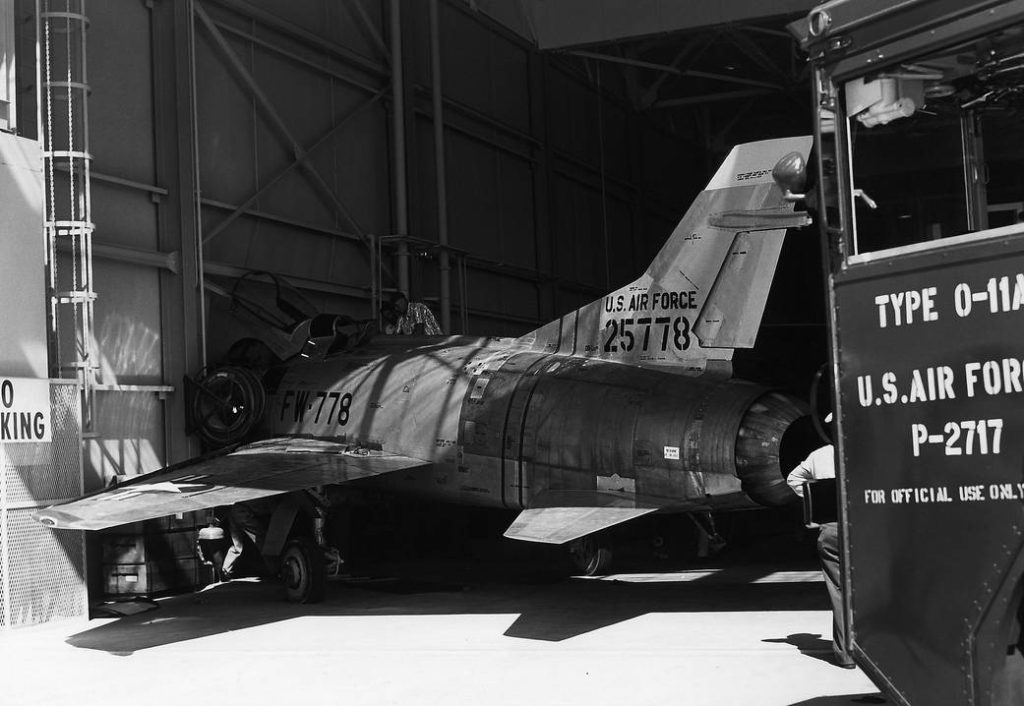
By the early 1960s, the modified F-100 was being used to help design future aircraft like the X-15 and the proposed Supersonic Transport. Engineers could use it as a flying laboratory to understand how a new airplane might behave before anyone built a costly prototype. Instead of discovering dangerous surprises later, they could predict them in advance. The Super Sabre showed that flying faster than sound was not just about speed. At those velocities, aerodynamics, mechanical systems, and human reactions all became tightly linked. A stability margin that felt comfortable in a slower aircraft could suddenly become unsafe in a faster one, and small design details, such as the tail size, control damping, or control feel, could be the difference between a perfect and unmanageable aircraft. Over years of testing, the F-100 turned these lessons into standard practice, and bigger vertical tails, better damping, and safer pitch behavior are all principles that it taught engineers. Check out more such Flight Test Files articles HERE.