






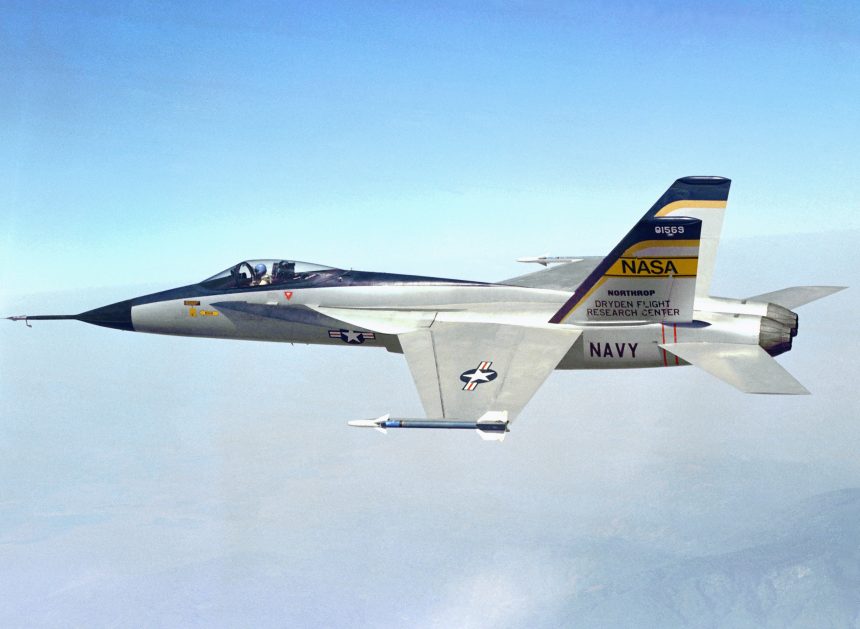

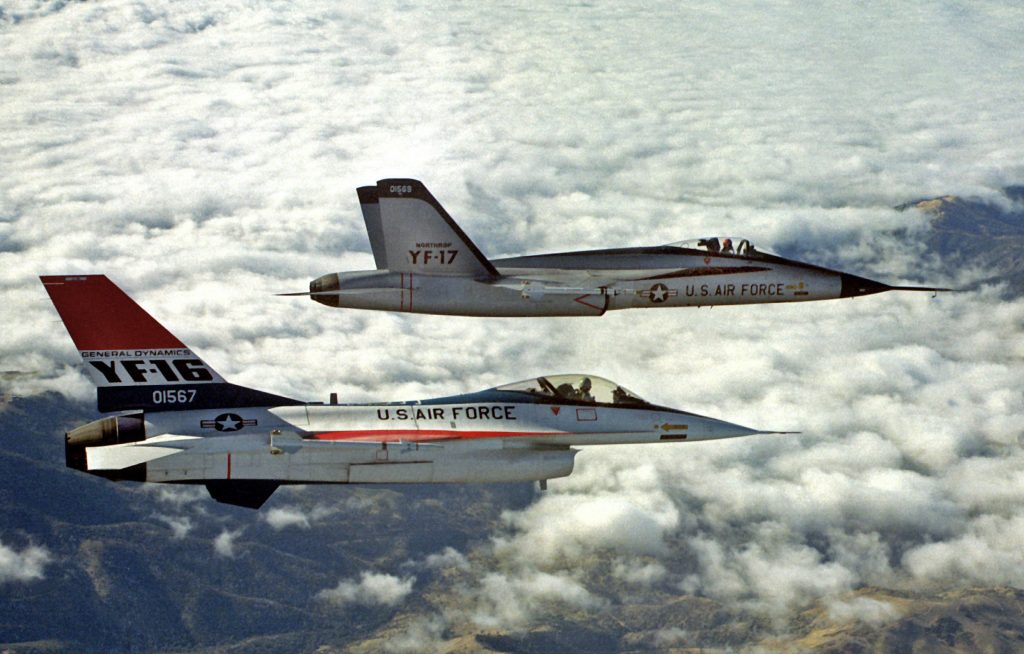
During the 1960s, the U.S. Air Force felt the need for a lightweight aircraft to be used alongside its larger F-15 Eagles. As a result, the service initiated a Lightweight Fighter (LWF) technology evaluation program in 1971. Many companies, including Boeing, Lockheed Martin, Northrop, and General Dynamics, participated in the program. Northrop entered the program with its YF-17, while General Dynamics took part with its YF-16. The Northrop YF-17 design was a modification to the company’s previous work. The main design features of the aircraft began in early 1965 with the Northrop project N-300. This N-300 was based on the F-5E with a longer fuselage and more powerful GE15-J1A1 turbojet engines that produced 9,000 pounds of thrust. The wings were positioned higher to provide more ground clearance for added weapons. The N-300 evolved into the P-530 Cobra, which used GE15-J1A5 engines that provided 13,000 pounds of thrust.
Design of Northrop YF-17
The P-530 wing and nose shape were similar to the F-5, featuring a trapezoid design with a 20-degree sweep at the quarter-chord line and a straight trailing edge. However, it had more than double the area, measuring 400 square feet compared to the F-5E’s 186. Initially, the wings were installed on the shoulders but were later moved to a mid position. The additions provided about 50% more lift at high angles of attack, enhancing maneuverability. The design also improved airflow into the engines at steep angles. The wings resembled the head of a cobra, leading to the nickname “Cobra” for the P-530. For the US Air Force competition, Northrop modified the P-530 design to create the P-600, which became the YF-17. Unlike the P-530, which was meant to serve multiple roles, the P-600 was designed only as an air-to-air demonstrator. Because of this, the cannon was moved from the bottom of the fuselage to the top.
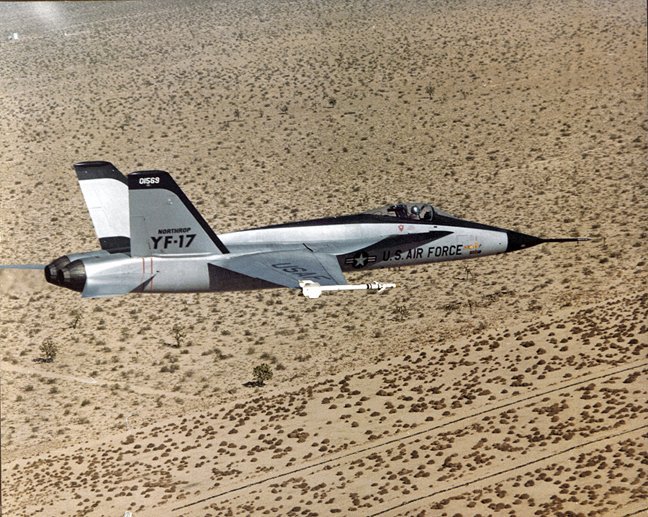
The Northrop YF-17 was powered by two General Electric YJ101-GE-100 turbojet engines, each producing 9,479 pounds of dry thrust and 15,000 pounds with afterburner. Designing the YF-17 and its prototype engine, the YJ101, took over a million hours of work and 5,000 hours of wind tunnel testing. The first prototype of the Northrop YF-17 was rolled out on April 4, 1974, with its first flight taking place at Edwards Air Force Base on June 9. During that flight, which lasted 61 minutes, the plane reached an altitude of 18,000 feet and a speed of 610 mph. The second YF-17 prototype first flew on August 21. Throughout 1974, the YF-17 competed against the General Dynamics YF-16. Together, the two YF-17 prototypes completed 288 test flights, accumulating 345.5 flight hours. The Northrop YF-17 was 55.6 feet long, 14.6 feet high, with a wingspan of 35 feet and a wing area of 350 square feet. Its empty weight was 17,390 pounds, the gross weight was 24,760 pounds, and the maximum takeoff weight was 34,430 pounds.
US Air Force Cancellation and US Navy Adoption
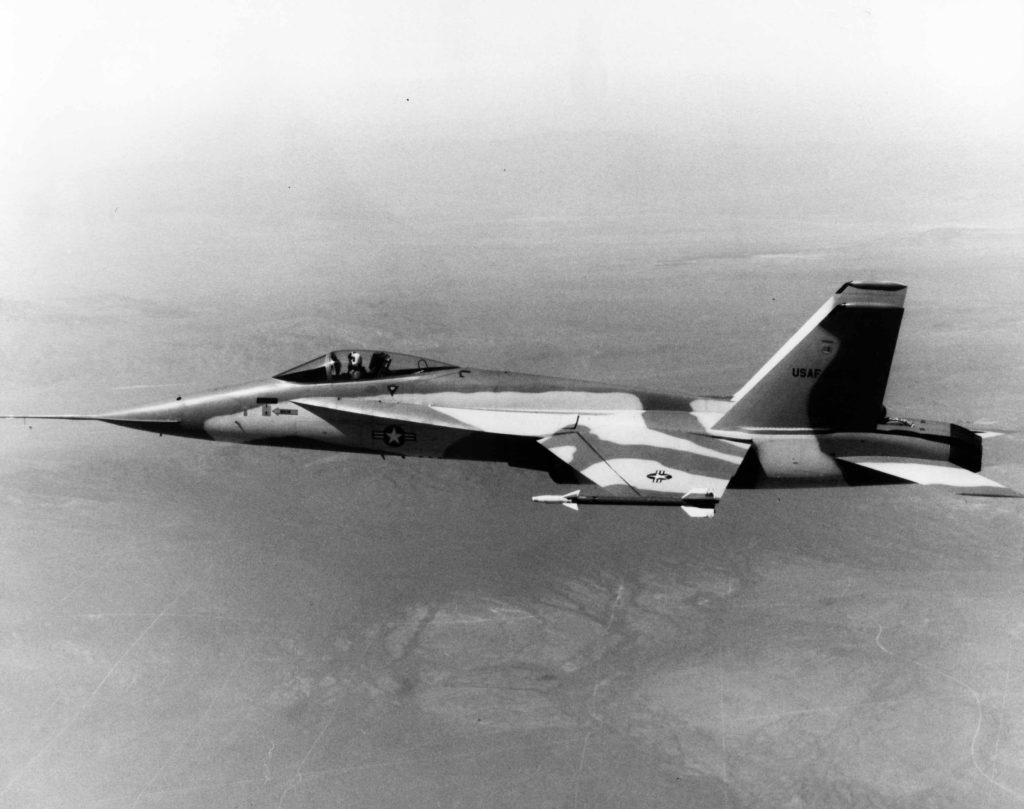
During the tests, the YF-17 achieved a top speed of Mach 1.95, a maximum load factor of 9.4 g, and reached an altitude of over 50,000 feet. It also demonstrated an angle of attack of 68 degrees at an indicated airspeed of 28 knots. The aircraft could carry a 20 mm M61 Vulcan Gatling gun, and had provision for four bombs and two missiles. However, after completing the testing in 1974, the US Air Force selected General Dynamics’ YF-16, which became the world’s now-familiar F-16 Fighting Falcon. Though its doors were closed to the US Air Force, a US Navy program gave the Northrop YF-17 new hope. In August 1974, Congress told the Navy to use the technology and hardware from the US Air Force’s LWF for its new lightweight strike fighter program, called the Naval Fighter Attack Experimental (VFAX). At the time, both General Dynamics and Northrop had no experience with naval fighters.
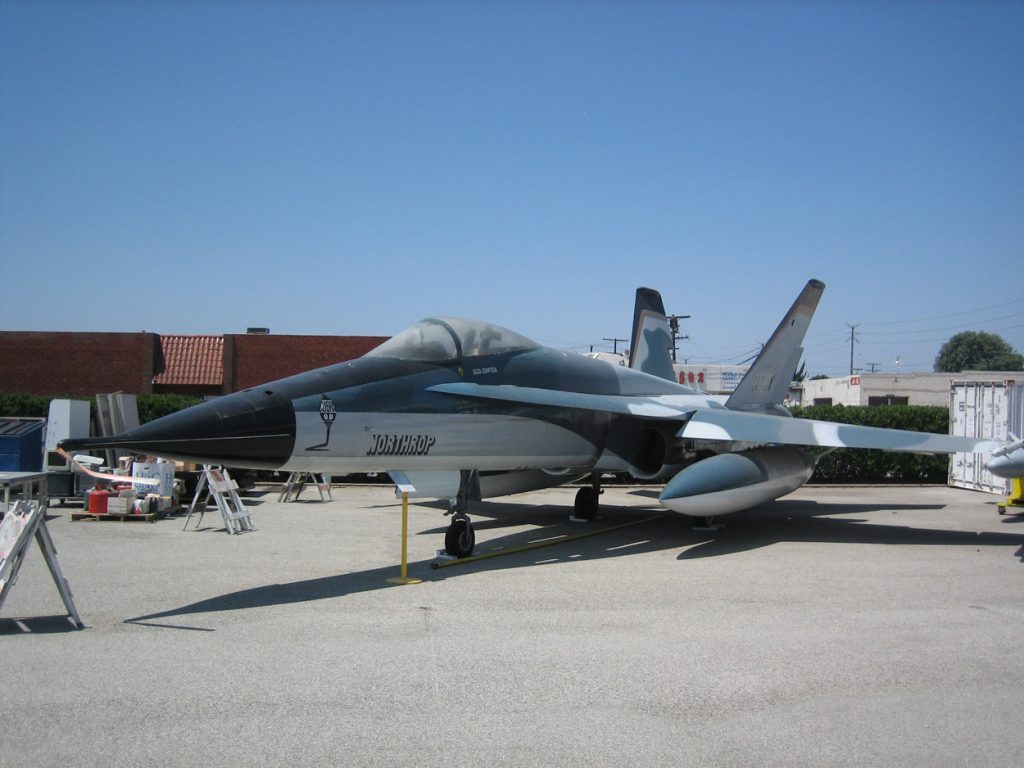
As a result, General Dynamics teamed with Vought to convert its YF-16 into the Vought Model 1600, while Northrop teamed up with McDonnell Douglas to convert its YF-17 into the F-18. Both companies revised their designs to meet the Navy’s needs for a long-range radar and multirole capabilities. In this competition, Northrop proved the worth of its design. In enlarged form, the YF-17 became the F/A-18 Hornet, a fighter jet used by the United States Navy and Marine Corps. It replaced the A-7 Corsair II and F-4 Phantom II, and it works alongside the more expensive F-14 Tomcat. The design started as a small, lightweight fighter but was later enlarged to create the Boeing F/A-18E/F Super Hornet, which was similar in size and weight to the F-15 and has replaced the F-14. Not only the US Navy, but many air forces have also used the McDonnell Douglas F/A-18 as a land-based fighter. The F-16 and F/A-18 both became hugely popular worldwide. In the Grounded Dreams series, the Northrop YF-17 stands as an aircraft that proved insufficient for the US Air Force but proved to be one of the US Navy’s best fighters. Read more Grounded Dreams articles HERE.
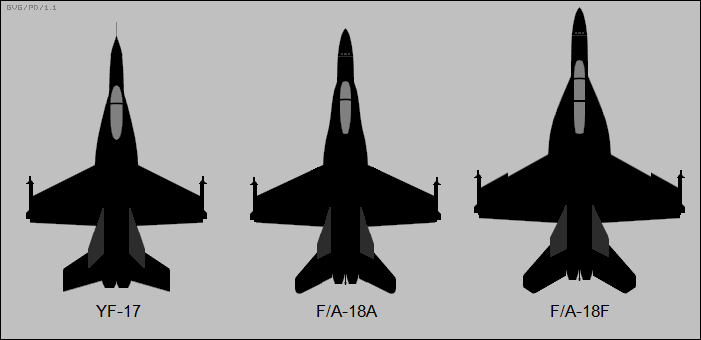






McDonnell Douglas became the lead on the F-18 because of their experience with carrier aircraft, but Northrop remained prime on any land-based versions, designated F-18L. Unfortunately, the F-16 was available on the international market at a lower price than the F-18L and none of the latter were sold. The F-18L probably carried some performance penalties as well, being based on a carrier aircraft.