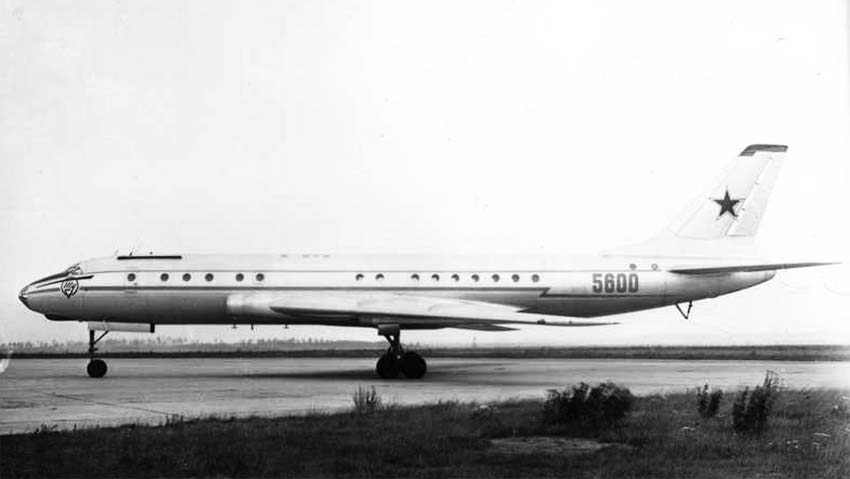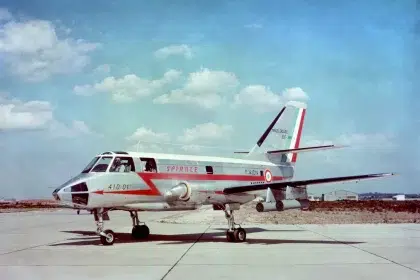
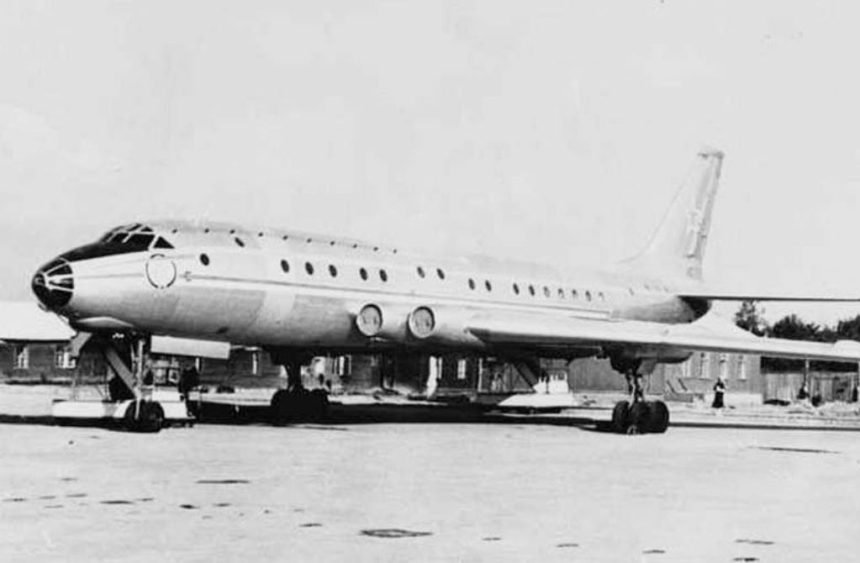

In the early 1950s, as the age of passenger jets began, the Soviets built a twin-engine jetliner, the Tupolev Tu-104. The twin-turbojet-powered aircraft was only the second jetliner in the world, after the British de Havilland Comet. It carried 90 million passengers during its service and was the only jetliner operating between 1956 and 1958. But it had a limited range and was not stable, making it unsuitable for long-distance coverage. As a result, the Tupolev design bureau decided to develop a four-engine jetliner capable of long-range ocean-crossing flights, designated Tupolev Tu-110. The Soviet government approved the design bureau’s plan. On August 12, 1955, the USSR Council of Ministers approved the development of the Tupolev Tu-110 based on the Tu-104 design. The new aircraft would be powered by four AL-7 turbojet engines, each producing 14,300 pounds of thrust.
Design of Tupolev Tu-110
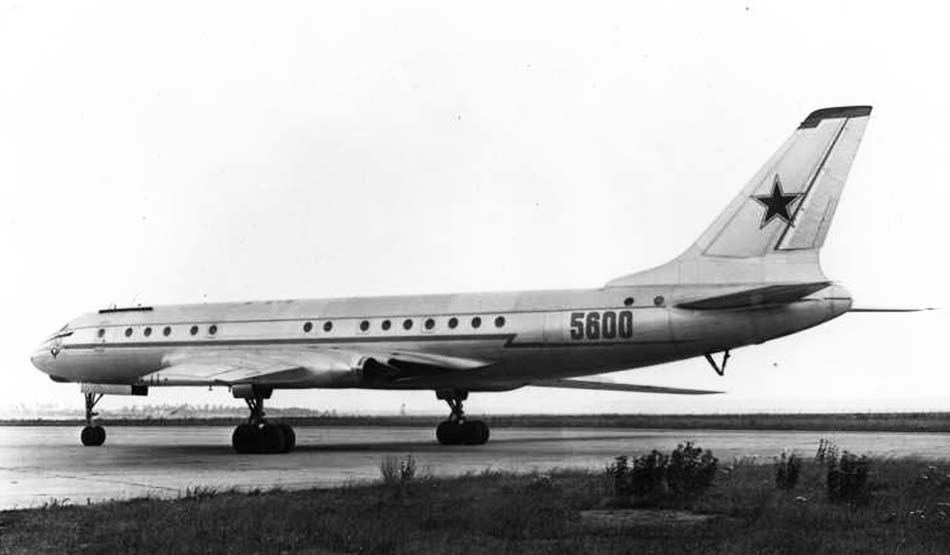
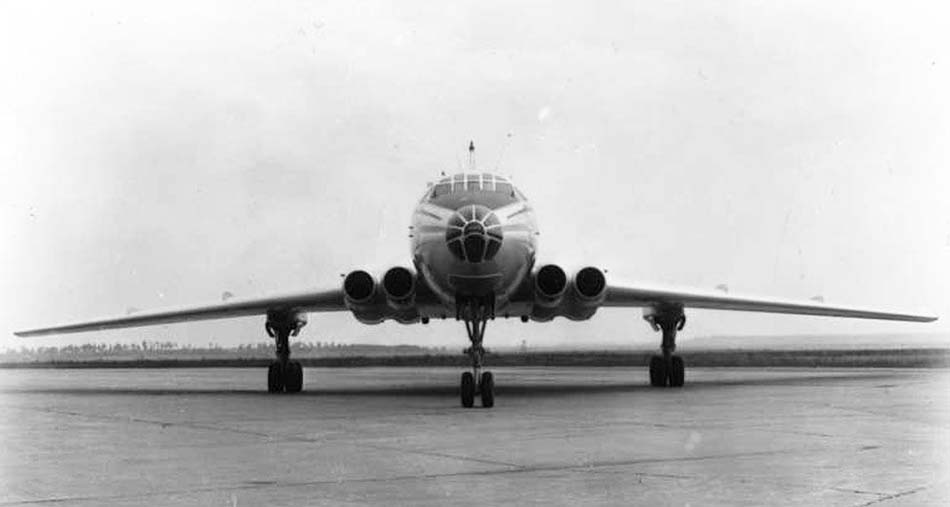
The thrust produced by Tupolev Tu-110’s AL-7 engine was less than the Tu-104’s AM-3M-500 turbojet engine’s 21,400 pounds of thrust. The decision to choose four AL-7s, paired at both wing roots on Tu-110s, was made to improve the plane’s safety in the event of an engine failure. By reducing the size of the engines and the airflow through them, they could stop using the airflow-separation method used on the Tu-104. The wings and fuselage of the Tu-110 were longer than those of the Tu-104. The development of the Tu-110 began in June 1955. In early 1957, the design bureau completed development of the aircraft’s first prototype. On March 11, 1957, the Tupolev Tu-110 flew for the first time. The flight test proved the aircraft’s capabilities, and it was cleared for civil use. With a crew of five, the aircraft could carry 100 passengers. It was 125.8 feet long, with a wingspan of 123 feet and a wing area of 1,960 square feet. The empty weight of the aircraft was 97,555 pounds, with a maximum takeoff weight of 174,827 pounds. Its maximum speed was 620 mph, and the cruise speed was 550 mph. The aircraft had a range of 2,140 miles and a service ceiling of 39,000 feet. Satisfied with the aircraft’s performance, the government authorized the production of the Tupolev Tu-110 at the Kazan Aircraft Factory, with an initial order of 10 aircraft.
The Cancellation
Serial production began in 1957, and by 1958, the Kazan Aircraft Factory had a plan to deliver five aircraft. However, the factory could build only three Tu-110s before the program was canceled in 1958. With the improved reliability and safety of the modified AM-3 engine, the Tu-104 matched the Tu-110’s performance, and the government deemed the program impractical to continue the Tu-110 program, leading to its cancellation. In the late 1950s, the Tupolev Tu-110 prototype was modified to use four Soloviev D-20 turbofan engines. Later, it was fitted with D-20-PO engines with an air bleed system, becoming the Tu-1 YUL flying laboratory. In 1960, three production Tu-110As were also equipped with D-20P engines. They were tested and improved as part of the Tu-124 development program. The Tu-110A received a new designation, the Tu-110B, with the D-20P engines, and was used as a flying laboratory to test various electronic equipment. In 1960, work began on the Tu-124A, a rear-mounted-engine aircraft. At the same time, a similar upgrade for the Tu-110, called Tu-110D, was proposed. However, this project did not go beyond the proposal stage, unlike the Tu-124A, which eventually became the production Tu-134. The Tupolev Tu-110 itself did not enter service, but it proved many concepts, including four-engine operation, boundary-layer control systems, electronics and avionics, and missile systems. In the Grounded Dreams series, the Tupolev Tu-110 stands as an aircraft that could become the Soviet response to the Boeing 707, a four-engine jetliner often credited with launching the global Jet Age, which first flew in 1954. Read more Grounded Dreams articles HERE.