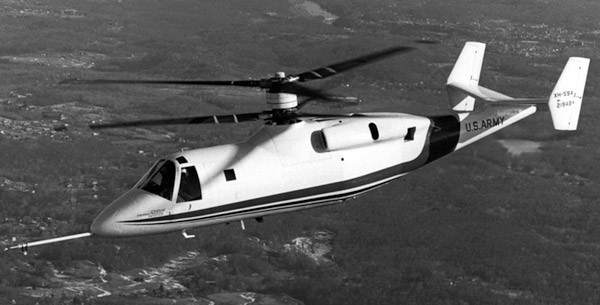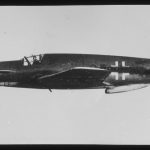
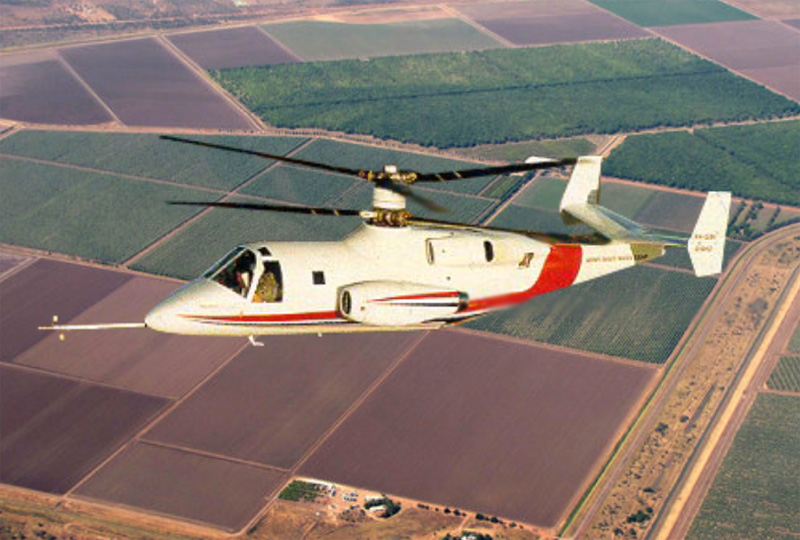


In the 1970s, the US Army Air Mobility Research and Development Laboratory, along with NASA, wanted to test the Advancing Blade Concept (ABC). The ABC rotor system was designed to solve issues with classical retreating blade stall and allow rotary-wing flight across a broader range of conditions. Unlike earlier compound helicopters that used wings to help the rotor at high speeds, an ABC helicopter maintained rotor lift at high speeds and high altitudes, so it did not require a wing. To test the concept, the US Army and NASA funded Sikorsky to develop the Sikorsky S-69, which received a military designation of XH-59. The experimental Sikorsky S-69 used the ABC system with two rigid rotors. The contra-rotating rotors were placed 72 cm (30 inches) apart and helped lift the aircraft by taking advantage of the airflow over the advancing blades. At high speeds, the blades moving away from the direction of flight experienced less load because the advancing blades support most of the weight, reducing the risk of stalling. The design removed the need for a wing, improved maneuverability, and also eliminated the need for a tail rotor to counter torque.
Design of Sikorsky S-69
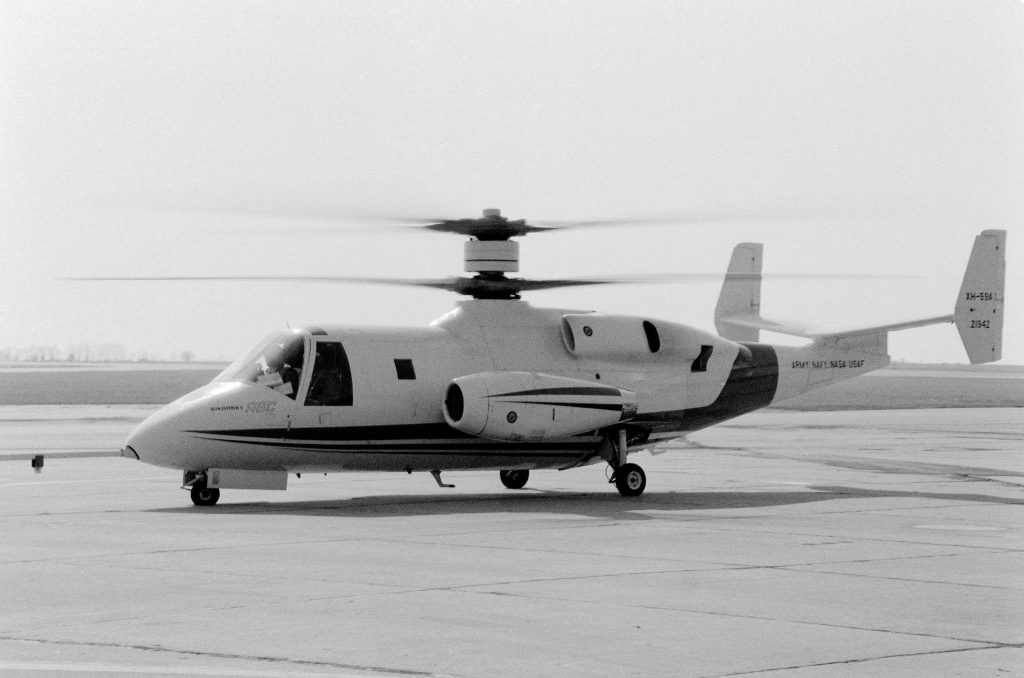
The Sikorsky S-69 was equipped with a hybrid propulsion system, consisting of a Pratt & Whitney Canada PT6T-3 Turbo Twin Pac turboshaft engine, producing 1,500 horsepower to power the main coaxial rotors and two Pratt & Whitney J60-P-3A turbojet engines, each producing 3,000 pounds of thrust for auxiliary forward propulsion. With a crew of two, the aircraft was 40.9 feet long, 13.2 feet high, and had two three-bladed main rotors with a diameter of 36 feet and an area of 2,036 square feet. The Sikorsky S-69 flew for the first time on July 26, 1973. On August 24, 1973, the first aircraft was badly damaged in a low-speed crash due to unexpected rotor forces and poor control systems. After this, the airframe was converted into a wind tunnel testbed and tested in the NASA Ames Research Center’s 40×80 feet full-scale wind tunnel in 1979. A second airframe was developed, which first flew on July 21, 1975. Initially tested as a helicopter, two extra turbojets were added in March 1977. As a helicopter, the XH-59A reached a maximum level speed of 180 mph. With the added turbojets, it achieved a maximum level speed of 274 mph and later reached 303 mph in a shallow dive.
Problems and Legacy
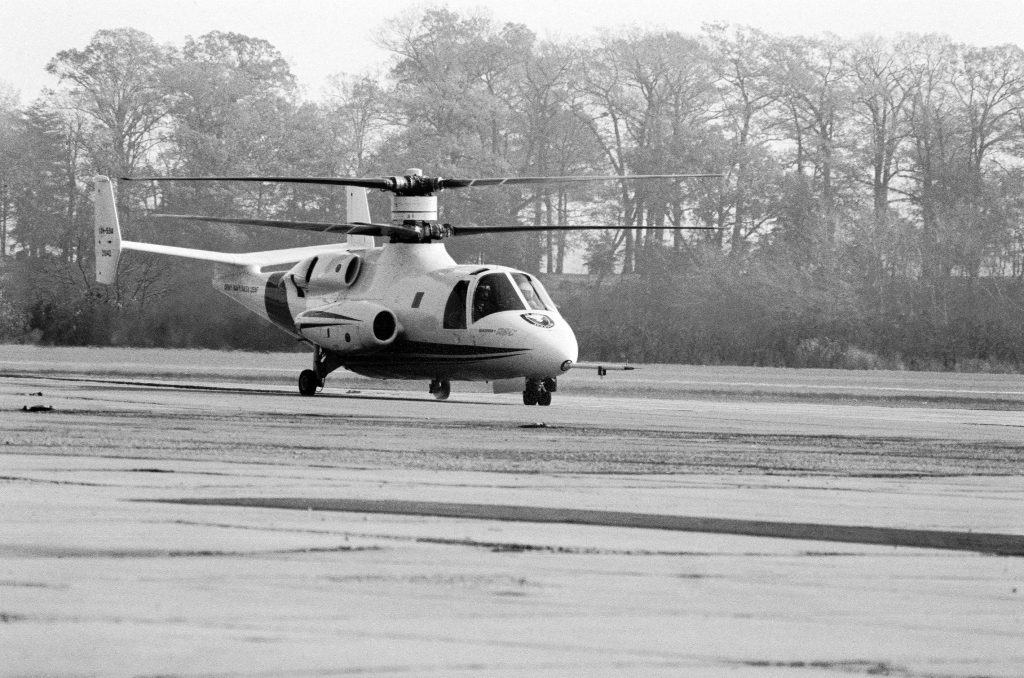
In the tests, the Sikorsky S-69 was stable in crosswinds and tailwinds during hovering. However, with the jets installed, the S-69 produced insufficient power to hover out of ground effect, so it relied on short take-off and landing for safety. In addition, airframe stress prevented a reduction in rotor speed and limited full-flight performance, resulting in increased vibration and fuel consumption. The testing of the Sikorsky S-69 helicopter lasted 106 hours and ended in 1981. In 1982, a plan was announced to modify it into a new version with better rotors, two new GE T700 engines, and a ducted pusher propeller at the back. However, the plan did not move forward because Sikorsky refused to share the costs. Instead, in the 2000s, Sikorsky focused on developing new helicopters based on the concept, including the Sikorsky X2 and the Sikorsky S-97 Raider. In the Grounded Dreams series, the XH-59A helicopter proved the ABC system by flying at 240 knots without wings, a first for the helicopter industry. Read more Grounded Dreams articles HERE.