

On May 10, 1940, Germany invaded Belgium, and the invasion was not only an important historical event but also marked the first use of military gliders in aviation history. Military gliders were unpowered aircraft towed by larger planes and dropped directly onto the battlefield to transport troops and supplies. In its invasion of Belgium, the Germans used 11 DFS 230 assault gliders to transport 78 troops. Later, in May 1941, Germany used these gliders to transport around 750 troops in the airborne invasion of the Mediterranean island of Crete. In this battle, it defeated British and Greek forces stationed on the island. As a result, the US Marine Corps became interested in using military gliders and initiated a glider program in May 1941. The service was interested in inducting enough 12 and 24-seater gliders to transport a battalion of Marines that used to have 715 troops with equipment. The US Marines wished to use these gliders for “island hopping” operations in the Pacific theater.
Design of Bristol XLRQ
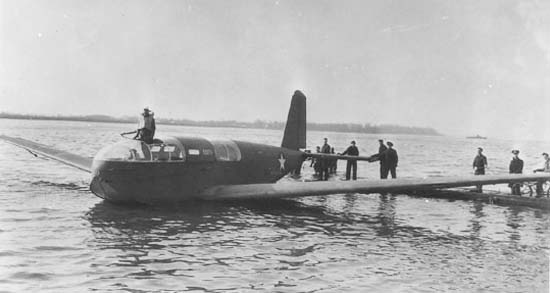
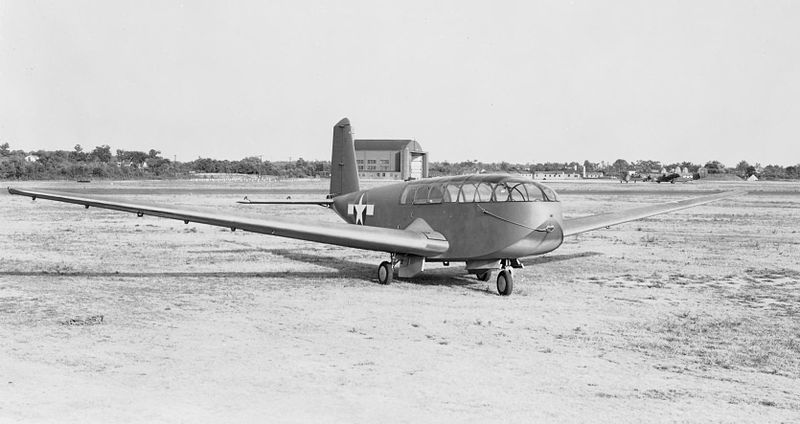
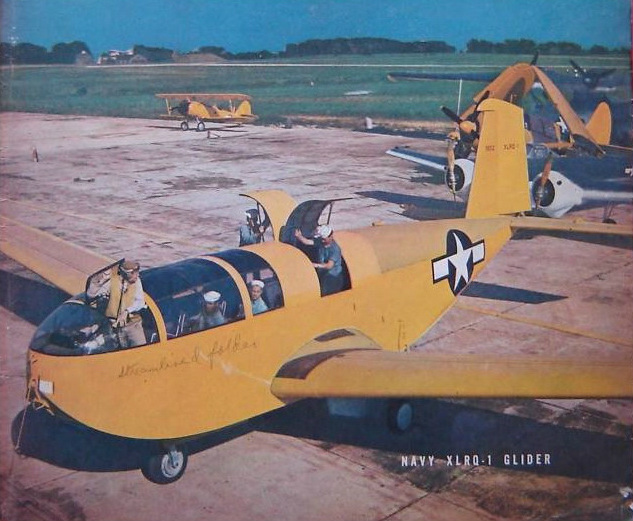
The gliders were intended to be built of wood or composite materials, and the US Marines wanted them to take off and land from both land and water. The glider needed to be equipped with exterior machine guns and a provision for a static line to open parachutes for paratroopers automatically. As a result, the US Marines ordered prototypes of the Bristol Aeronautical Corporation XLRQ and the Allied Aviation Corporation XLRA for a 12-seater glider. As a part of the contract, Bristol needed to develop four XLRQ prototypes, with a similar contract awarded to Allied as well. Bristol developed a static model of the XLRQ by mid-1942, which underwent testing in October 1942. It was followed by tow flights in January 1943, and the first prototype flew for the first time on August 6, 1943. The glider, with a crew of two and capable of transporting 10 equipped Marines and their equipment, was 43.6 feet long and 16 feet high. It had a wingspan of 71 feet, with a wing area of 500 square feet. The Bristol XLRQ featured a high-wing monoplane configuration with a hull resembling that of a flying boat. The glider had retractable landing gear, and the roots of its wings helped keep it stable on the water. Initial testing proved the glider’s capability and technical viability. The Bristol XLRQ was stable, and an initial order to develop 100 XLRQs as LRQ-1 variants was placed with Bristol. However, the order was canceled in September 1943.
The Cancellation
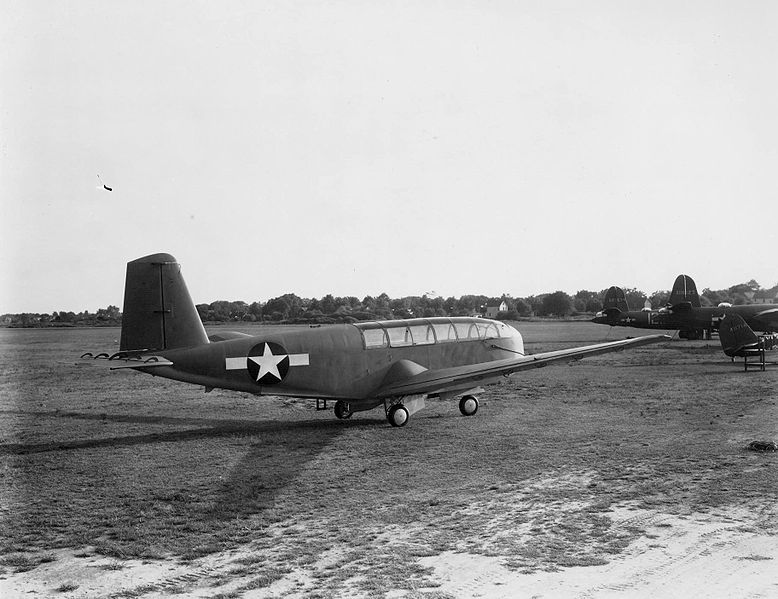
At the time, the US Marines assessed that the gliders were of no use for operating on small, heavily defended Pacific islands, for which the glider was initially designed. The service further decided that the gliders, which had proved their capabilities in protected environments such as jungles, required protective lagoons for amphibious landings, and, as a result, the Marines’ doctrine shifted away from gliders. In addition, the wartime production did not match the scale that the US Marines expected. By the time the program was canceled, Bristol had built only two XLRQs and a static platform. Due to production delays, the service did not receive sufficient training to operate them, and the Bristol XLRQ was canceled as a result. Though the Bristol XLRQ was canceled, the U.S. military did use gliders in WWII. During the war, US companies constructed 14,612 gliders, and the U.S. military, mainly the U.S. Army Air Force, trained more than 6,000 pilots to fly them. The first major Allied operation to use gliders was the Sicily Campaign in July 1943. The gliders saw U.S. military usage to battle the Japanese Army in Burma in March 1944, and on D-Day, during the Invasion of Normandy, France, in June 1944. Later, they were used in Operation Market-Garden, the Battle of the Bulge, Operation Varsity, and even in the Pacific Theater, helping the US forces win the war. It proves that the gliders were not a bad concept, and Bristol XLRQ was not a bad glider. It came at the right time, but for a different service. The gliders didn’t see much use with the naval services, and the U.S. Army Air Force never tested the Bristol XLRQ. As a result, like many aircraft in the Grounded Dreams series, this time, a glider, Bristol XLRQ, was canceled. Read more Grounded Dreams articles HERE.