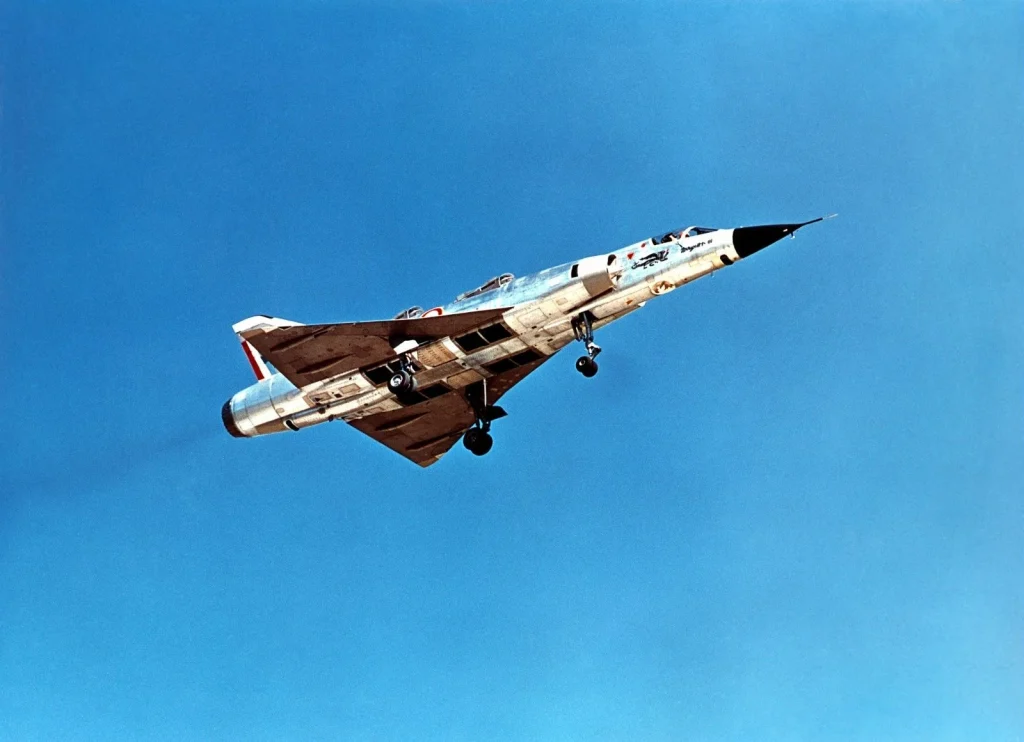
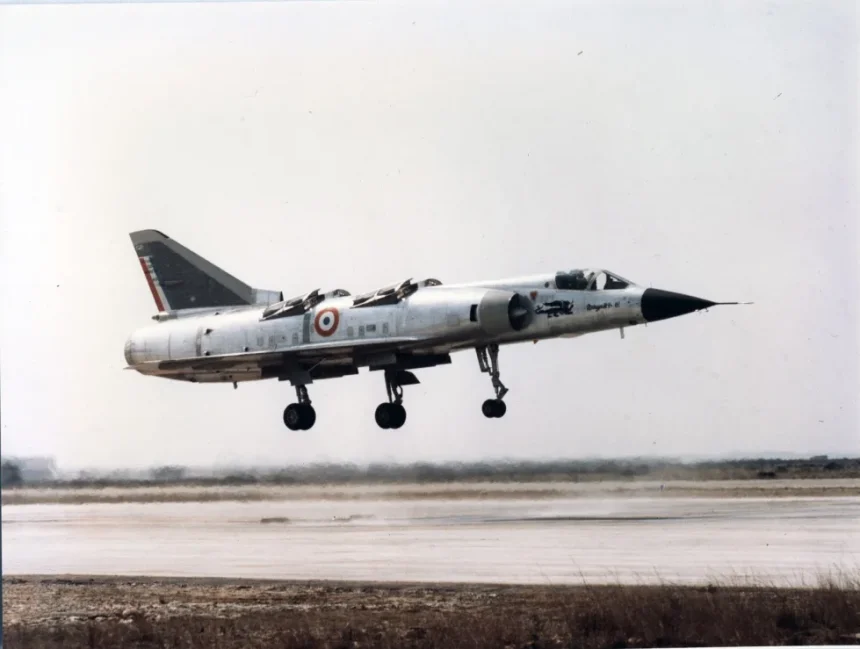


In August 1960, the French Air Force wanted to develop a supersonic vertical takeoff and landing aircraft. Générale Aéronautique Marcel Dassault (GAMD), now called Dassault Aviation, proposed the Mirage III V to meet Air Force requirements, and in September 1960, the project was approved. The project was to be completed in two steps, with Dassault and Sud-Aviation partnering for it. First, an experimental version of the aircraft, Balzac V, needed to prove the project’s feasibility, using existing turbojet engines. Second, full-scale Migrage III prototypes with more powerful lift and propulsion were needed for Mach 2 flights. On February 2, 1961, the French state-run aviation technology development agency, Direction Technique et Industrielle de l’Aéronautique (DTIA), ordered the experimental Balzac V. In August, the agency ordered the development of two Mirage III V prototypes. The Balzac V was powered by eight Rolls-Royce RB 108 tubojet engines, each producing nearly 2,200 pounds of thrust, to lift the aircraft vertically. These lift engines were mounted vertically in pairs of two on each side of the propulsion engine’s air duct. The propulsion engine was a Bristol Siddeley Orpheus 3, producing 4,850 pounds of thrust. The lift jets received air through four intakes located above the fuselage. Their exhaust pipes were also above the fuselage, located in openings with blanking caps that were closed during normal flight.
Design and Testing of Balzac V
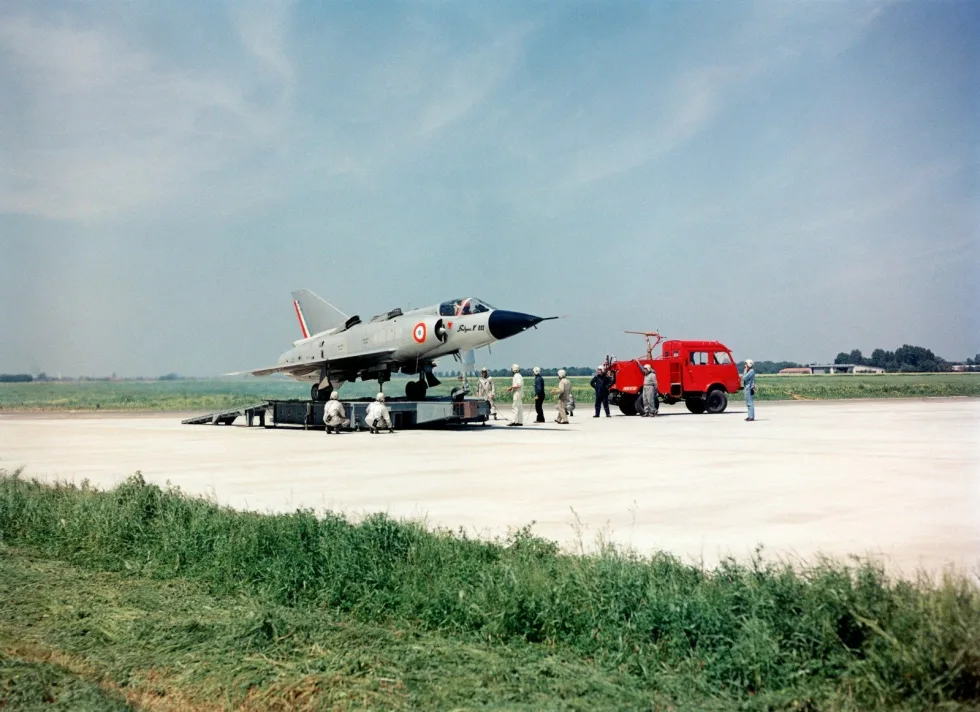
The Balzac V used part of the wing from Mirage III 001 Balzac and had a fuselage designed in collaboration with Sud-Aviation. It was an experimental single-seater aircraft for studying and developing the vertical take-off Mirage III V. It did not carry any weapons or operational equipment. The aircraft was designed to study vertical takeoff and landing and the transition between these stages, as the Mirage III’s conventional flight performance had already been proven. Balzac V was the first aircraft to have modern flight controls. It was also the first aircraft to send flight data to the ground using telemetering. The first stationary flight test of Balzac V took place on October 12, 1962. The aircraft was secured with nylon cables attached to its front lifting point and main landing gear. A second tethered flight happened the same day, followed by a third on October 15. On October 18, the first low-level free flight was made, and during its third free flight on the 25th, the aircraft remained in hovering flight for more than two minutes. On March 18, 1963, during its 17th sortie, the aircraft made its first transition from vertical to horizontal flight. By the 29th, it completed its first full cycle of vertical take-off, horizontal flight, and vertical landing. Several pilots tested the Balzac V and praised its technical performance, but added that it had a complex configuration. It was proved first on January 10, 1964, when the aircraft crashed during a low-altitude hover test, killing its pilot. The aircraft was found to have stability issues and control difficulties at low speeds. However, Dassault rebuilt the aircraft for further testing. A second accident took place on September 8, 1965, yet again killing another pilot. The crash happened due to potential hydraulic issues and fuel exhaustion. By the time the second crash took place, two Mirage III V prototypes were already built, so Balzac V was not restored.
Mirage III V and Cancellation
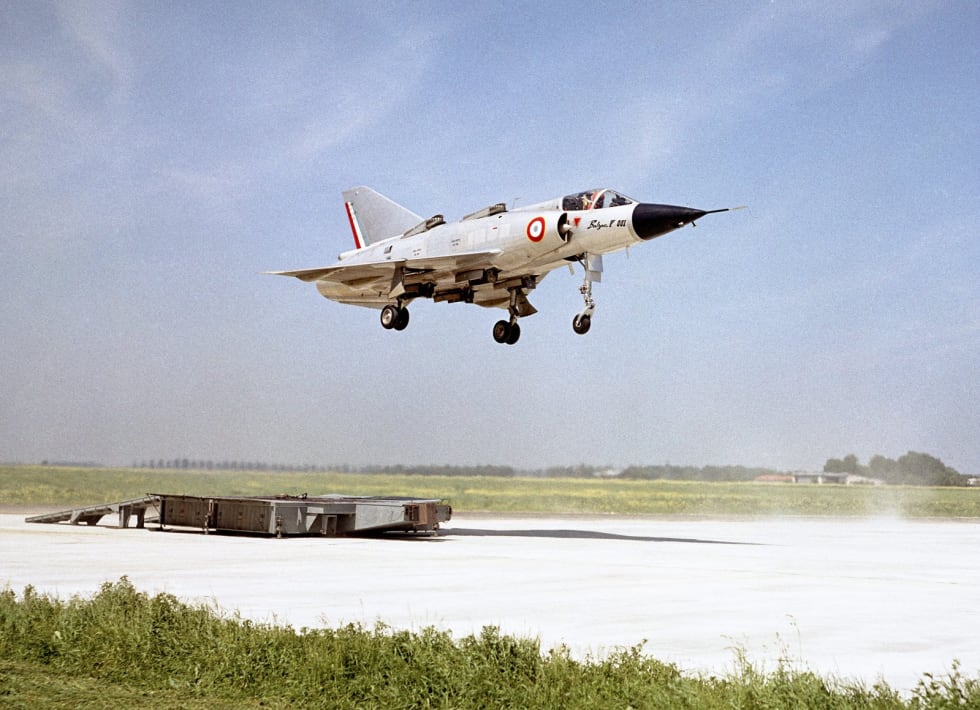
The Mirage III V, capable of exceeding Mach 2, was larger and heavier than the Balzac V. It was powered by Rolls-Royce RB 162-1 lift-jet engines, each producing 4,409 pounds of thrust. The propulsion engine was a Snecma TF 106, the French version of the Pratt & Whitney JTF 10 turbofan, producing 19,842 pounds of thrust with afterburner. The single-seat aircraft was 59 feet long, 18.3 feet high, with a wingspan of 28.7 feet. While the empty weight of Balzac V was 11,800 pounds, the Mirage III V weighed 14,800 pounds. The first prototype of Mirage III V, equipped with a less powerful TF 104 b turbofan, made its debut stationary flight on February 12, 1965. By December 1965, the aircraft received its TF-106 engine during its 15th sortie. However, the design proved more complicated than expected, and by the end of 1965, the Air Force created requirements for the new aircraft to be needed by 1970 to replace the F-100s and Mirage III Es. The aircraft conducted its first transition from stationary to horizontal flight on March 24, 1966. But the aircraft was found to be performing inferior to Balzac in terms of stability during the transition. As a result, on March 28, 1966, the Defense Ministry halted the production program due to technical and financial issues, allowing the test flights to continue. In June 1966, NATO also abandoned its program for a vertical take-off supersonic aircraft. The second Mirage III V prototype, equipped with a more powerful Snecma TF 306 turbofan engine, producing 22,700 pounds of thrust with afterburner, made its first flight on June 22, 1966. It had new air intakes above the lift jets. During its 11th flight on September 12, the aircraft reached Mach 2.03, making it the only vertical takeoff and landing aircraft in the world to exceed Mach 2. However, on November 28, 1966, it crashed during crabbing flight tests. The pilot ejected safely, but the program was canceled. Despite being the only supersonic vertical takeoff and landing platform in the world, the Mirage III V was not allowed to enter service. In the Grounded Dreams series, Mirage III V stands as an aircraft that proved valuable but complex. However, it could have done wonders if the authorities had not lost interest in it. Read more Grounded Dreams articles HERE.