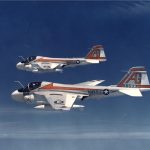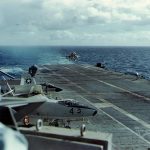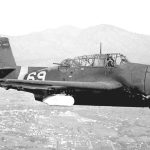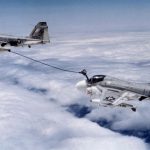
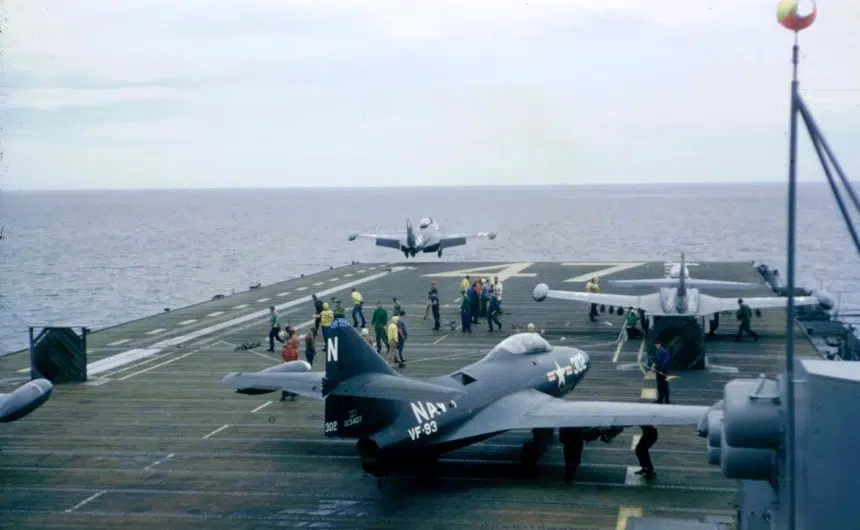

Attack Squadron 93 (VA-93) was one of the most adaptable US Navy attack squadrons, changing missions and aircraft several times. It started during the early days of jets, shifting from fighter planes to the A-4 Skyhawk and later to the A-7 Corsair II. The squadron served during the Vietnam War and other Cold War events before it was disbanded in 1986. Initially named “Blue Blazers” and later “Ravens,” VA-93 began as Fighter Squadron 93 (VF-93) on March 26, 1952. The squadron was first based at Naval Air Station Alameda, California, and got its first aircraft in May of that year, including the FG-1D Corsair and F9F-2 Panther. The Navy moved further into the jet age with the F9F-5 Panther in September 1953, followed by the F9F-8 Cougar in January 1955. On September 15, 1956, VF-93 was redesignated Attack Squadron 93 and began an attack mission. Soon the squadron began flying the Douglas A-4 Skyhawk. It received its first A4D-1 Skyhawk in November 1956, followed by the A4D-2 in 1958 and the A4D-2N in 1960. By then, the Skyhawk had become one of the Navy’s main light attack aircraft. In March 1962, the squadron moved to Naval Air Station Lemoore in California. However, its operations increasingly took it to the Pacific. In May 1963, after Pathet Lao forces took key positions in Laos’ Plain of Jars, USS Ranger entered the South China Sea to support potential US operations in the area. Later that year, Attack Squadron 93 set up Detachment Q to deploy aboard the anti-submarine carrier USS Bennington. The detachment flew A-4B Skyhawks and provided daylight protection for the carrier’s anti-submarine warfare aircraft.

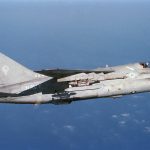
On February 7, 1965, Attack Squadron 93 took part in Operation Flaming Dart, a retaliatory strike against North Vietnam. The operation was ordered after the Viet Cong attacked a US military advisers’ compound in Pleiku, South Vietnam. However, when the squadron reached its target at Vit Thu Lu, the mission was canceled due to bad weather. Four days later, Attack Squadron 93 participated in Operation Flaming Dart II, targeting military barracks at Chanh Hoa in North Vietnam. The squadron continued its combat operations into March. On March 15, Attack Squadron 93 joined the first phase of Operation Rolling Thunder, attacking an ammunition storage area at Phu Qui in North Vietnam. By this time, the A-4 had become the squadron’s main combat aircraft. VA-93 received the A-4E in September 1966 and the A-4F a year later. Attack Squadron 93 transitioned to the LTV A-7 Corsair II and received the A-7B in April 1969. The aircraft improved the Navy’s attack capabilities, offering better range and payload than the smaller Skyhawk. The squadron later operated the A-7A and eventually the A-7E, which it received in April 1977. The Corsair II served VA-93 during some of the most intense years of the Vietnam War. From May to October 1972, the squadron took part in Operation Linebacker, a major US air campaign aimed at disrupting North Vietnam’s war efforts in South Vietnam. VA-93 continued its combat role until the end of American involvement in Vietnam. In April 1975, Attack Squadron 93 took part in Operation Frequent Wind, which evacuated American personnel from Saigon as South Vietnam fell.

In August and September 1976, Attack Squadron 93 operated near the Korean Peninsula after the Axe Murder Incident, in which North Korean soldiers killed two US Army officers who were trying to cut down a tree in the Demilitarized Zone. The next year, the squadron received the A-7E, its last aircraft type. Attack Squadron 93 was also affected by a major change in how the US military operated overseas. The squadron arrived in Japan in October 1973, joining a forward-deployed naval force ready to respond to crises in the western Pacific. In November and December 1979, Attack Squadron 93 deployed on the USS Midway to the Arabian Sea as a response to the seizure of the US Embassy in Tehran and the Soviet invasion of Afghanistan. The squadron remained part of the US response during rising tensions between Washington and Moscow. VA-93 returned to East Asia in May and June 1980, operating off the coast of South Korea after the Kwangju uprising and massacre, and stayed there until the situation calmed down. In December 1981, unrest in Korea once again brought Midway and VA-93 back to the area. By this time, the squadron had spent nearly 30 years adapting to changes in naval aviation. After over 30 years of service, the squadron returned to Naval Air Station Lemoore in April 1986. Just a few months later, on August 31, 1986, Attack Squadron 93 was disbanded.