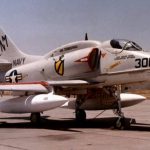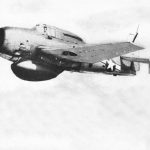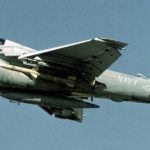
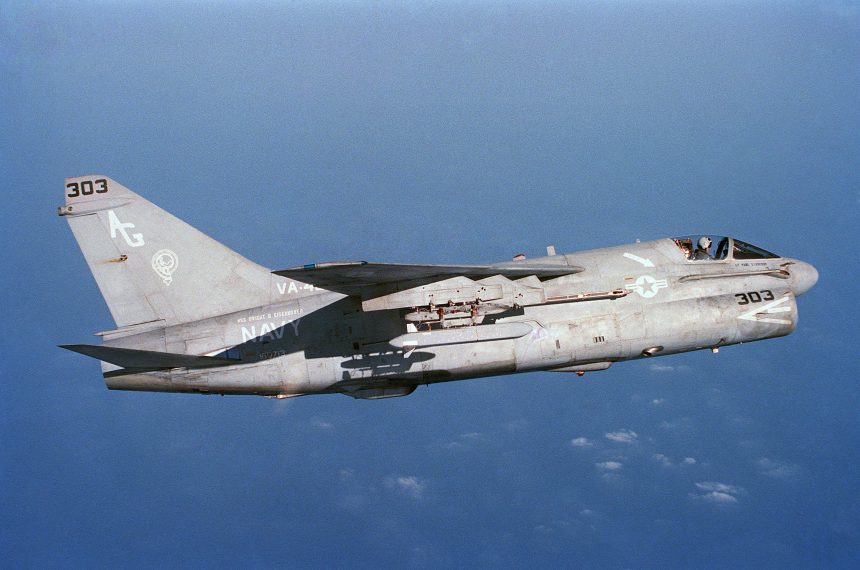

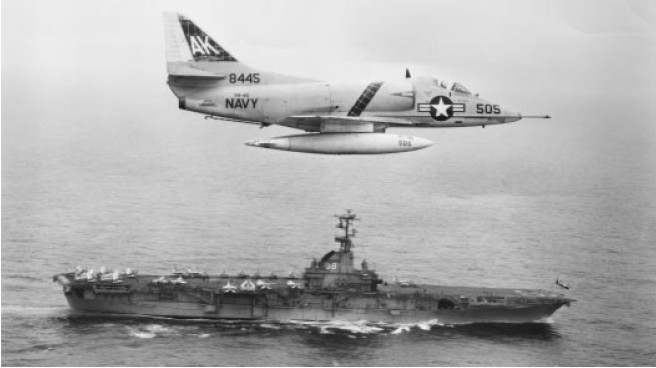
Attack Squadron 46 (VA-46), known as the “Clansmen,” was a US Navy attack squadron that operated during the Cold War. The squadron participated in combat operations in Vietnam, Libya, and the Persian Gulf. It was based at Naval Air Station Cecil Field in Florida and was established on May 24, 1955, flying the Grumman F9F-5 Panther. The squadron’s Scottish identity came from its first commander, Clifford A. McDougal, who chose the McDougal clan tartan for the squadron’s emblem. VA-46 made its first overseas deployment in July 1956 aboard the USS Randolph and flew the F9F-8 Cougar. During this deployment, it helped evacuate foreign nationals from Alexandria, Egypt, during the Suez Crisis. In 1958, the squadron switched to flying the Douglas A-4 Skyhawk and continued missions in the Mediterranean and the Caribbean. In 1965, it deployed on the USS Shangri-La amid tensions between Greek and Turkish communities in Cyprus. VA-46 conducted its first combat mission in the Vietnam War on July 25, 1967, flying A-4E Skyhawks from the USS Forrestal at Yankee Station. The deployment would become one of the most traumatic experiences in the squadron’s history. On July 29, the Forrestal was getting ready to launch more aircraft against targets in North Vietnam when a Zuni rocket accidentally fired and hit an A-4 Skyhawk on the flight deck. The rocket struck a parked Douglas A-4 Skyhawk that was fully fueled, causing the fire to spread rapidly.
Personnel from Attack Squadron 46 joined other members of Carrier Air Wing 17 and the ship’s crew to fight a fire on the USS Forrestal. The fire destroyed seven A-4E Skyhawk aircraft and resulted in the deaths of 134 sailors, with 62 others injured. One of the pilots, Lieutenant Commander John McCain, was directly involved. He escaped from his burning Skyhawk and tried to help another pilot, but was injured by fragments from an exploding bomb. The disaster caused severe damage to Forrestal and forced the carrier to suspend combat operations. Attack Squadron 46 changed from using the A-4 Skyhawk to the A-7 Corsair II between 1968 and 1970. The squadron responded to various crises in the Mediterranean, including a deployment in 1970 after four airliners were hijacked and another in 1973 during the Yom Kippur War. In 1975, Attack Squadron 46 members received awards for their bravery after the USS John F. Kennedy collided with the USS Belknap. In 1985, Attack Squadron 46 conducted operations inside a fjord for the first time when the USS America was in Norway’s Flekkefjord. The next year, the squadron participated in Operation El Dorado Canyon, during which the US launched strikes against Libya, using Shrike and HARM missiles on Libyan radar and missile sites.
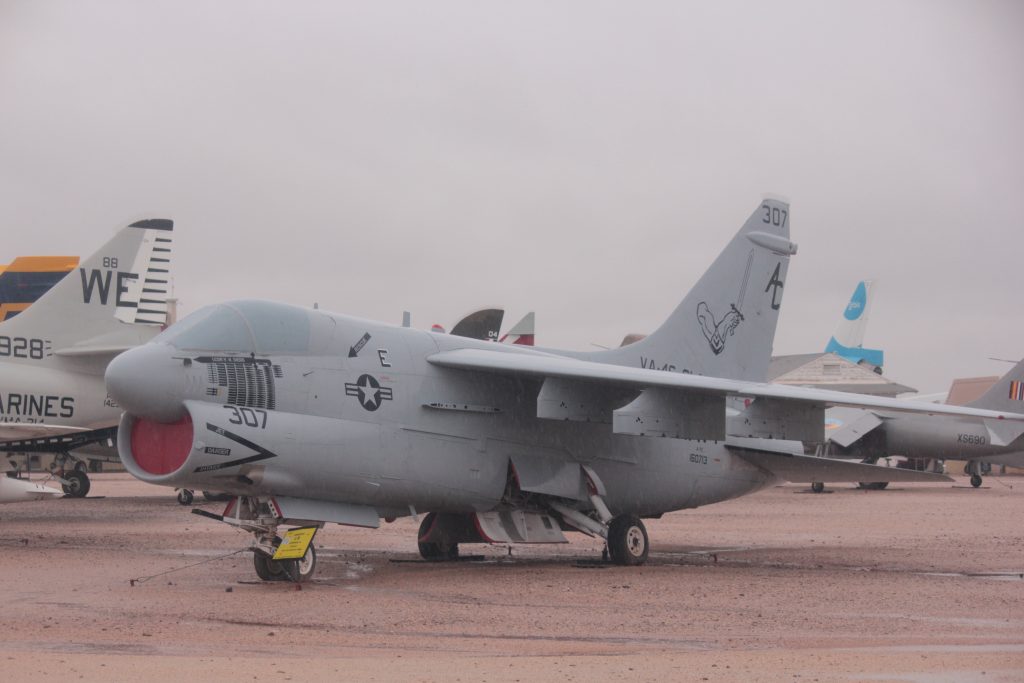
Attack Squadron 46’s last combat deployment was during Operation Desert Storm in 1991. Its A-7E Corsair II aircraft took part in the first airstrike against Iraqi targets in Baghdad. Along with VA-72, the squadron completed the final combat missions of the A-7 Corsair II. VA-46 was officially disbanded on June 30, 1991, making it the last US Navy squadron to use the A-7 Corsair II. Several aircraft from VA-46 are displayed in museums across the United States. A-7E Corsair IIs with Attack Squadron 46 markings can be seen at locations including the Heritage Park at Naval Air Station Jacksonville, the Patriots Point Naval & Maritime Museum in Mount Pleasant, South Carolina, the Heritage In Flight Museum in Lincoln, Illinois, Jacksonville University’s NROTC facility in Jacksonville, the Pima Air & Space Museum in Tucson, Arizona, and the National Naval Aviation Museum in Pensacola, Florida. An A4D-2 Skyhawk with VA-46 markings is displayed at the National Vietnam War Museum in Orlando, Florida. The Pima Air & Space Museum also displays an A-7E Corsair in Attack Squadron 46 markings.