






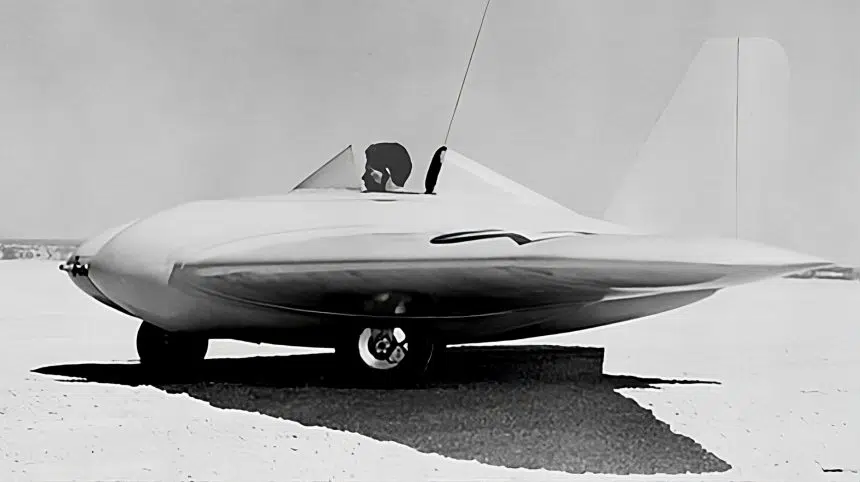

On a bright August day in 1943, observers at Rogers Dry Lake in the Mojave Desert scanned the sky for a triangular yellow object that they knew was, at that moment, falling silently toward the earth. One of the observers spotted it through binoculars and yelled for the Northrop cameraman to start rolling. The tiny craft went from a speck in the distance to a distinct, if odd, object nearing the end of the runway. Inside, test pilot Harry Crosby guided the peculiar little glider toward a landing. He flared at the end of the runway, but ground effect and the glider’s enormous delta wing refused to allow it to land. Crosby sailed past the motion-picture cameras, a few feet in the air, until the glider gently stalled and banged to the ground on its suspensionless wheels, kicking up small dust devils off its wingtips.
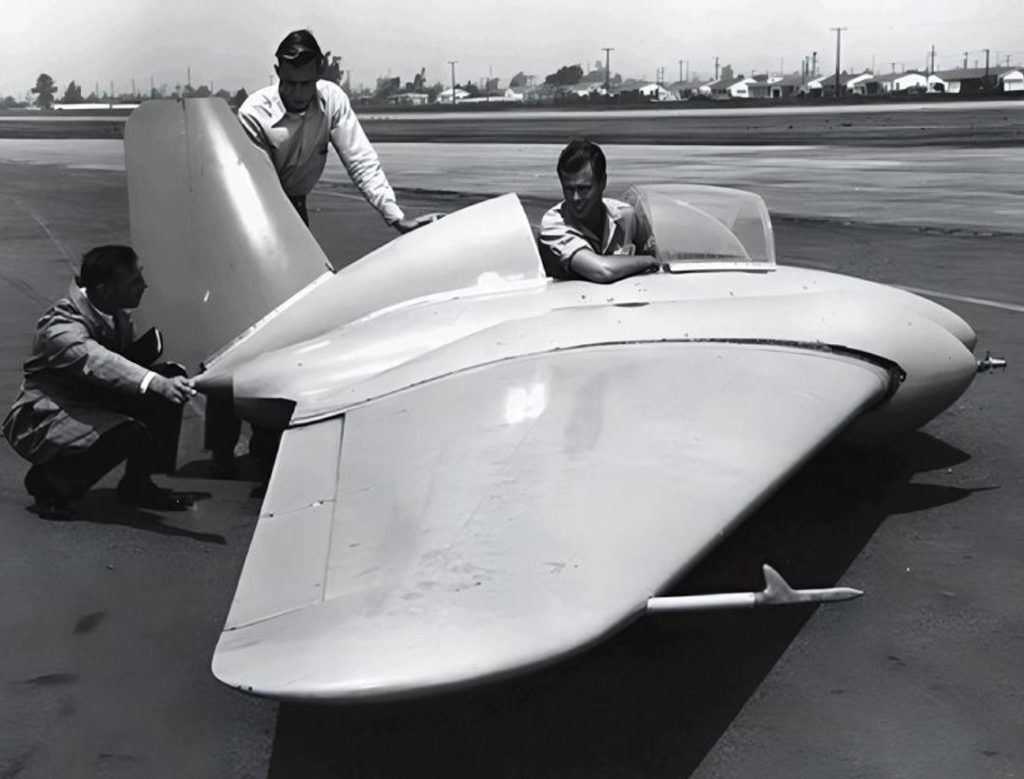
So ended the first flight of the Northrop JB-1 “Bat,” or “Thunderbug,” as it was nicknamed by its crew. The JB-1 looked like something straight out of “The Jetsons,” with an open cockpit, a semi-hemispherical windscreen, and two large pods flanking the cockpit section. A small triangular tail poked up behind the cockpit but ahead of the trailing edge of the wing. Towlines were attached to points on the pods, enabling it to be towed aloft. It looked like a whimsical attempt at a sporting glider, but the JB-1’s origins were anything but whimsical. “JB” stood for “Jet Bomb,” and the “Bat” was built to study aerodynamics and guidance for an American answer to the Fieseler Fi 103, more commonly known as the V-1. When V-1 flying bombs began falling on England in June 1944, they came as a surprise to the citizens of London and the other towns targeted by the “vengeance weapons,” as Nazi propaganda dubbed them.
But they weren’t a surprise to Allied intelligence.
As early as 1941, British intelligence had been aware of German testing of unusual weapons at Peenemünde, on the island of Usedom in the Baltic Sea. A special bureau was formed inside “Lombard,” the intelligence network of the Polish Home Army, dedicated to gathering intelligence within Germany and the occupied territories incorporated into the Third Reich. This group was charged with uncovering data about these weapons. In August 1942, a crashed V-1 was found on the Danish island of Bornholm. The Danish naval officer in charge of the island photographed and sketched the wreckage, and he passed his materials to British intelligence, confirming German work on an unmanned flying bomb. In 1943, thanks to intelligence provided when an anti-Nazi Austrian serving at Peenemünde was turned by Polish agents, the first detailed report on the V-1 hit the desks of Allied intelligence. This information fueled two parallel responses. First came plans to defend against the V-1, which would lead to rings of anti-aircraft and fighter defenses within England, “Noball” airstrikes on the V-1 launch sites, and ultimately a series of raids on Peenemünde itself. Second came plans for the Allies to develop pilotless, jet-powered flying bombs of their own.
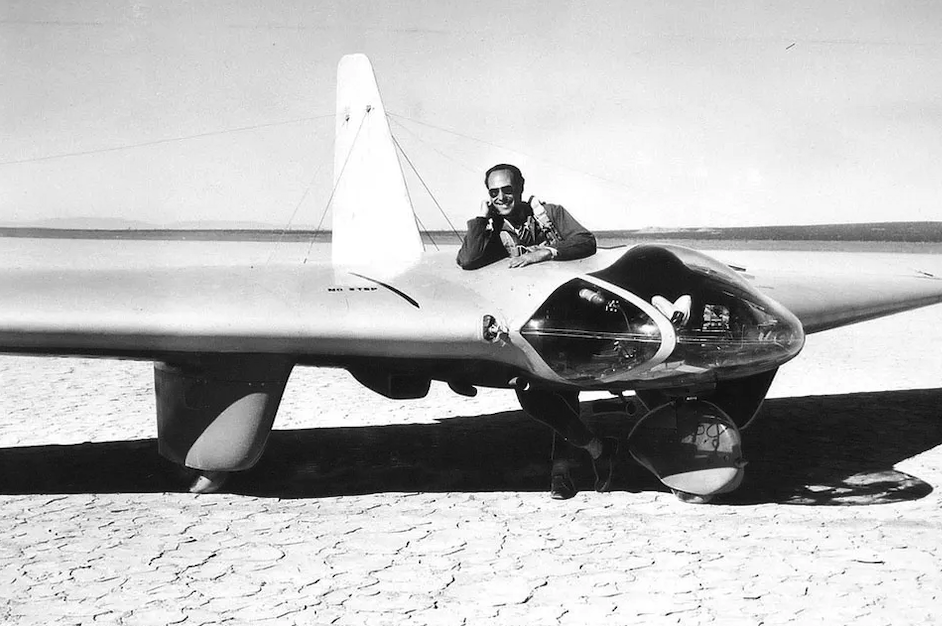
The Army Air Force, taking note of Northrop’s recent series of unconventional projects, including the XP-56 Black Bullet and N-9M flying-wing demonstrator, issued a contract to build a flying bomb based on its flying-wing platform. Project Don Smith was able to reuse the layout of Northrop’s Project MX-324, the “Rocket Wing,” which would eventually lead to the unsuccessful XP-79. The MX-324 featured a prone pilot position, which required a new set of controls for the pilot, and was powered by an Aerojet rocket. Landing was to be accomplished through a pair of landing skids. After several unsuccessful attempts to fly, the unconventional aircraft made it into the air with Crosby at the controls on Sept. 4, 1943. The JB-1, as the Army Air Force and Northrop envisioned it, would house two General Electric Type B1 turbojets in its fuselage, generating a combined 400 pounds of thrust. In each of the pods would be a built-in 2,000-pound bomb. The JB-1 was expected to carry this payload at 427 mph over a 670-mile maximum range, with a 6,000-foot ceiling. In every way, this would outclass the V-1, which carried a 1,870-pound warhead a maximum of 250 miles at 415 mph and 3,000 feet. But Northrop wasn’t quite ready for that technological leap, and it also lacked access to a wind tunnel, so the first JB-1 would be a test and research glider. The pilot would not sit prone, as in the MX-324, but in a conventional cockpit installed where the jet engine was intended to go in the flying bomb. The glider would prove the aerodynamic viability of the layout, and it would also help validate the automatic control system developed by the Hammond Instrument Company of Chicago. This system controlled pitch, yaw, roll, and altitude through a set of gyroscopes and an aneroid altitude-control device.

The JB-1 glider looked almost toy-like, but its construction was anything but. It was built around a magnesium center section and bomb containers made from formed and welded magnesium-alloy plate, the same construction slated for the flying bomb. The 28-foot, 4-inch aluminum wings were swept back 27 degrees; these were spot-welded and riveted to the body and sported magnesium wingtips. In all, the little glider weighed 7,080 pounds—about 320 pounds less than the maximum loaded weight of the Waco CG-4A combat glider. The cockpit included the guidance system and a radio, which resulted in the mounting of a tall whip antenna. As the project continued into 1944, the open cockpit was outfitted with a closing canopy that slid forward, as well as an additional radio antenna on the reworked spine of the aircraft. Testing continued in parallel with the development of the armed, powered, and pilotless JB-1A. The JB-1 would be towed aloft by the P-38 Lightning bailed to Northrop for testing, then released and guided back for a landing. Crosby reported that the glider needed to be kept at relatively high speeds; low speeds for the heavy glider led to some unpleasant characteristics, but they were acceptable since the operational aircraft would never have to fly slowly.

Northrop was building the first armed and powered JB-1 (called the JB-1A in some references) even as the glider completed its test program. While the glider was useful for testing electronics and aerodynamics, it couldn’t help with features like the fuel system, which leaked, or the starter system. Both delayed testing. Finally, in December 1944, the JB-1A was ready for its first trial. At Eglin Field, Florida, the aircraft was mounted on a rocket sled that would accelerate it to 160 mph before the aircraft reached the end of a flat track that pitched up to nine degrees at its end. As per Northrop’s suggestions, the elevons were set at nine degrees. The engines were started and whined to life, and when they reached full power, the launch team fired the rocket sled. At this point, years of work and hundreds of thousands of dollars were wiped out in seconds. The JB-1A hurtled off the rail and abruptly pitched up at a 45-degree angle. The craft climbed briefly before stalling and smashing into the Florida soil about 400 yards from the launch rail. Examination of the wreckage revealed that the elevons were incorrectly set, but even if they had been set correctly, the right engine had also failed. The General Electric engines generated half the power Northrop really wanted; on a single engine, the JB-1A had no chance to fly.

In response, Northrop and the Army Air Force selected the Ford-built PJ-31-1 pulsejet engine, a reverse-engineered copy of the engine in the V-1 that powered Ford’s JB-2 Loon missile— itself a V-1 manufactured by Ford—to replace the General Electric engines. Northrop built 11 heavily modified, pulsejet-powered JB-10s. Ten of these were expended in tests between April and December 1945; only two tests were judged successful. The Northrop flying-bomb program was doomed at this point, not simply by performance but by cost. The JB-10 cost $55,425 per unit, while the Ford JB-2 cost $8,260—and it actually worked. Northrop would continue working on flying wings, including the XB-35 and YB-49 bombers. Work continued on the XP-79 as well, which stemmed from the original MX-324 but used a Westinghouse B-19 jet instead of a rocket. The odd fighter made its first flight on Sept. 12, 1945, taking off under its own power. Sadly, after 15 minutes of flying, the XP-79 entered a slow roll and never recovered. The high speed and unconventional cockpit arrangement prevented Harry Crosby from bailing out, and the only man to fly the JB-1 was killed when the XP-79 smashed into the desert near Muroc Army Air Field.

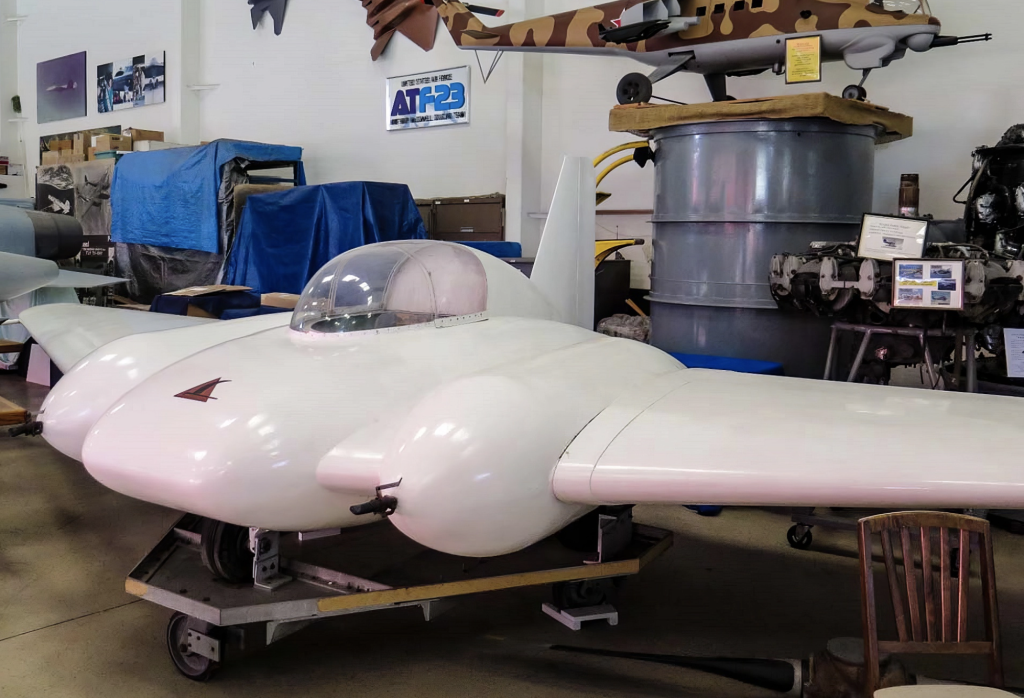
And what became of the JB-1 glider? When the program was officially terminated in 1946, the Army Air Forces planned to scrap it, but it instead went back to Northrop, and in 1995 it was restored. The JB-1 is preserved—not in its original yellow paint, but in white—at the Western Museum of Flight in Torrance, California, a reminder of the early days of American cruise-missile development.











Aerodrome was not Branston, it was Burnaston but it was near Derby. This is reference the story I sent to you about the Mosquitos being prepared for shipment to Canada in 1954 ish. It would be nice know what happened to them. The airfield became a car plant for possibly Honda.
A fascinating article … Who Knew? WHO KNEW … VERY FEW!
But the main point of interest, for me, was the Test Pilot …Harry Crosby.
There comes a point – after All The Calculations, And All The Ground Testing & Drawings – When An Unsung Hero Has To Put THEIR LIFE, ON THE LINE.
Because What’s Required … Is a Human, Analytical, Pilot; someone with Years Of Flight Experience with which to pronounce upon the Good and the Bad Points of Any Aircraft.
Because, until it leaves the ground – despite All The Work To That Point – NO ONE KNOWS IF IT WILL FLY, OR HOW IT WILL FLY.
And the Test Pilot needs to be both Supremely Skilled, And Lucky, ToLive To Tell The Tale … Thinking, even whilst Bailing-Out of a Doomed Machine – ‘Why, What Wasn’t Right/Went Wrong?’
Hats Off … To The Great Unsung Heroes, and Heroines, of The Testing World.
Their Names Should Be In The Pantheon, With All Other Great Explorers.