





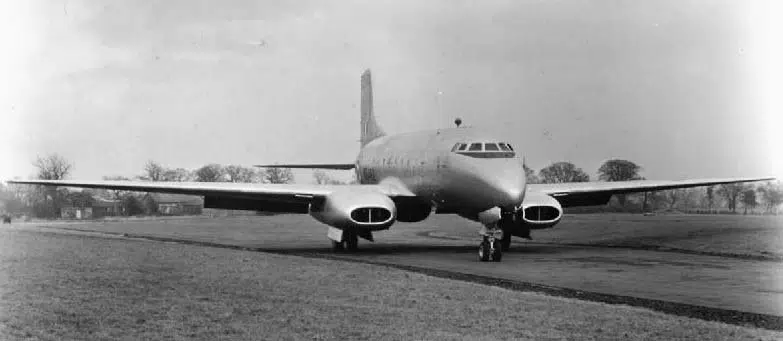

On this day in aviation history, 76 years ago (September 1, 1950), the Avro 706 Ashton made its first flight. Developed by A.V. Roe & Company as a four-engine jet research aircraft, the Ashton was derived from the earlier Tudor airliner and was intended primarily as a flying testbed rather than a production transport. The prototype, WB490, was powered by four Rolls-Royce Nene turbojets installed in paired nacelles beneath the wings. Although its origins could be traced to Avro’s piston-powered Tudor, the Ashton incorporated a redesigned wing and other changes necessary for high-speed jet research. Six examples were completed, and the type was employed in a variety of experimental programs during the 1950s. Individual aircraft were modified for work involving jet engines, aerodynamic research, bombing and navigation equipment, and other emerging technologies.

The Ashton never entered commercial or military operational service, but its usefulness came from its role as a flexible research platform during a period of rapid development in British aviation. One aircraft, WB491, survives today as part of the collection of the Newark Air Museum in England. The Ashton Mk 1 had a crew of five. The aircraft measured 84 ft. 0 in. long and had a wingspan of 120 ft. The Ashton’s maximum speed was approximately 425 mph, under the power of four Rolls-Royce Nene 5 turbojet engines, each with 5,000 lbs of thrust. WB494, the sole-built Ashton Mk.4, was fitted with a pressurised bombardier compartment. The Mk. 4 carried practice bombs, located in underwing bomb panniers.









I lived a short walk from the Bristol Siddeley factory in Patchway north of Bristol and I remember it being a very familiar site landing on Filton airfield ( the landing approach was over our council house!!)
It was presumably employed in flight tests?