





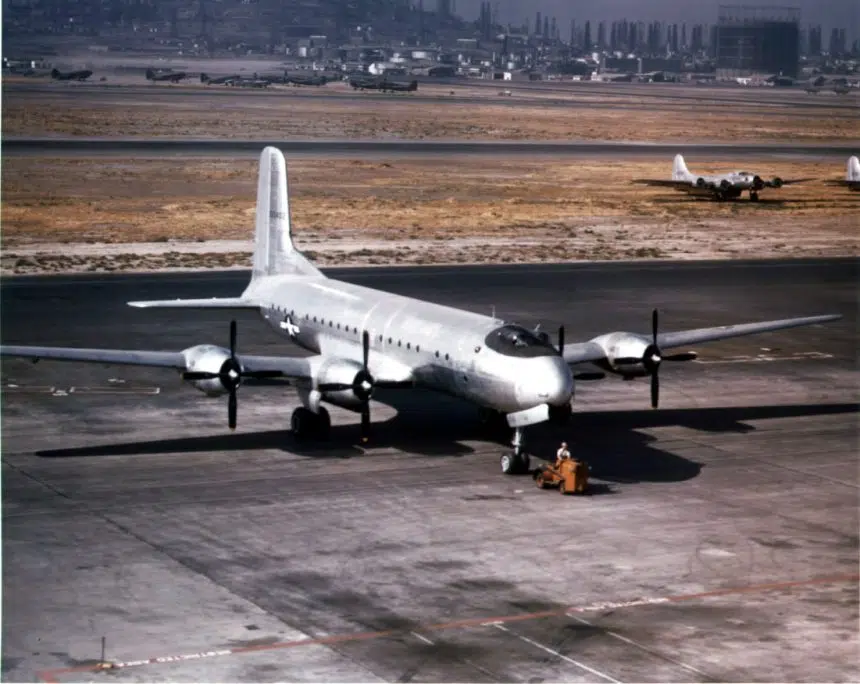

On this day in aviation history, 81 years ago (September 5, 1945), the Douglas C-74 Globemaster took flight for the first time. Developed during WWII as a heavy strategic transport for the United States Army Air Forces, the enormous four-engine aircraft was designed to carry troops and heavy equipment across the vast distances of the Atlantic and Pacific. Douglas began studying the new transport in early 1942, using the company’s DC-4 as a starting point but greatly increasing its size and carrying capacity. The resulting Model 415 was designed to transport equipment ranging from light tanks and bulldozers to artillery pieces and other large military cargo. The first C-74 took off from Long Beach, California, with test pilot Ben O. Howard at the controls and remained airborne for 79 minutes. At the time, it was the largest landplane to enter production.

The end of WWII dramatically reduced demand for the Globemaster, and an original order for 50 aircraft was cancelled after only 14 were built. Despite its small numbers, the C-74 demonstrated the potential of heavy strategic airlift, serving with the USAAF and later the U.S. Air Force. One aircraft participated in the Berlin Airlift, while Globemasters also supported operations during the Korean War. Experience gained with the C-74 contributed directly to the development of the much more numerous C-124 Globemaster II. The C-74 measured 124 feet 1½ inches in length with a wingspan of 173 feet 3 inches and was powered by four Pratt & Whitney R-4360 Wasp Major radial engines producing up to 3,250 horsepower each. It could reach 328 mph, had a range of 3,400 miles, and a service ceiling of 21,300 feet. The Globemaster could carry 125 troops, 115 litter patients with medical personnel, or more than 48,000 pounds of cargo.










Austin – I think there was a C-74 aircraft that appeared in the (original) Italian Job movie – in the very beginning !
I was right – from Wikipedia https://en.wikipedia.org/wiki/Douglas_C-74_Globemaster
42-65409 was sold on the civilian market in 1956 as N3181G. After reconditioning at Oakland, California, it was operated by Aeronaves de Panama as HP-379 in Europe and the Middle East. It flew from Europe to the Middle East frequently carrying live cattle from Copenhagen to the Middle East.[11] It was abandoned at Milan, Italy in 1969 and appeared in the 1969 Michael Caine movie The Italian Job. It was painted in the colors of the fictitious Communist Chinese Civil Aviation Airlines that delivered the gold to FIAT in Turin. Later moved to Turin airport, it caught fire while on public display on 11 June 1970 and again on 24 September 1970 while it was being salvaged, this time killing two salvage workers.[6]