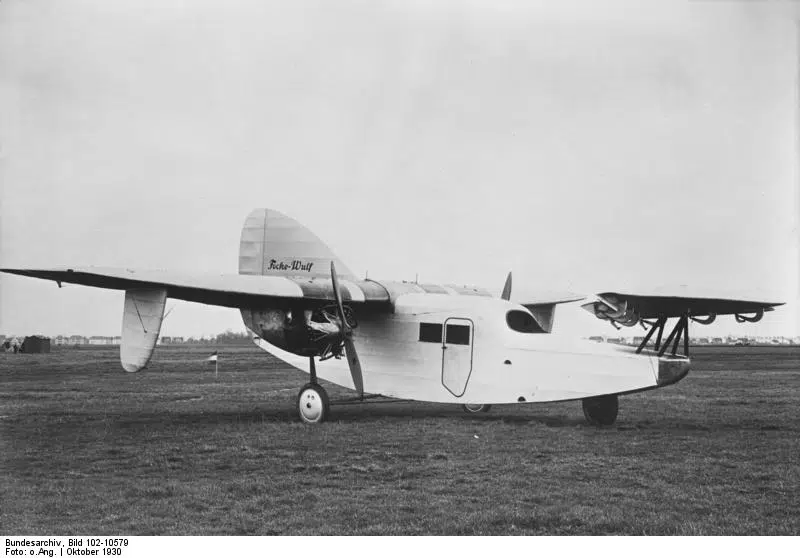


On this day in aviation history, 99 years ago (September 2, 1927), the Focke-Wulf F 19 Ente took flight for the first time. Developed in Germany as an experimental civil aircraft, the F 19 was distinguished by its unusual canard configuration, placing its horizontal stabilizing surface ahead of the main wing. The name “Ente” translates to “Duck” in English. Development of the F 19 grew from Focke-Wulf co-founder Henrich Focke’s longstanding interest in canard aircraft. Focke-Wulf approached the Deutsche Luftfahrtforschungsanstalt in 1925 with a proposal to construct such an aircraft, leading to extensive model and wind tunnel testing. The resulting F 19 was a high-wing, twin-engine monoplane with fixed tricycle landing gear, an open cockpit for the pilot, and an enclosed cabin capable of carrying three passengers.

Early testing of the F 19 proved promising, but tragedy struck less than a month after its maiden flight. On September 29, 1927, Focke-Wulf co-founder Georg Wulf was killed when the aircraft crashed during a demonstration of single-engine flight after a control rod failed. Investigators determined that the accident was not caused by a fundamental flaw in the design, and a second F 19 was subsequently constructed. The second aircraft flew in 1930 and later toured Europe before being destroyed during an Allied air raid on Berlin in 1943. The Focke-Wulf F 19 measured 34 feet 7 inches in length with a wingspan of 32 feet 9 inches and was powered by two 110-horsepower Siemens Sh 14 radial engines. It could reach a maximum speed of approximately 88 mph and had a service ceiling of 9,840 feet. The aircraft carried one pilot and up to three passengers, with only two examples of the unusual Ente ever constructed.