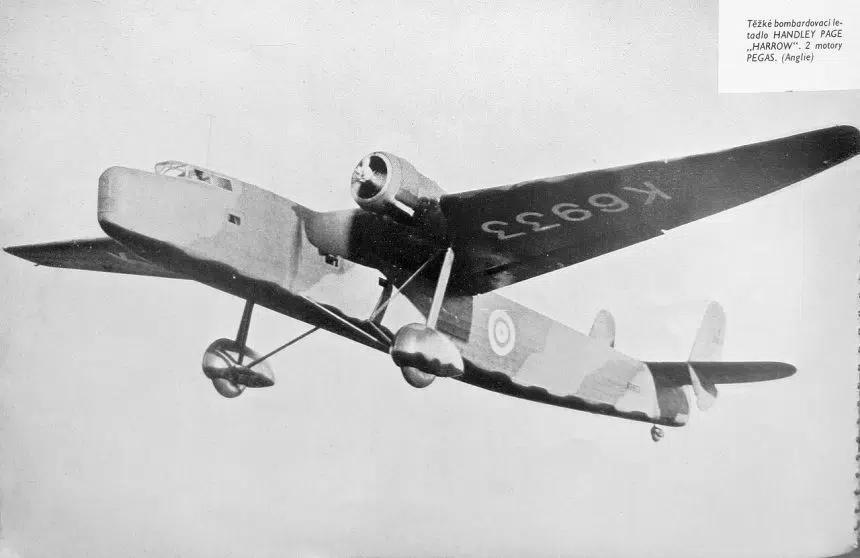

On this day in aviation history, 90 years ago (October 10, 1936), the Handley Page H.P.54 Harrow took flight for the first time from Radlett, England. Designed by Gustav Lachmann, the Harrow was a twin-engine heavy bomber developed as a “stop-gap” aircraft during the rapid expansion and modernization of the Royal Air Force in the years leading up to WWII.

The Harrow was developed from the earlier Handley Page H.P.51 bomber-transport and featured a high-mounted wing and fixed landing gear. Despite its relatively conventional appearance, the aircraft incorporated several modern features, including variable-pitch propellers, hydraulically powered gun turrets, and a steam-based cabin heating system. The need to expand the RAF was so urgent that the Air Ministry ordered 100 Harrows in August 1936, nearly two months before the aircraft’s first flight.

The Harrow entered RAF service in January 1937, but improvements in bomber technology quickly overtook the design. It was withdrawn from frontline bomber squadrons by the end of 1939 without flying a combat bombing mission. The Harrow nevertheless found a second career during WWII as a transport and air ambulance, including evacuating wounded during Operation Market Garden. Several were also used in the unusual Long Aerial Mine experiments during the Blitz. The last Harrows were retired in May 1945.

The Harrow Mk.II measured 82 feet 2 inches in length with a wingspan of 88 feet 5 inches. Power came from two 925-horsepower Bristol Pegasus XX radial engines, giving the aircraft a maximum speed of 200 mph, a range of 1,260 miles, and a service ceiling of 22,800 feet. A crew of five operated the aircraft, which could carry up to 3,000 pounds of bombs or, when used as a transport, 20 fully equipped soldiers.