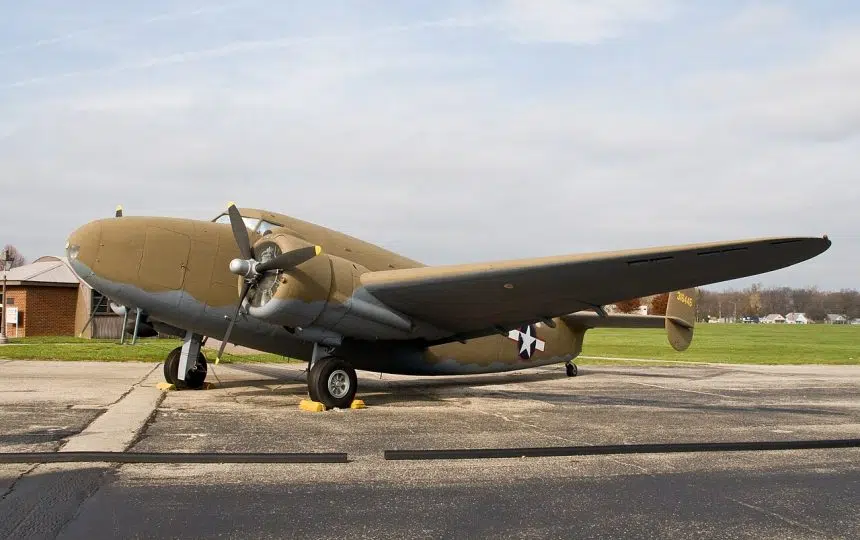

On this day in aviation history, 87 years ago (September 21, 1939), the Lockheed Model 18 Lodestar took flight for the first time. Developed as a passenger transport, the twin-engine Lodestar was created to improve upon the economics of Lockheed’s Model 14 Super Electra while retaining its strong performance. Although the Model 14 was fast and capable, it had struggled commercially against the larger and more economical Douglas DC-3. Lockheed responded by stretching the Model 14’s fuselage by 5 feet 6 inches, providing room for two additional rows of seats. The first Model 18 prototype was converted from a Model 14 previously operated by Northwest Airlines and flew in its new configuration on September 21. Two additional prototypes were also conversions, while the first newly built Model 18 flew in February 1940.

The Lodestar received its type certificate in March 1940 and entered airline service with Mid-Continent Airlines. Although domestic airline sales remained limited by the dominance of the DC-3, the Lodestar found considerable success overseas and in military service. During WWII, variants served with the U.S. Army Air Forces as the C-56, C-57, C-59, and C-60, and with the U.S. Navy and Marine Corps as the R5O. A total of 625 Lodestars of all variants were built. The Model 18-07 was powered by two 875-horsepower Pratt & Whitney Hornet S1E2-G radial engines and normally accommodated around 14 to 17 passengers. Later Lodestars received a variety of Pratt & Whitney Twin Wasp and Wright Cyclone engines producing up to 1,200 horsepower. The military C-60A measured 49 feet 10 inches in length with a wingspan of 65 feet 6 inches, could reach approximately 266 mph, and had a range of around 2,500 miles.