





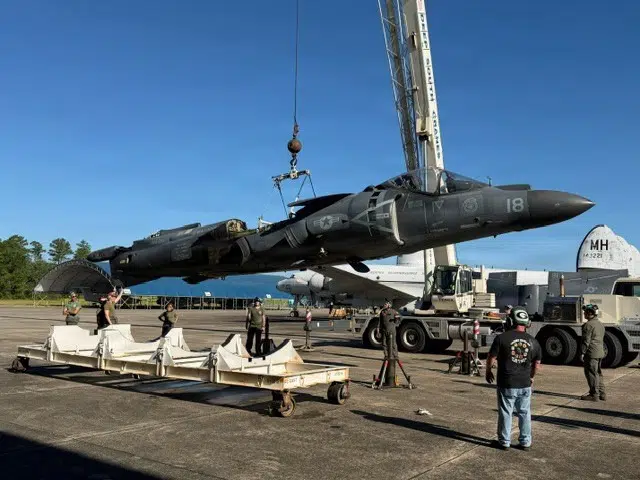

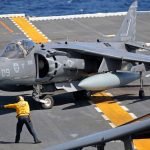
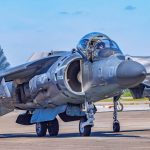
The final AV-8B Harrier II+ produced for the U.S. Marine Corps completed its last journey in July, traveling to Naval Air Station Pensacola, Florida, for preservation at the National Naval Aviation Museum. Before leaving Marine Corps Air Station Cherry Point, North Carolina, AV-8B BuNo 166288 was demilitarized and made safe for public display. The aircraft was then transported by truck to Pensacola, where it will remain as part of the museum’s permanent collection.

BuNo 166288 is among several retired Marine Corps Harriers transferred to museums across the United States beginning in 2024. Vintage Aviation News has covered the arrival of these aircraft at several institutions, including the Hickory Aviation Museum, Castle Air Museum, Tillamook Air Museum, CAF Airbase Arizona Museum, and Fort Worth Aviation Museum.
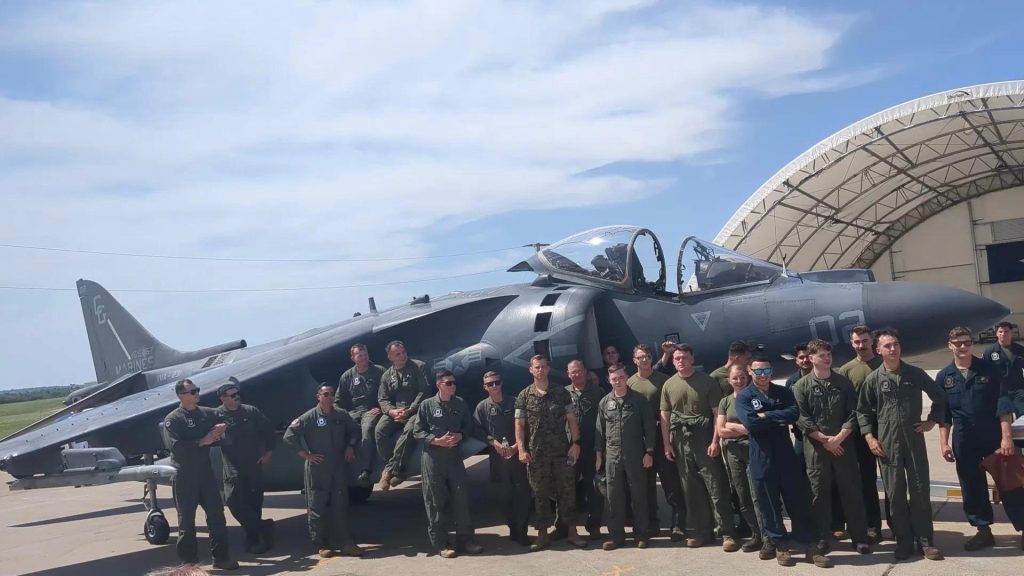
Delivered by Boeing in September 2003, BuNo 166288 accumulated more than 5,800 flight hours during its service career. The aircraft deployed aboard multiple amphibious assault ships and operated from land-based sites in support of combat missions. Its final assignment was coordinated by Pablo “Louie” Sanchez, assistant program manager for logistics with the V/STOL Advanced Development and Transition Program Office (PMA-257) and leader of the Harrier Museum Task Force.

Sanchez, a retired Marine Corps gunnery sergeant, has worked with the AV-8B program since 1989, first as a mechanic and later as a civilian member of the program office. He emphasized the importance of preserving the aircraft and the history of the people who operated and maintained it. “Each aircraft has a story, and BuNo 166288, being the last USMC-produced Harrier, seemed fitting to find its final home in the National Naval Aviation Museum,” Sanchez said.

“The arrival of the final produced AV-8B Harrier II+ at the National Naval Aviation Museum marks the end of an extraordinary chapter in Marine Corps aviation,” said Bonnie Town of the National Naval Aviation Museum. “The National Naval Aviation Museum is deeply honored to preserve this historic aircraft as a lasting tribute to the extraordinary chapter of Marine Corps aviation history it represents.” The aircraft’s previously removed Rolls-Royce F402-RR-408 engine will also be exhibited on a separate stand. The axial-flow, twin-spool turbofan features counter-rotating compressors and four rotating exhaust nozzles designed to vector thrust. This arrangement gave the Harrier its distinctive vertical and short takeoff and landing capabilities, as well as the ability to use vectoring in forward flight.

The Harrier’s arrival in Pensacola followed the type’s retirement from Marine Corps service. On June 3, 2026, Marine Attack Squadron 223 (VMA-223), the “Bulldogs,” conducted the AV-8B’s final official flight during a sundown ceremony at MCAS Cherry Point. The ceremony concluded nearly 55 years of Harrier operations by the Marine Corps. The service introduced the British-built AV-8A in 1971, followed by the McDonnell Douglas AV-8B Harrier II in 1985. Numerous squadrons operated the “jump jet” during its long career, but VMA-223 was the last. As commanding officer of the final Marine Corps squadron to operate the AV-8B, Lt. Col. John Cumbie views the Pensacola display as a permanent tribute to the entire Harrier community.
“Leading this squadron through the final operational phases of the legendary AV-8B Harrier and steering our transition to the F-35B Lightning is the honor of a lifetime,” Cumbie said. “Maintaining and operating the Harrier required tireless dedication and adherence to the highest professional standards—a testament to our aviators, maintainers, and support Marines alike.” Maj. Eric Scheibe, the squadron’s executive officer, said those standards were essential to meeting the unique demands of operating and maintaining a vertical-flight aircraft. “The challenge of operating and maintaining the platform required a tight-knit culture of professionalism from the pilots to the maintainers and support personnel,” Scheibe said. “As we move forward to the F-35 transition, that culture and professionalism of Marine fixed-wing attack will live on in the individual Marine.”

For the VMA-223 maintainers assigned to reassemble BuNo 166288 at NAS Pensacola, the mission carried particular significance. “After 10 years of dedication to the AV-8B Harrier platform, I am sad to see it go,” said Staff Sgt. Christian Regueira. “Working on this aircraft has been a personal blessing to me.” Gunnery Sgt. Bradley Birchfield similarly described the assignment as an appropriate conclusion to his career with the aircraft. “As an AV-8B maintainer, placing these legacy aircraft into the National Naval Aviation Museum is the perfect end to my Harrier career,” Birchfield said.

The F-35B Lightning II has succeeded the AV-8B in Marine Corps service, bringing greater speed, advanced sensors, stealth, and integrated mission capabilities while retaining the short-takeoff and vertical-landing flexibility pioneered by the Harrier. Although the AV-8B’s operational career has ended, BuNo 166288 will preserve the aircraft’s legacy—and that of the Marines who flew, maintained, and supported it—for future generations.









A British Legend
Saw an AV8A demonstration at the Camp Wilson airfield, 29 Palms, in 1979. As it was hovering, the engine quit, and it bounced like a basketball on the tarmac. Saw that jet, a week later, disassembled, on a flatbed, heading back to El Toro.
The Hawker Siddeley Harrier, a truly remarkable Aircraft.
The Only Successful design to emerge from the numerous mid-fifties experimental projects by Various Countries.
I well remember buying an Airfix Kit of the exciting new prototype, from Woolworths, in 1961; which, being your average teenager, took me all of 10 minutes to put together!
1960-2025 … Hawker Siddeley – British Aerospace – McDonnell Douglas … Harrier to Sea Harrier to Harrier II – Not Bad For An Aircraft ‘Written Off’ by some in the Sixties as a ‘Wasted Idea’.
And by the Red & Blue Penny-Pinching British Governments, from the earliest days; both of which killed-off all hopes of the Supersonic Version, along with the BAC TSR-2.
The ‘Semi-Failure’ that steadily proved All Its Critics Wrong; and its worth in various NATO Countries. And, finally, Crowning its Success in The Falklands War – The RN Fleet Air Arm & R.A.F Operating Successfully from Carriers in the harsh conditions of the South Atlantic; where its V/STOL capabilities … and 2xCannon + Aim Missiles + Bombs … proved useful … War Winning.
And, of course, it was always a ‘Crowd Pleaser’ at the various Air Shows, for years. I well remember being ‘Gob-Smacked’ when first seen; it arrived … At Speed … Hovered … Then, after a couple of Hovering Turns and Nose-Dipping Salutes to the Crowd … FLEW BACKWARDS!!!
My Cup Runneth Over!