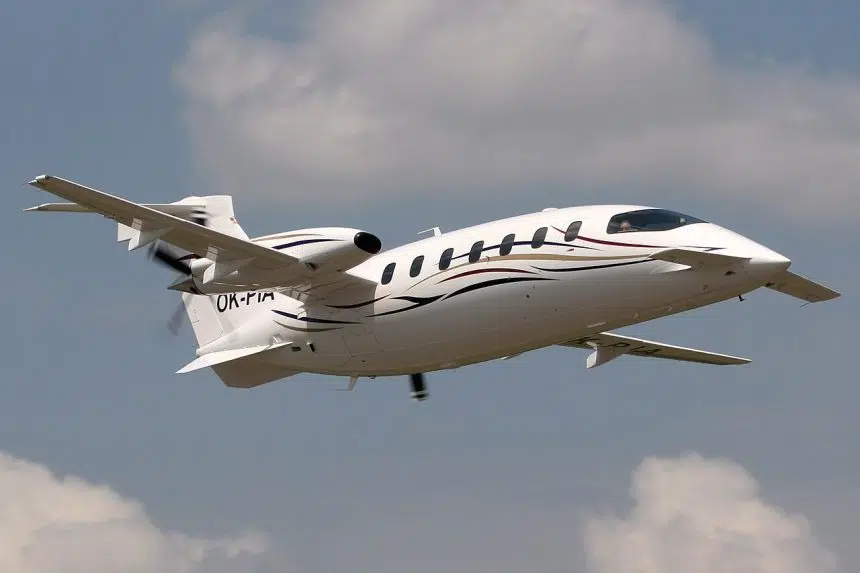

On this day in aviation history, 40 years ago (September 23, 1986), the Piaggio P.180 Avanti took flight for the first time. Developed in Italy as a high-speed executive transport, the Avanti combined twin pusher turboprop engines with an unusual three-surface aerodynamic configuration. Its distinctive appearance and near-jet performance have made it one of the most recognizable turboprop aircraft ever produced. Engineering studies for the Avanti began in 1979, followed by extensive wind-tunnel testing in Italy and the United States. Beginning in 1983, Piaggio partnered with Gates Learjet on development of the aircraft, which was initially known as the Gates Piaggio GP-180. Learjet’s financial difficulties ended the partnership in early 1986, but Piaggio continued development independently and flew the first prototype that September.

The Avanti’s unconventional configuration uses a small forward wing, main wing, and conventional tailplane, with its two turboprop engines driving pusher propellers behind the passenger cabin. The arrangement was designed to reduce drag while providing a large pressurized cabin and high cruise speeds. The P.180 received Italian and American certification in 1990, followed by improved Avanti II and Avanti EVO models. The current Avanti EVO measures 47 feet 3 inches in length with a wingspan of approximately 46 feet and is powered by two 850-horsepower Pratt & Whitney Canada PT6A-66B turboprops. It can cruise at up to 460 mph, has a maximum range approaching 2,000 miles depending on configuration, and can operate at altitudes up to 41,000 feet. The pressurized cabin accommodates up to nine passengers, while the aircraft may be flown by one or two pilots.