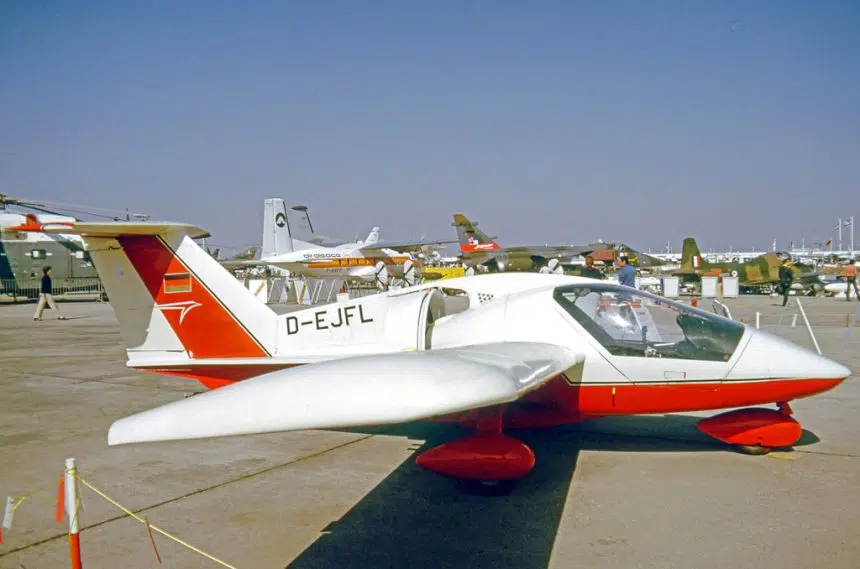


On this day in aviation history, 53 years ago (October 8, 1973), the RFB Fanliner took flight for the first time. Developed by West Germany’s Rhein-Flugzeugbau (RFB) in cooperation with American manufacturer Grumman American, the Fanliner was an experimental two-seat light aircraft featuring an unusual Wankel rotary engine driving a ducted fan. The Fanliner grew from RFB technical director Hanno Fischer’s experiments with ducted-fan propulsion during the 1960s and early 1970s. RFB envisioned an inexpensive light aircraft that could provide some of the handling characteristics of a jet while retaining the lower operating costs of a piston-powered aircraft. The company partnered with Grumman American, allowing components from existing Grumman light aircraft to be incorporated into the design.

The first prototype used wings and horizontal tail surfaces from the Grumman American AA-1, while its 114-horsepower Audi NSU Wankel engine was installed behind the cockpit and drove the ducted fan. A second, considerably revised prototype followed in 1976, incorporating components from the larger AA-5 and a more powerful engine. Only two Fanliners were constructed, as RFB ultimately concentrated its efforts on the military Fantrainer. The Fanliner nevertheless provided valuable development data for that aircraft’s ducted-fan propulsion system. The original Fanliner measured 20 feet in length with a wingspan of 24 feet 5 inches and was powered by a 114-horsepower Audi NSU Ro 135 Wankel engine. The aircraft could reach a maximum speed of 140 mph, cruise at 110 mph, and had a range of approximately 410 miles. Its maximum takeoff weight was just 1,653 pounds, with accommodations for two occupants seated side-by-side.