







(Image credit: VAN)
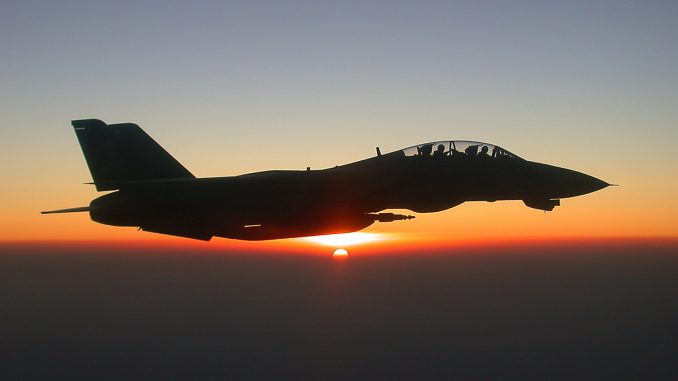
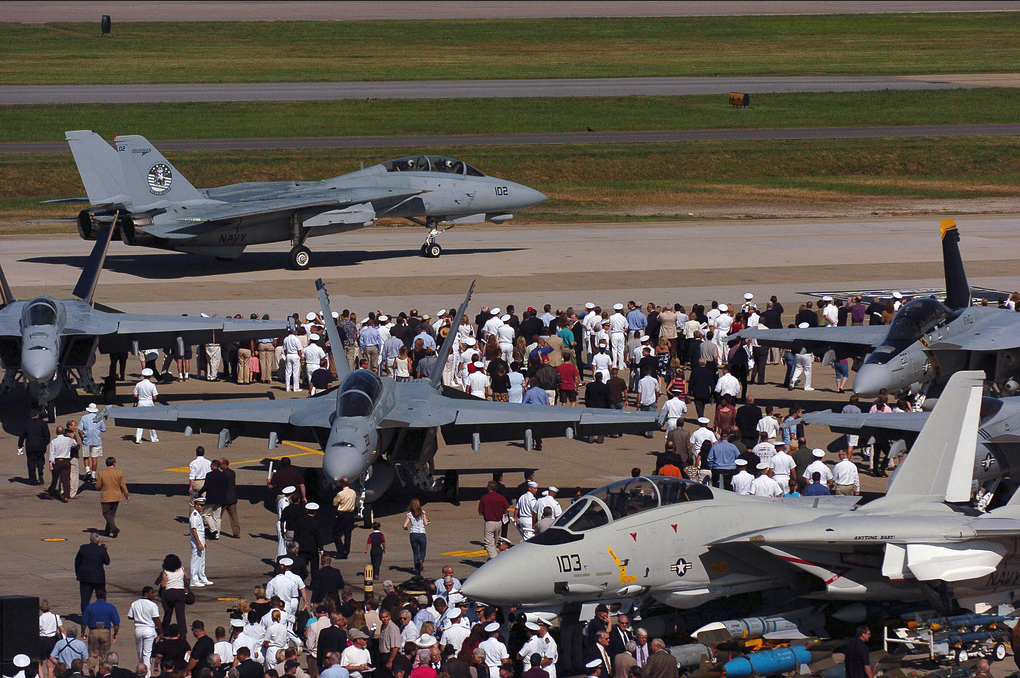
Nineteen years ago today, on September 22, 2006, the legendary Grumman F-14 Tomcat officially retired from service with the United States Navy. Naval Air Station Oceana hosted a special farewell ceremony that included speeches, an invocation, the playing of the National Anthem, and one last flight by an F-14D Tomcat from VF-31 “Tomcatters.” While the type’s final flight in U.S. airspace took place on October 4, 2006 — a ferry flight that delivered VF-31’s F-14D BuNo. 164603 to Republic Airport in Farmingdale, New York — the September 22 ceremony is remembered as the Tomcat’s official sendoff.
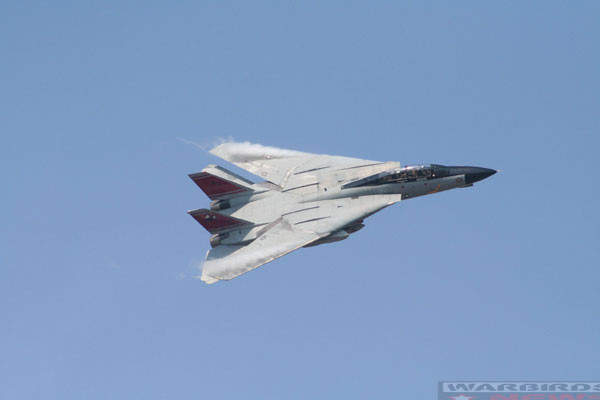
The Grumman F-14 Tomcat was a groundbreaking, carrier-based, twin-engine fighter that symbolized American naval air power for more than three decades. Featuring a crew of two, twin tails, and its signature variable-sweep wings, the Tomcat could adapt its configuration to excel in both slow-speed carrier approaches and supersonic intercepts. Its first flight took place on December 21, 1970, and it entered operational service in 1974. The F-14 would go on to see extensive action in Operation Desert Storm, Operation Deliberate Force, Operation Allied Force, and in the post-9/11 conflicts in Afghanistan and Iraq. Between 1969 and 1991, Grumman produced 712 Tomcats across multiple variants. Though retired from the U.S. Navy, the aircraft remains in limited service with the Iranian Air Force — though questions remain regarding their airworthiness.
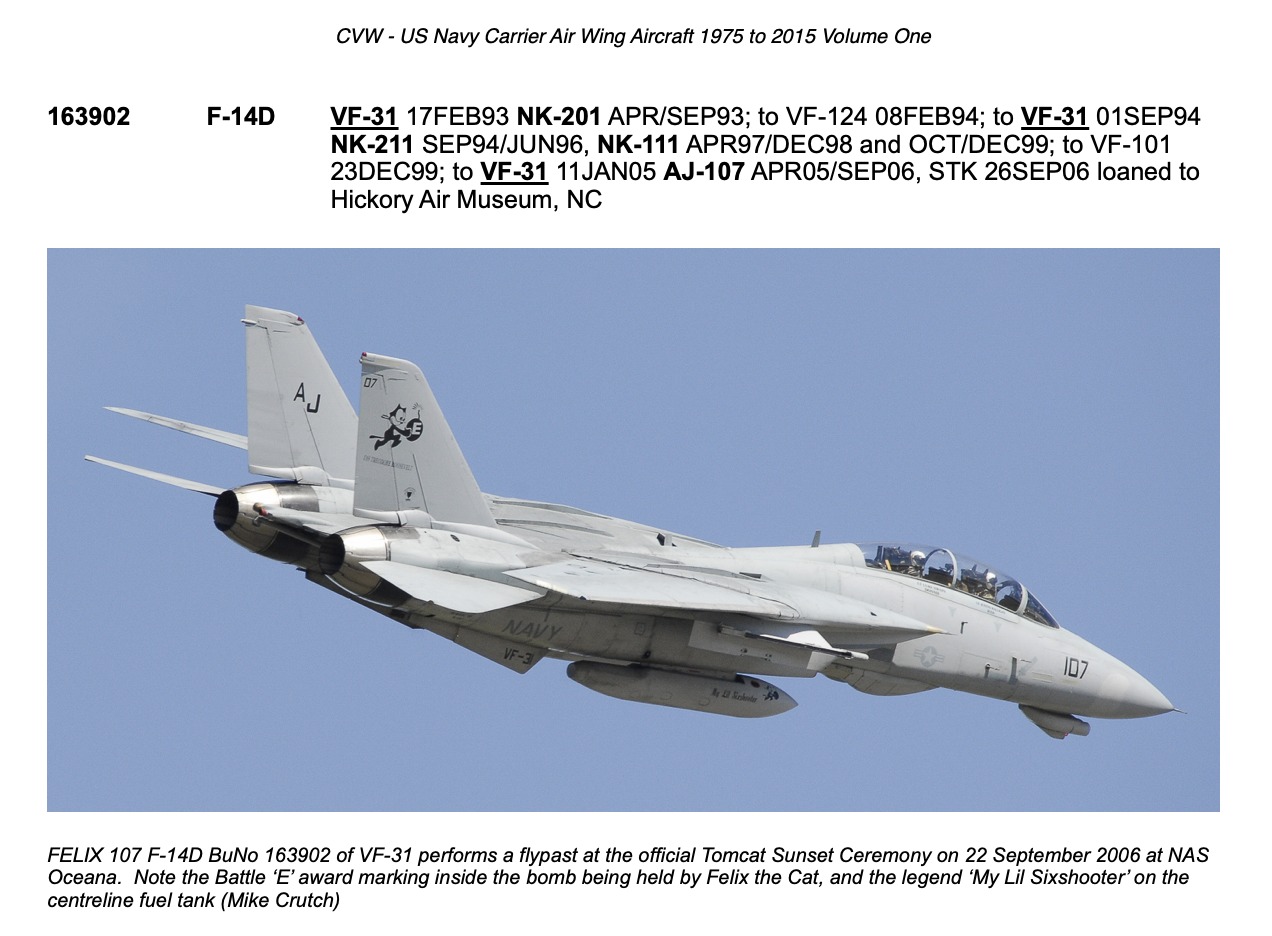
The F-14 was powered by two General Electric F110-GE-400 afterburning turbofans, each producing 16,333 pounds of thrust. This gave the Tomcat a top speed of Mach 2.34, roughly 1,544 miles per hour, and a combat range of over 500 nautical miles. The aircraft could climb at an astonishing 45,000 feet per minute and operate at altitudes up to 53,000 feet, enduring up to +7.5 G in combat maneuvers. Its internal M61A1 Vulcan cannon carried 675 rounds of 20 mm ammunition, and its ten hardpoints allowed it to carry an array of rockets, bombs, and missiles — including the long-range AIM-54 Phoenix, a weapon that gave the Tomcat an unmatched air-intercept capability during its prime.
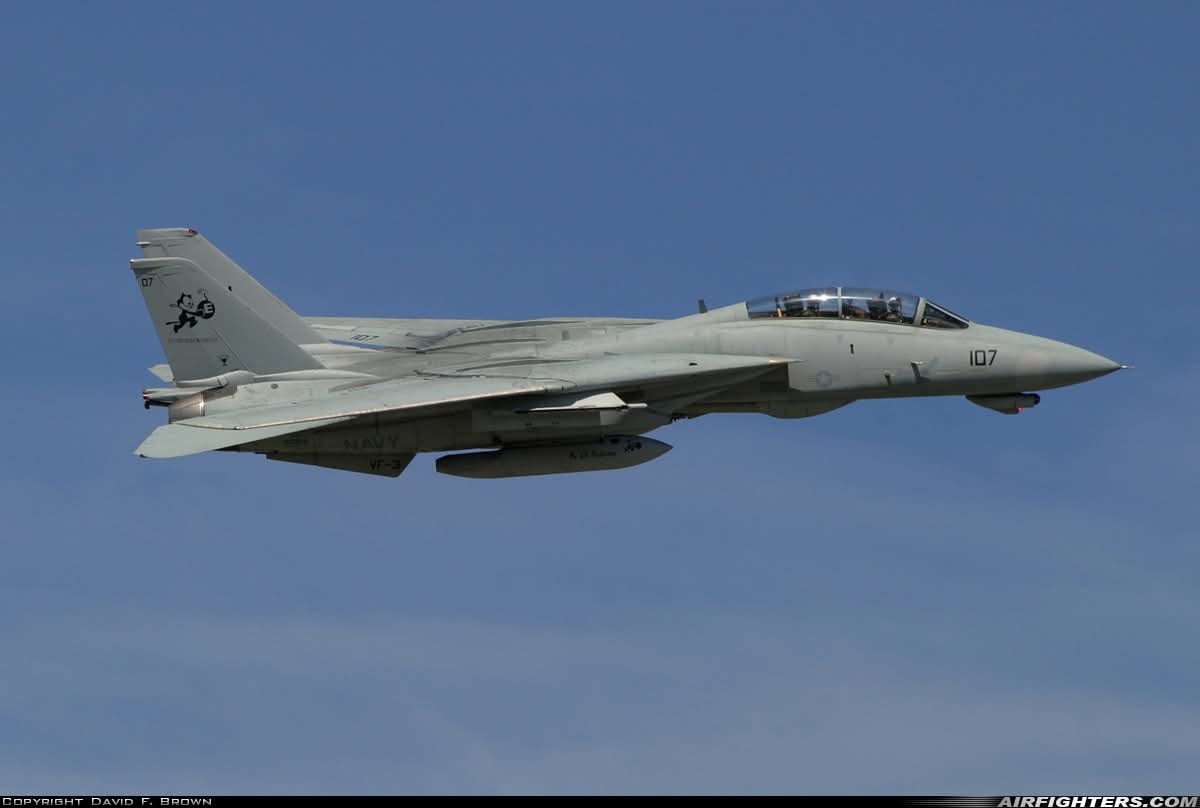
Public fascination with the Tomcat soared in 1986 with the release of Top Gun, the blockbuster film that turned the F-14 into a pop culture icon and helped cement its status as one of the most beloved fighter aircraft in history. Today, many Tomcats are preserved in museums across the United States, where they continue to inspire new generations of aviation enthusiasts. In recent years, aviation entrepreneur and pilot Jared “Rook” Isaacman has hinted at the possibility of seeing an F-14 fly again in U.S. skies. If that dream comes true, the unmistakable roar of the Tomcat could once again echo across American airspace — a fitting tribute to an aircraft that defined an era of naval aviation.









The F110-GE400 actually produces 27,000 pounds of thrust, the thrust rating you listed is what it developed in Mil.Power, not full burner. Please, go back, and recheck your information on aircraft engines before you post another article, please.
The F-14D was powered by the F110 engine. Most F-14s were F-14A models, powered by Pratt & Whitney TF30 engines of considerably less thrust.
And Mr. Osbourn is correct, the F110 is rated around 16,000 lb thrust dry, 27,000 lb thrust in full afterburner.