





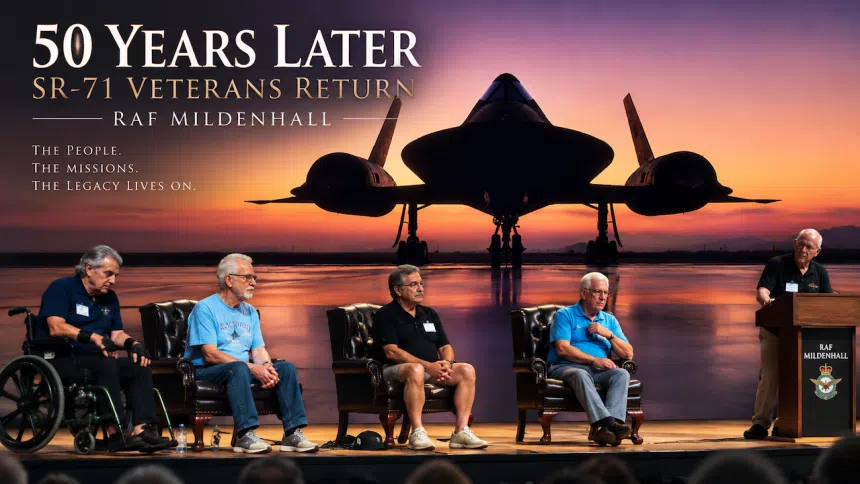

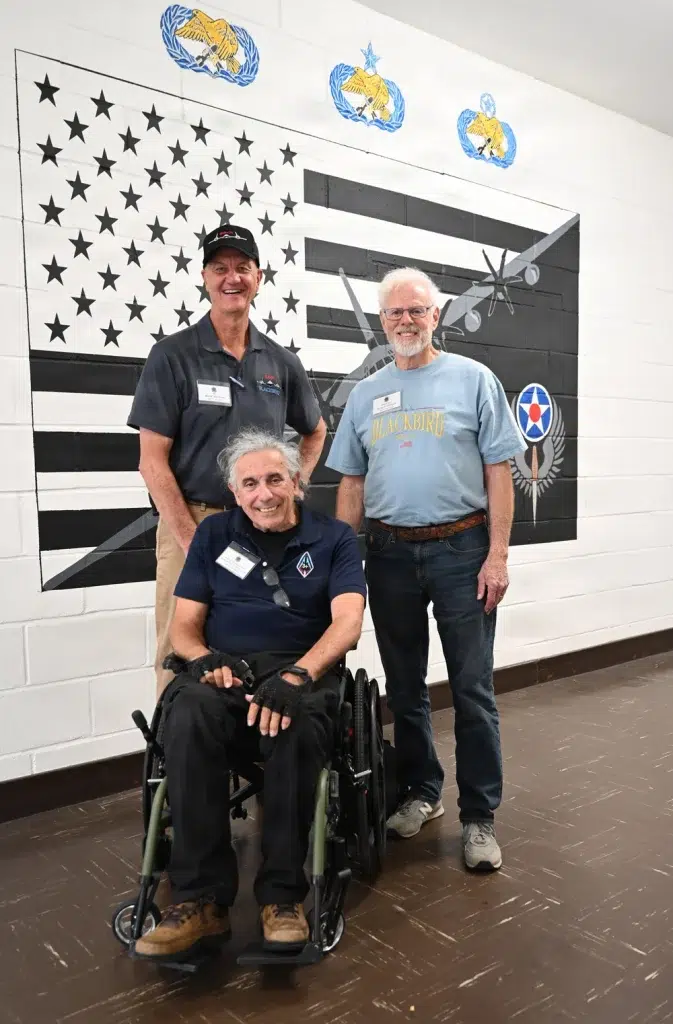
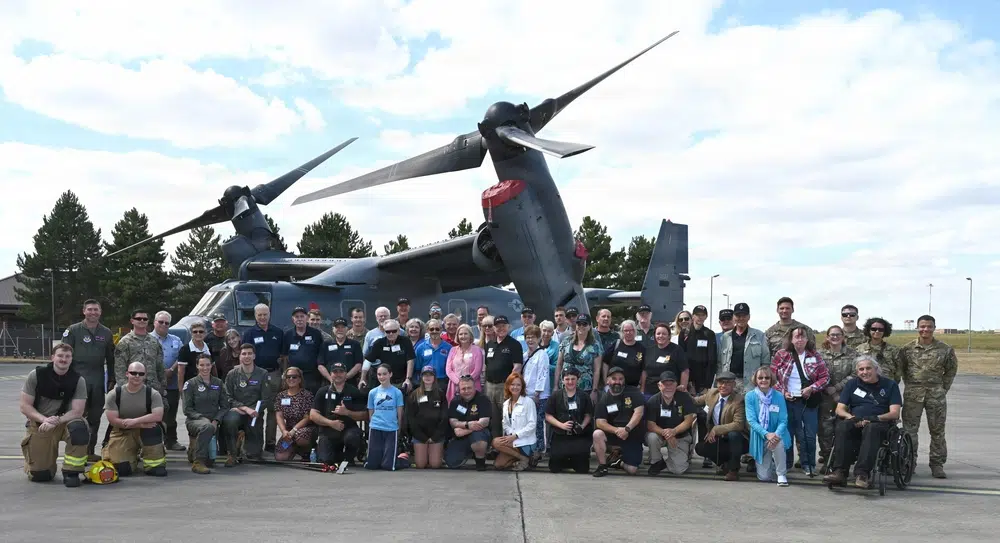
Veterans who flew, maintained, and planned missions for the legendary Mach 3 reconnaissance aircraft returned to the English base that became one of the Blackbird’s most recognizable Cold War homes. More than three decades after the unmistakable shape of an SR-71 Blackbird last departed RAF Mildenhall, some of the people who made those extraordinary flights possible have returned. On July 27, 2026, former SR-71 pilots, aircrew, maintainers, and intelligence personnel gathered at the base in Suffolk, England, as the U.S. Air Force marked the 50th anniversary of the Blackbird’s association with Mildenhall. Joined by family members and representatives of the RAF Sculthorpe Heritage Center, the veterans received briefings on today’s missions, toured the base, and revisited hangars where they had once worked.

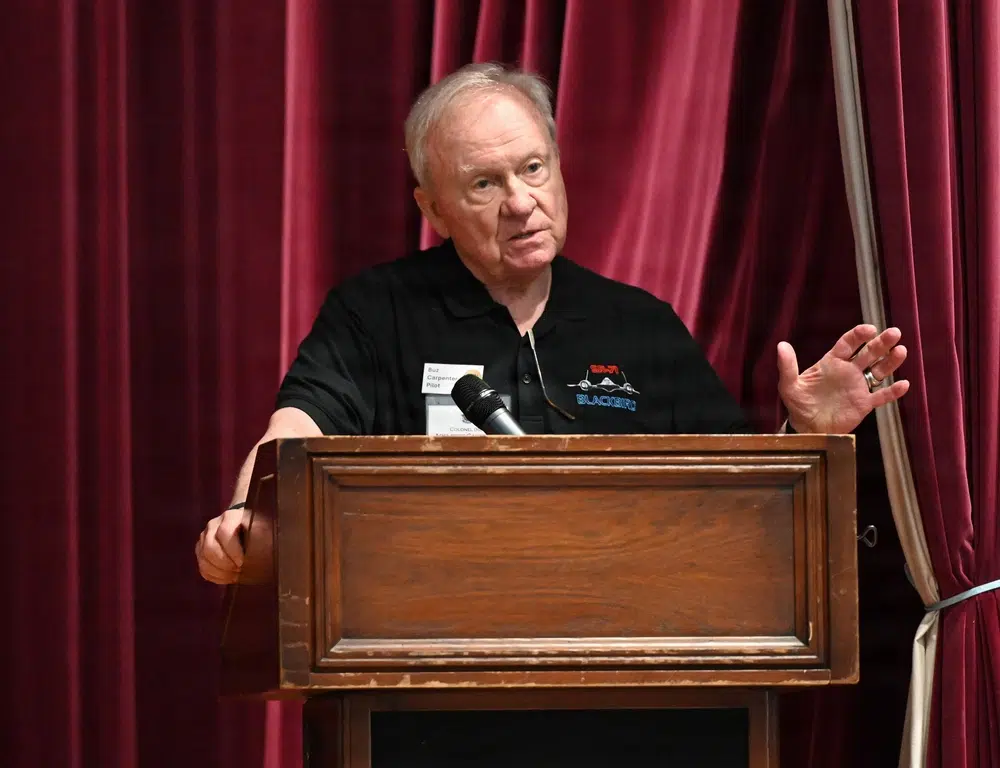
For a generation that remembers the Cold War, the SR-71 needs little introduction. Capable of sustained flight above Mach 3 and at altitudes exceeding 80,000 feet, Lockheed’s extraordinary reconnaissance aircraft became an icon of American aviation technology. But the reunion at Mildenhall was less about numbers than people. Among those returning was retired Col. Adelbert “Buz” Carpenter, a former SR-71 pilot and instructor whose career included one of the more remarkable missions flown by a Blackbird from British soil.
The Blackbird Comes to Mildenhall
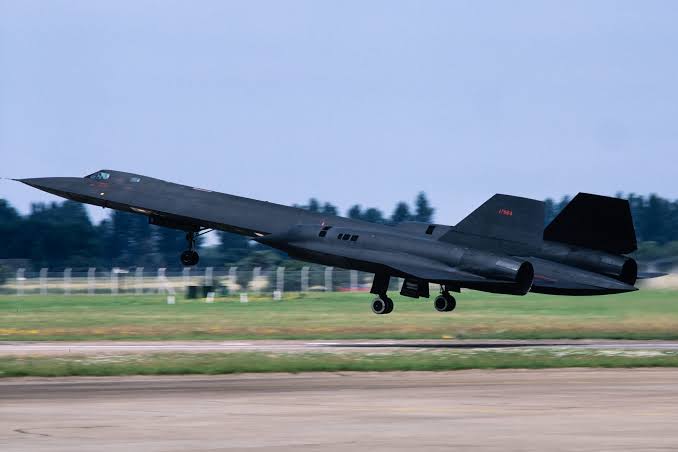
Mildenhall’s connection with the SR-71 actually predates the anniversary being commemorated. In September 1974, Maj. James Sullivan and Maj. Noel Widdifield brought an SR-71 to England after setting a New York-to-London speed record of 1 hour, 55 minutes and 42 seconds, averaging 1,817 mph. It was the Blackbird’s first visit to Mildenhall. The relationship soon became operational. RAF Mildenhall’s official history records that the SR-71 returned on April 1, 1978, when Detachment 4 of the 9th Strategic Reconnaissance Wing moved to the base to oversee temporary deployments of SR-71 and U-2 reconnaissance aircraft. On April 5, 1982, the British government approved the permanent basing of two SR-71s at Mildenhall. From there, the Blackbird became so closely associated with the base that RAF Mildenhall’s own history notes that the aircraft came to symbolize Mildenhall in the public eye. Carpenter was one of the select few who knew the aircraft from the cockpit. A 1967 U.S. Air Force Academy graduate, Carpenter flew RF-4C reconnaissance missions during the Vietnam War before entering the SR-71 program. His first Blackbird flight came on July 9, 1976, and he went on to fly more than 60 operational missions. One of them would become his most memorable.
Nine Hours and 45 Minutes
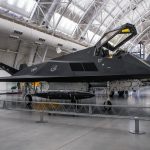
In March 1979, conflict between Saudi Arabia and Yemen created an urgent demand for intelligence. An SR-71 mission was ordered for President Jimmy Carter, and Carpenter and his reconnaissance systems officer were tasked with flying deep into the Middle East from RAF Mildenhall. The aircraft was SR-71A 61-7972 — the same Blackbird preserved today at the Smithsonian’s Steven F. Udvar-Hazy Center. The political stakes were unusually high. Carpenter later told the Smithsonian that the flight represented the first time the British government had approved launching an SR-71 mission from the United Kingdom, flying it into the Middle East and then recovering it back in Britain. Previous concerns had included the possibility of retaliation against Britain in the form of an oil embargo.
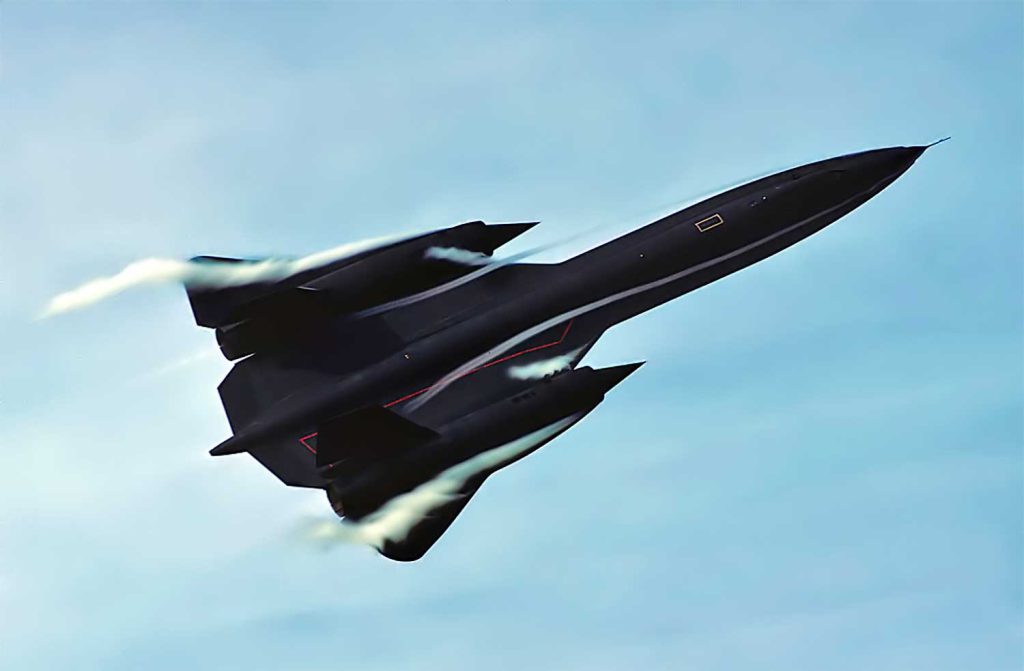
The importance of the mission was reflected in the briefing room. Carpenter recalled senior U.S. and Royal Air Force leadership being present along with Britain’s MI5 and MI6 leadership and the deputy U.S. ambassador. President Carter, Carpenter said, monitored the mission from the White House. Then came another complication: France would not permit the SR-71 to cross its airspace. The Blackbird may have been able to outrun virtually anything sent after it, but it could not outrun diplomacy. Instead of taking the shorter route across France, Carpenter’s aircraft had to fly west and south around Portugal and Spain before passing through the Strait of Gibraltar and entering the Mediterranean. What might have been roughly a seven-and-a-half-hour flight became a nine-hour, 45-minute mission requiring five aerial refuelings. That detail alone illustrates something easily lost in the mythology surrounding the SR-71. The Blackbird’s spectacular speed depended on an enormous support operation. Tankers carrying its specialized JP-7 fuel had to be positioned along the route, and each rendezvous had to work.

For Carpenter and his crew, it did. The SR-71 crossed the Arabian Peninsula and gathered the required intelligence. Carpenter later recalled that the nose camera provided a view approximately 72 miles wide. After 61-7972 returned to England, its film was placed aboard a waiting aircraft and flown across the Atlantic to Washington for processing. “We collected all the intelligence the decision-makers needed in a single mission,” Carpenter later told the Smithsonian. He would ultimately fly ten operational missions in 61-7972, logging more than 67 hours in that aircraft alone.
The People Behind Mach 3
Carpenter was only one part of the story represented at the 2026 reunion. Retired Master Sgt. Robert Butterfield, a former SR-71 crew chief, returned to Mildenhall, as did retired Maj. Robert Rieser, who served as an intelligence officer with Detachment 4. From 1982 to 1986, Rieser was chief of the detachment’s collection management branch. His job included building sensor actions into SR-71 flight paths, scheduling missions and coordinating theater and national intelligence-collection requirements.
At the reunion, Rieser held up computer data cards once used with the aircraft’s astro-inertial navigation system — small artifacts from an era when a reconnaissance aircraft traveling more than three times the speed of sound navigated without the GPS technology pilots now take for granted. Another returning veteran, retired Lt. Col. Thomas Veltri, reminded the audience how quickly a Blackbird mission could become dangerous. Veltri, a former SR-71 reconnaissance systems officer, recalled a mission over the Baltic in which the aircraft suffered a catastrophic engine failure and began losing altitude. According to the Air Force’s account of his remarks, Soviet fighters attempted to intercept the stricken Blackbird before Swedish fighters came to its aid, escorting the aircraft toward allied airspace. The crew eventually landed safely in Germany. These were the stories behind the airplane’s almost mythical reputation — stories involving not only speed records and titanium but crews making decisions thousands of feet above hostile territory and maintainers, tanker crews, intelligence specialists and mission planners working to bring them home.

Returning to Mildenhall
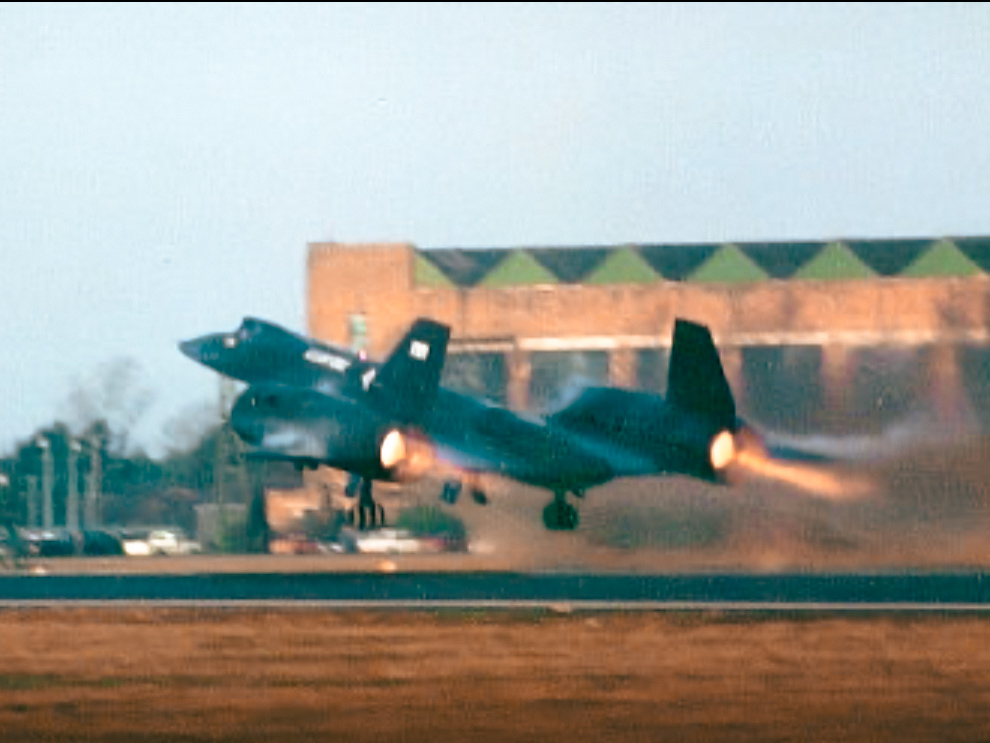
The SR-71’s Mildenhall chapter eventually came to an end. The last Blackbird departed the base on January 18, 1990, closing an operational presence that had made the aircraft one of the most recognizable symbols of RAF Mildenhall during the final years of the Cold War. Thirty-six years later, the airplane itself was absent when its veterans returned. Its memories were not. The men who once launched, flew, maintained and planned missions for the Blackbird walked through their old hangars and shared their experiences with today’s generation of Mildenhall Airmen and civilians. The SR-71 is remembered for astonishing statistics: Mach 3-plus, altitudes above 80,000 feet and speed records that remain impressive half a century later. Yet perhaps the most compelling legacy of the Blackbird cannot be measured in miles per hour. It is found in stories like Carpenter’s nearly ten-hour flight around closed French airspace, Rieser’s carefully planned reconnaissance routes and Veltri’s crippled Blackbird descending over the Baltic. Fifty years later, the aircraft remains legendary. The reunion at Mildenhall offered something increasingly valuable: a chance to hear the history from the people who actually lived it.


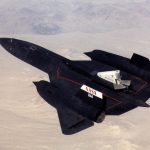






Hate to rain on the SR-71 parade but the photo of the one Blackbird flying over the mountains is not an SR-71, it’s a YF-12A. You can tell by the overly round nose and the fact that the chines do not extend all the way to the tip of the nose.
The YF-12A had an overly round nose and shortened chines in order to accommodate the fire control radar necessary for the missile control system.
Another difference – you can just make out a small vertical fin underneath the right engine. This fin and a corresponding fin underneath the left engine were added to the YF-12A in order to maintain directional stability when the chines were shortened at the nose.
Note that under related articles there is one that says, “Flight Test Files: Lockheed YF-12”, and if you look close you can see the fin underneath the right engine.
I would like to shake these men’s hands. They are the epitome of “rarefied air”. Ultimate respect.
Kadena I got to see the black bird in 1970-72 blew me away awesome sight.
We first saw … ‘The Blackbird’ … sometime in 198?, at R.A.F/U.S.A Mildenhall; an Open Day / Flying Display.
I couldn’t but help think ….. If we’re seeing it here, in Public, what is the New, Top Secret, HOT-ROD!!!