






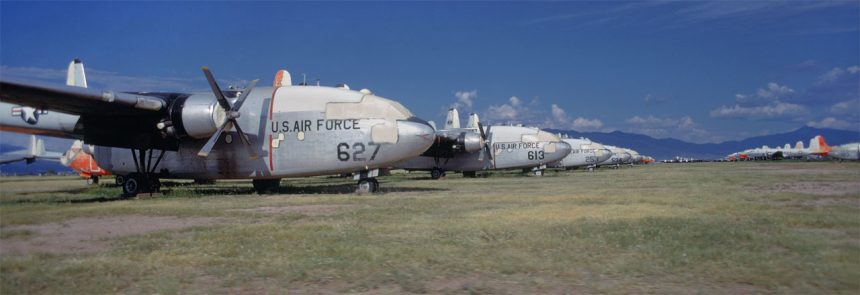

As we continue the Boneyard Files series, which showcases some of the retired aircraft resting at Davis-Monthan Air Force Base in Tucson, Arizona, in the late 1960s, today’s story features the Fairchild C-119 Flying Boxcar through the lens of Neil Aird’s “Monthan Memories” photos. The C-119 Flying Boxcar was developed soon after WWII to carry heavy cargo, transport paratroopers, tow mechanized equipment, or move medical patients. The first C-119 prototype, the XC-82B, flew for the first time in November 1947, and deliveries began in December 1949. To improve pilot visibility, the C-119 cockpit was moved to the front of the aircraft, flush with the nose rather than over the cargo area. It made the fuselage longer, which provided more usable cargo space than the C-82 could carry. The Fairchild C-119 Flying Boxcar was equipped with more powerful engines than its predecessors, which provided 60% more power than the C-82 aircraft. Over its service life, the C-119 was updated several times. The first model, the C-119A, had a basic design and was powered by two Pratt & Whitney R-4360-20W 28-cylinder air-cooled radial engines, each producing 3,500 horsepower. It was fitted with two 15-foot-diameter four-bladed Hamilton-Standard Hydromatic propellers. The C-119B model included stronger structures and aerodynamic improvements for better performance. The C-119C had an even stronger fuselage and better navigation and communication systems.
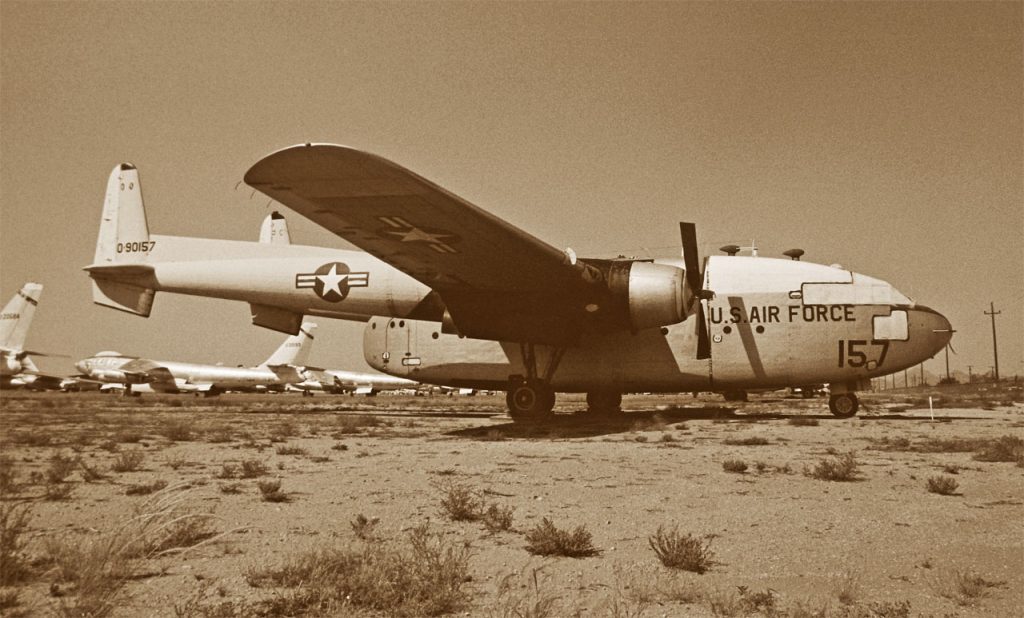
In addition to a crew of five, including a pilot, co-pilot, navigator, radio operator, and crew chief, the C-119C could carry 67 troops or 35 stretchers or 27,500 pounds of cargo. It was 86.6 feet long, 26.6 feet high, with a wingspan of 109.3 feet and a wing area of 1,447 square feet. The empty weight of the aircraft was 39,800 pounds, the gross weight was 64,000 pounds, and the maximum takeoff weight was 74,000 pounds. The maximum speed of the C-119C was 281 mph at 18,000 feet, and the cruise speed was 200 mph. The range of the aircraft was 1,770 miles while carrying a 5,500-pound payload, and the service ceiling was 23,900 feet. Later, a new version of the Fairchild C-119 Flying Boxcar, the C-119F, was equipped with more powerful Wright R-3350 Duplex-Cyclone twin-row, supercharged, air-cooled radial engines to improve payload capacity and fuel efficiency. The C-119G, one of the final major production variants, with 484 built, was fitted with strengthened landing gear and structural upgrades to improve its effectiveness in bad weather and during night operations. The C-119J Flying Boxcar achieved a milestone by being the first aircraft to catch an object from space. In August 1960, it captured the Discoverer XIV satellite using recovery equipment that was lowered from the open rear door. This equipment snagged the satellite’s parachute, and a winch slowly pulled the film capsule into the plane. “Satellite catching” became an important US Air Force operation for recovering secret reconnaissance satellite film. Later, the C-119K was fitted with additional jet engines to improve takeoff performance and overall flexibility.
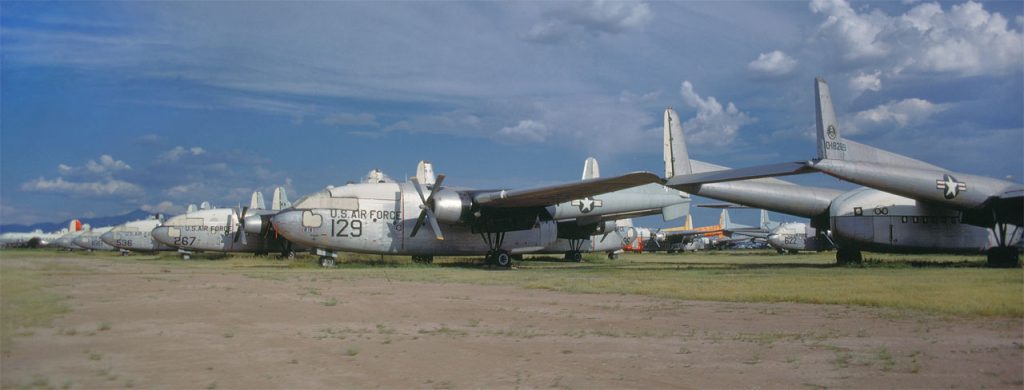
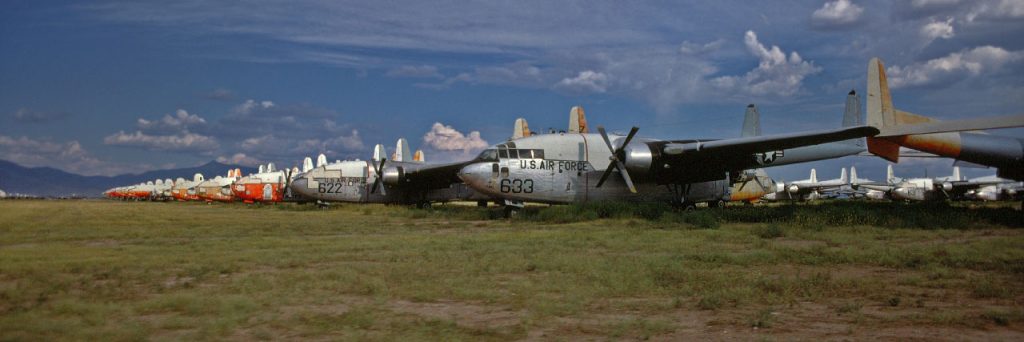
In terms of operations, the Fairchild C-119 Flying Boxcar played an important role in the Korean War by transporting troops and supplies. The most important airlift mission in Korea happened in 1950, when the US Air Force C-119B planes dropped bridge sections to US troops trapped by enemy forces at the Chosin Reservoir. The sections replaced a destroyed bridge over a deep gap, and helped thousands of soldiers and Marines to escape. The Flying Boxcars also served as gunships in the Southeast Asia War, providing support to ground forces. During the Vietnam War, the US Air Force modified the C-119 to create the AC-119G, a gunship designed for attack with four side-firing 7.62-mm miniguns mounted on the fuselage. A total of 1,150 Fairchild C-119 Flying Boxcars had been built by the time its production ended in 1955. In addition to the US, foreign countries such as Belgium, Brazil, Canada, Ethiopia, France, India, Italy, Jordan, Morocco, Norway, Spain, Vietnam, and Taiwan used the C-119. In civilian use, several companies that work for the federal government, including the United States Forest Service and the Bureau of Land Management, purchased aircraft to use as airtankers to fight wildfires. The US Air Force began retiring early versions of C-119 Flying Boxcar in the mid 1960s. In the late 1960s, some retired Fairchild C-119 Flying Boxcars were also spotted at Davis-Monthan Air Force Base, known as “The Boneyard.” Read more Boneyard Files Articles HERE.











Would really like to see pictures of the scrapping operations: cutting up, smelting, etc. Any and all types of the military aircraft that were held at the boneyard. Please consider .