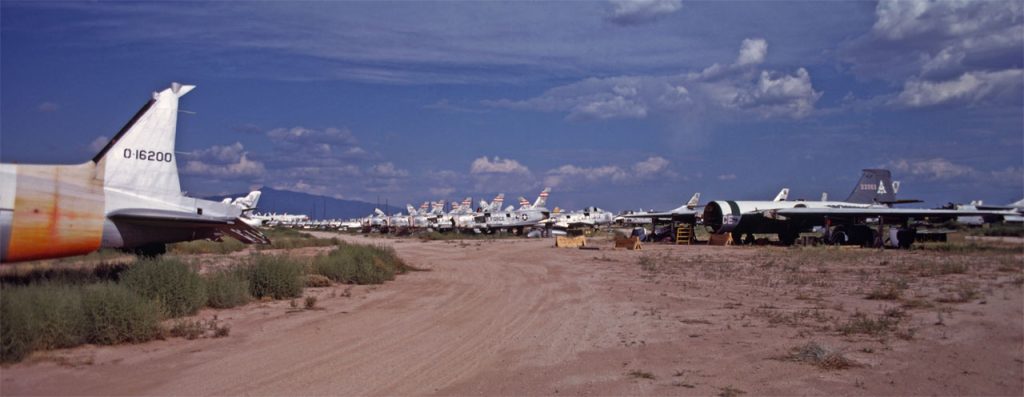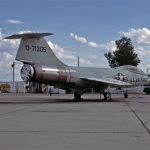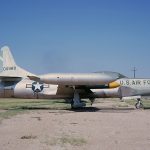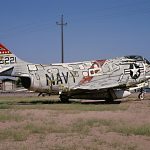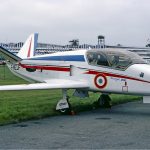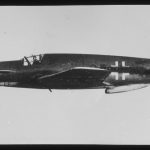
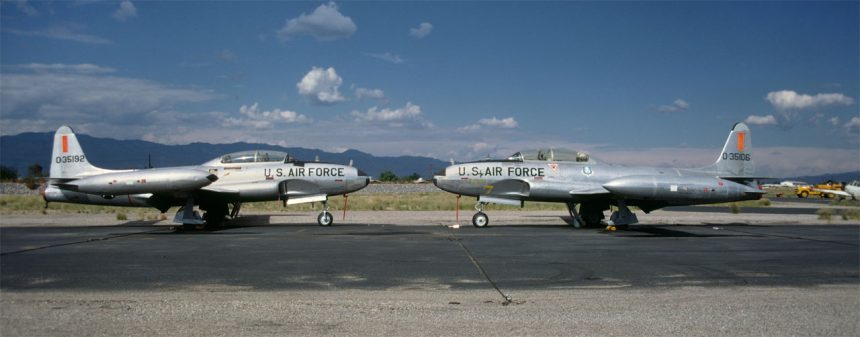

As we continue the Boneyard Files series, which showcases some of the retired aircraft resting at Davis-Monthan Air Force Base in Tucson, Arizona, in the late 1960s, today’s story features the Lockheed T-33 Shooting Star through the lens of Neil Aird’s “Monthan Memories” photos. In May 1947, Lockheed decided to develop a two-seat trainer called the Model 580 in response to rising accident rates with the P-80 accidents. Three months later, the US Air Force approved the use of a P-80C airframe to build the TP-80C prototype. To fit an instructor behind the pilot, Lockheed made the fuselage longer by adding a 26.6-inch section in front of the wing and a 12-inch section behind it. The company also reduced the size of the fuel tank in the fuselage and added wingtip tanks for extra fuel, which became standard on the plane. To save weight, the engineers reduced the built-in armament to two .50-caliber machine guns. The resulting aircraft, the Lockheed T-33 Shooting Star (originally called the TF-80C), first flew in 1948.
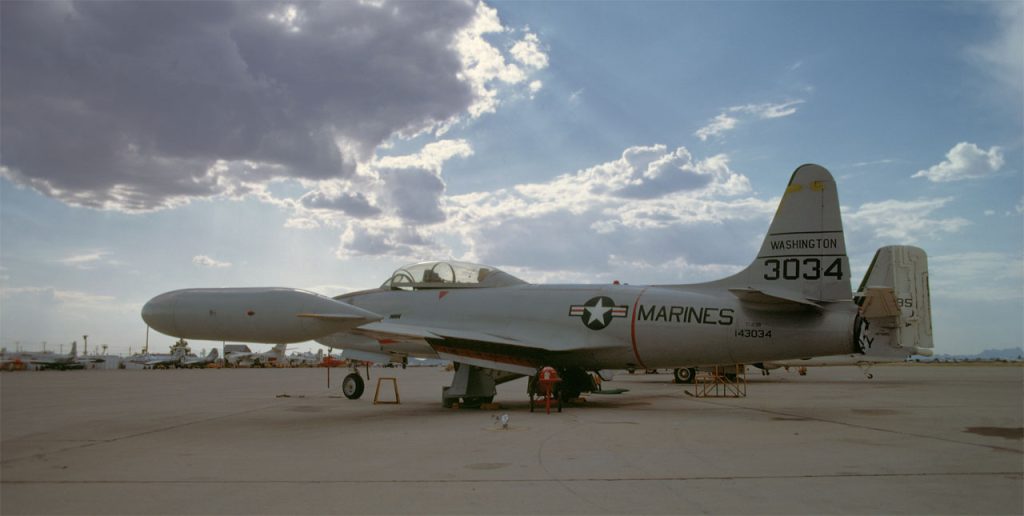
The USAF initially ordered 20 aircraft, and by 1959, a total of 5,691 Lockheed T-33 Shooting Stars were built. The aircraft was 37.8 feet long, 11.7 feet high, with a wingspan of 37.6 feet and a wing area of 234.8 square feet. The maximum speed of the aircraft was 525 mph, and its cruise speed was 455 mph. It was powered by an Allison J33-A-35 centrifugal-flow turbojet engine, producing 5,400 pounds of thrust at takeoff with water injection and 4,600 pounds in continuous dry operation. The range of the aircraft was 1,000 miles, and the service ceiling was 45,000 feet. Its empty weight was 8,365 pounds, its gross weight was 12,071 pounds, and its maximum takeoff weight was 15,061 pounds. The T-33 was mainly used as a trainer, but could also direct drones and tow targets, and in some countries, it had even been used in combat. The RT-33A was a special reconnaissance version with a camera in the nose and extra equipment in the rear cockpit, designed primarily for foreign use. The Lockheed T-33 was the only jet trainer in the US Air Force inventory from 1948 until the Cessna T-37A arrived in 1957 and the Northrop T-38A in 1961.
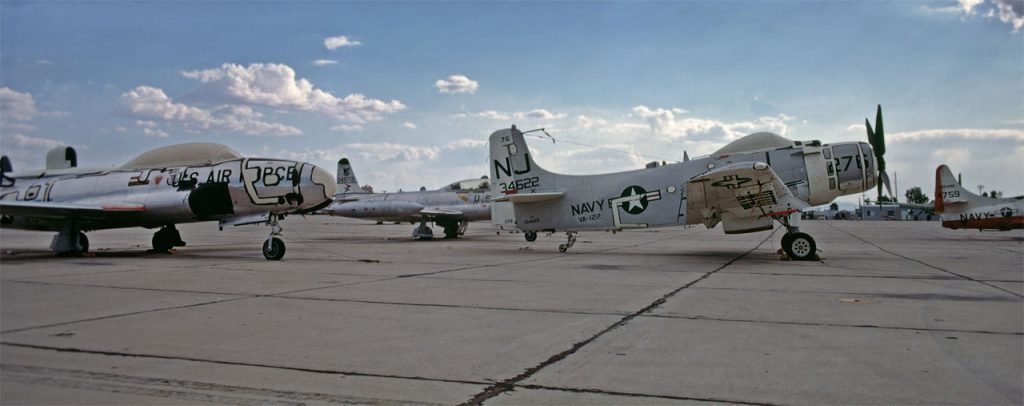
In the early 1950s, Canada began training its own aircrews and several thousand Allied personnel as part of NATO’s expansion. To support the jet training phase, Canada received 20 T-33A-l-LOs and borrowed an additional 10 from the US Air Force. The borrowed planes were later returned to the US Air Force or sent to Greece and Turkey when the Royal Canadian Air Force chose a Canadian-made version of the Lockheed T-33 Shooting Star. Canada began building its own T-33A aircraft in 1951 and flew the first one on November 27 of that year. It was powered by a Rolls-Royce Nene 10 engine, which produced 5,100 pounds of thrust, and was called the T-33A Silver Star Mk. 3 (also known as CL-30). Soon, countries like France, Greece, Portugal, Turkey, and Bolivia began using these Canadian-built T-33s. Additionally, Japan started producing its own T-33s on July 1, 1954. The Lockheed T-33 Shooting Star was popular with foreign air forces, not just in Canada and Japan. At least 1,058 Lockheed-built T-33s were sent to various nations through the Mutual Defense Aid Program; others came directly from the USAF inventory overseas. The Lockheed T-33 Shooting Star was also used as a combat aircraft during conflicts in several countries.
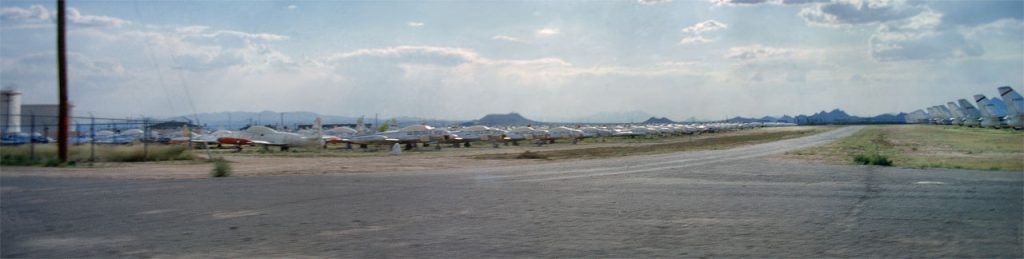
One interesting use of the T-33 occurred outside the US when Aérospatiale built a Canadian version of the wing to test a new “super-critical” wing design. The flight trials for this test wing started on April 13, 1977, and continued until 1979 or 1980. NASA used four Lockheed T-33A jet trainers for flight research from 1958 to 1973. The first T-33A arrived at the NACA High Speed Flight Station on February 5, 1958, and left for storage at Davis-Monthan AFB in Arizona on September 20, 1961. The second T-33A arrived at the NASA Flight Research Center on April 25, 1961, but was later sent to storage at Davis-Monthan AFB on May 31, 1961. The third T-33A arrived at NASA Flight Research Center on June 2, 1961, but was destroyed in a non-fatal crash on December 26, 1962. And the fourth T-33A, also known as NASA 815, arrived at NASA Flight Research Center on January 9, 1963. It was used for a monocular vision study and left on September 10, 1973, for Redding, California. In the early 1980s, several air forces, including the US Air Force, retired the Lockheed T-33 Shooting Star. Some of these planes were transferred to the US civilian register. In the late 1960s, some retired Lockheed T-33 Shooting Stars were also spotted at Davis-Monthan Air Force Base, known as “The Boneyard.” Read more Boneyard Files Articles HERE.