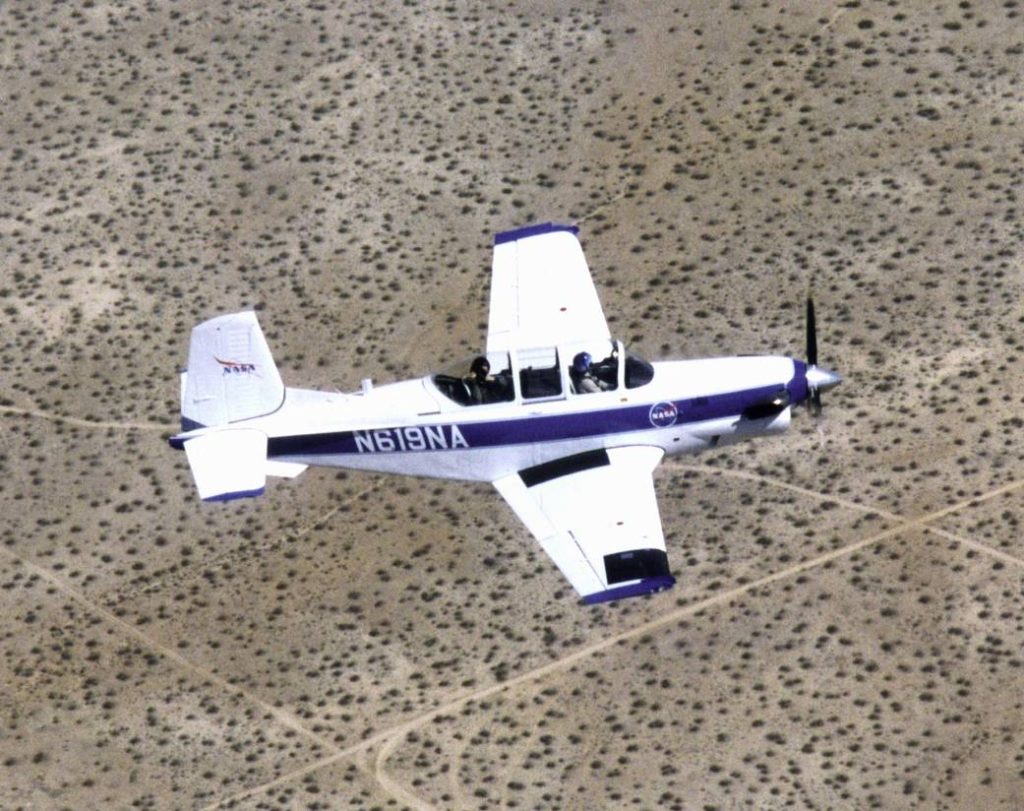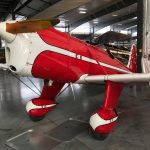
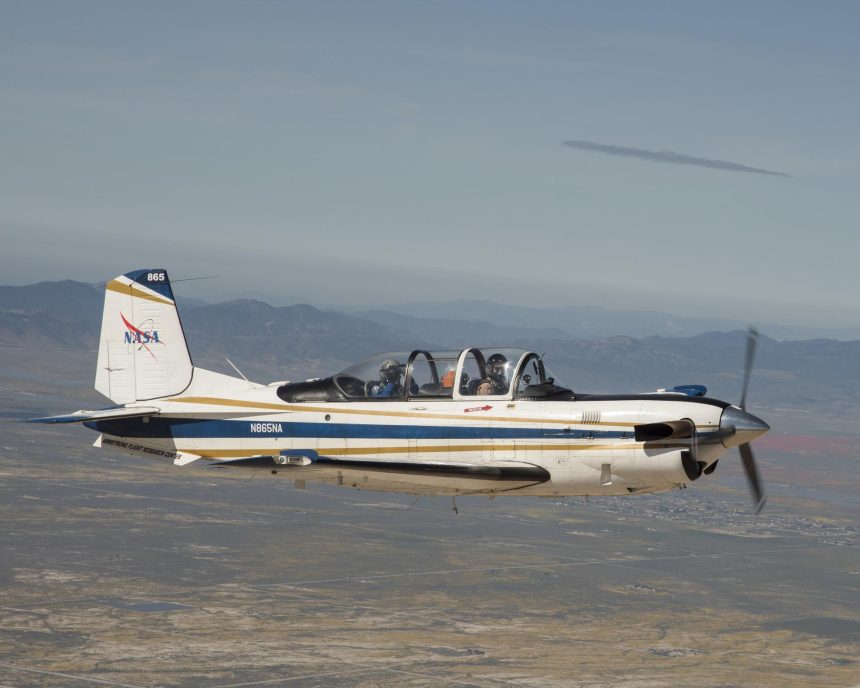

As the age of unmanned aerial systems arrived at NASA, when it conducted major projects from 2011 through 2020 and continues to mature autonomous flights today, a training plane helped the organization validate detect-and-avoid (DAA) technology. The T-34C Mentor, an unpressurized, tandem cockpit, low-wing, single-engine, propeller-driven monoplane, first arrived at NASA’s Armstrong Flight Research Center (then called NASA Dryden Flight Research Center) in Edwards, California, in 1996 after serving at NASA’s Glenn Research Center in Ohio for propulsion experiments involving turboprop engines. The military used the two-seat aircraft as a trainer, with the instructor pilot in the back seat and the student in the front. At NASA, working as a chase plane, the back seat was occupied either by a photographer or a flight engineer for data on research missions. NASA returned the first T-34C Mentor to the US Navy in 2002, and the Dryden Flight Research Center received another one in early 2005, where it remains in service to this day. Built by Beech Aircraft Corporation, later part of Raytheon Aircraft, the T-34C is 28.6 feet long and 9.7 feet high, with a wingspan of 33.4 feet. The aircraft shares a similar wing planform and landing gear as the civilian Beechcraft Bonanza series aircraft from which it was derived. Its empty weight is 3,000 pounds, and the maximum takeoff weight is 4,400 pounds. It is primarily used as a low-cost research testbed for low- to medium-altitude flight systems and experiments. Flight tests and verification of avionics and sensor systems were other major missions of the aircraft. The T-34C was also used as a slow-speed safety and photo chase aircraft.
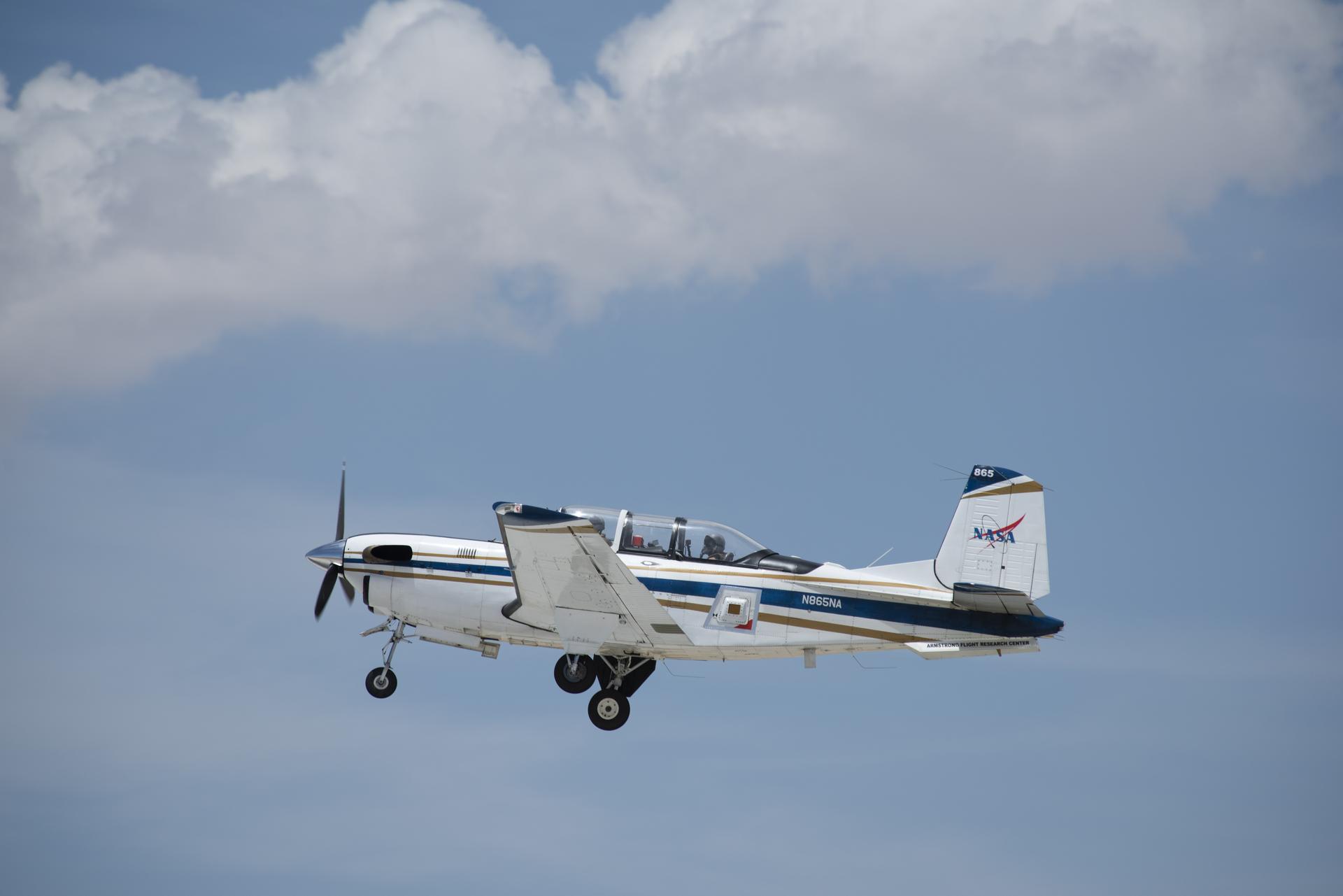
Nicknamed the Turbo Mentor, the T-34C Mentor aircraft has a maximum speed of 320 mph with a cruise speed of 257 mph at 17,500 feet. The aircraft’s maximum altitude is 25,000 feet, with a maximum rate of climb of 1,500 feet per minute. Powered by a Pratt & Whitney PT6A-25 turboprop engine producing 550 horsepower, the T-34C could carry a payload of 1,300 pounds at 600 nautical miles range. At NASA’s Armstrong, one of the major missions the T-34C conducted was to chase remotely piloted unmanned air vehicles that fly slower than the NASA F-18 mission support aircraft. The T-34C was used as a support aircraft to test DAA technology in unmanned aircraft systems. According to NASA, a DAA system uses a suite of sensors, trackers, detection algorithms, and a display to provide the remotely located pilot with sufficient awareness to avoid a loss of separation with other aircraft. In April 2016, NASA Armstrong started flying the T-34C as an “intruder” in a series of flight tests to integrate unmanned aircraft systems into the national airspace. The T-34C Mentor was one of six aircraft used in a test to help a drone operate safely. It carried Automatic Dependent Surveillance-Broadcast (ADS-B) and Traffic Alert and Collision Avoidance System (TCAS) I. The T-34C’s job was to fly at a set distance from NASA Armstrong’s Ikhana drone along a specific route. The test aimed to evaluate the systems that help the drone’s pilot on the ground detect nearby aircraft and stay aware of their surroundings, ensuring they can keep a safe distance.
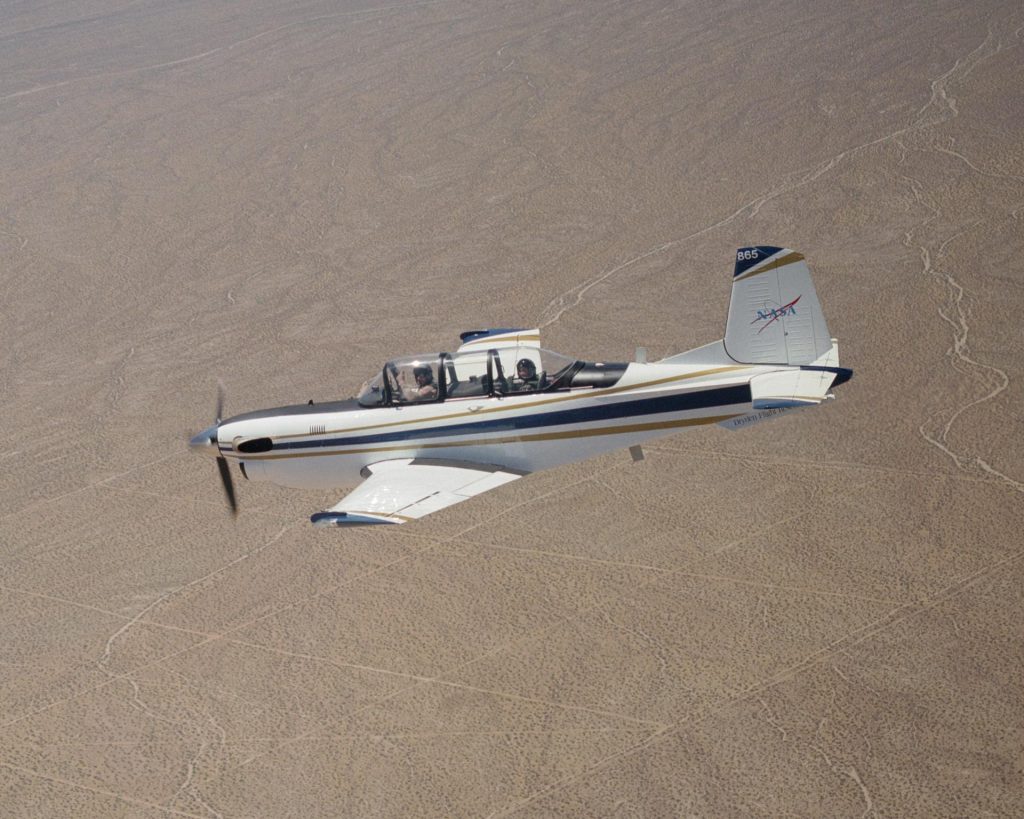
The tests showed positive results and matured the DAA technology. With only two T-34C Mentors ever serving at NASA’s Armstrong, the aircraft did not undertake many missions or demonstrate new heroic concepts. Rather, it was more of a team player that proved useful whenever and wherever the engineers needed it. In the Flight Test Files series, the T-34C Mentor stands as an aircraft that trained thousands of US Navy, Marine Corps, Coast Guard, and international student pilots between 1977 and 2012, and helped NASA prove several concepts, including helping to usher in the age of unmanned flight as we see it now. “If only these aircraft could talk and tell us about the thousands of pilots who took their first flights in the T-34C Mentor: the anxiety, fear, fright, and excitement,” said Marine Colonel James Grace on the occasion of the airplane’s retirement in 2012. Read more Flight Test Files articles HERE.