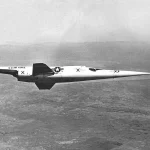
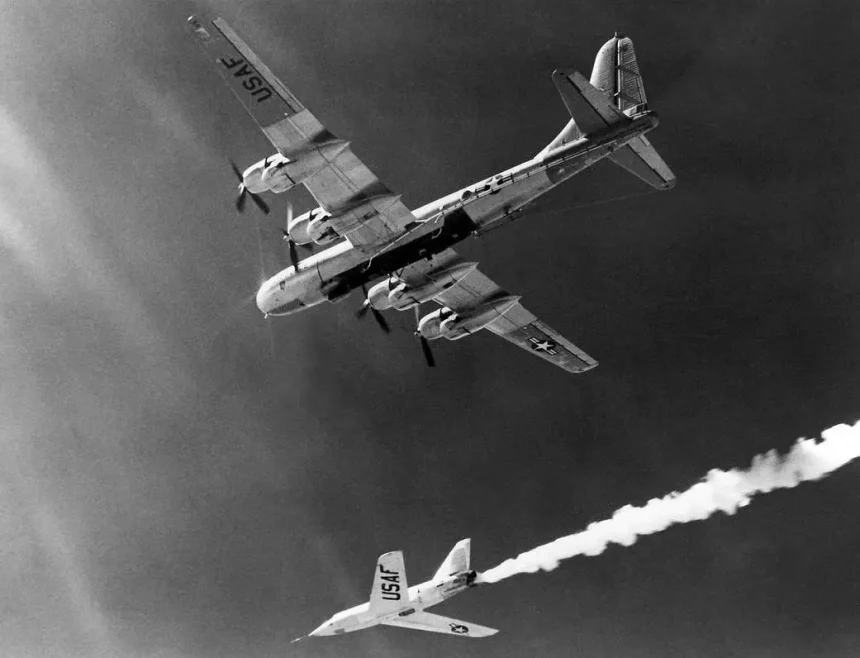

In 1945, the National Advisory Committee for Aeronautics (NACA, now NASA), the US Air Force, and Bell Aircraft Corporation wanted to explore the aerodynamic problems of supersonic flight. The program also intended to expand the speed and altitude ranges achieved with the earlier X-1 series of research aircraft. The Bell X-2, which was a rocket-powered research aircraft, was built to study flight at very high speeds and altitudes. Before the aircraft flew, NACA began testing scale models of the X-2, and in 1946, the NACA Pilotless Aircraft Research Division tested X-2 models from Wallops Island, Virginia, to gather stability and control data. The NACA also tested the aircraft in spin tunnels and supersonic wind tunnels at the Langley Memorial Aeronautical Laboratory in Hampton, Virginia, to evaluate various aspects of the X-2 design. Two X-2 aircraft, nicknamed “Starbuster,” were built using K-monel (a copper-nickel alloy) and stainless steel. The aircraft were powered by a two-chamber Curtiss-Wright XLR25 throttleable liquid-fueled rocket engine, which produced a variable thrust range of 2,500 to 15,000 pounds. The X-2 Starbuster also carried an unusual escape system. In an emergency, the entire nose section of the aircraft would separate from the fuselage and deploy a parachute, and then the pilot would exit the escape capsule once it reached a lower altitude. The X-2 was built to be carried to altitude by a modified Boeing B-50 bomber, in an arrangement where the aircraft would have been attached beneath the bomber’s wing and carried to about 30,000 feet.
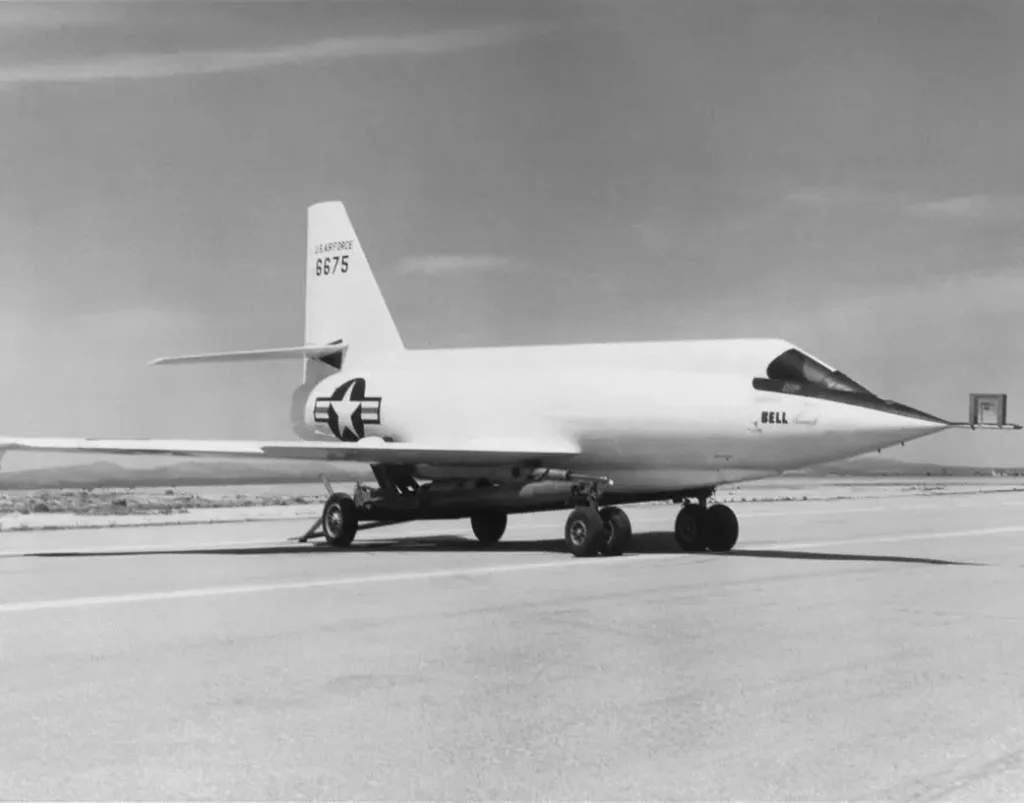
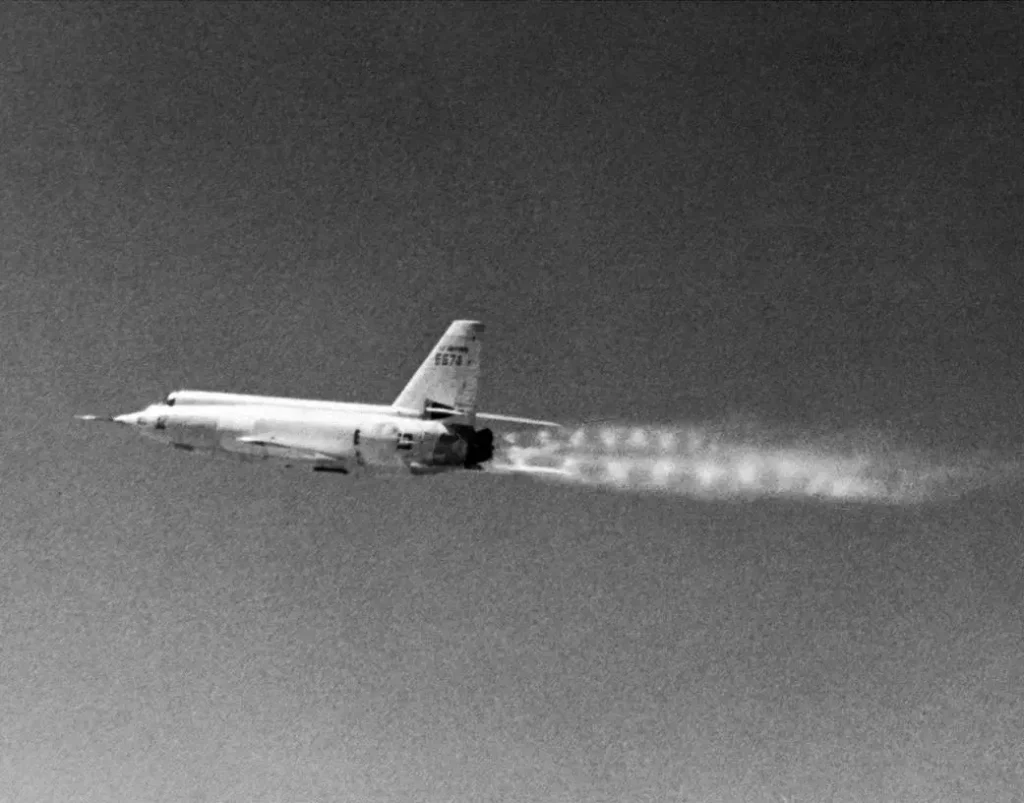
On April 22, 1952, the X-2, airframe 46-675, was first delivered to Edwards for glide testing, while engine work was being undertaken on the other X-2 Starbuster, airframe 46-674. After two captive flights beneath the B-50, Bell test pilot Jean Ziegler made the first glide flight on June 27, 1952, in which a hard landing caused damage to the aircraft. The next glide flight took place on October 8, followed by another successful glide flight two days later, flown by Air Force test pilot Major Frank “Pete” Everest. After these tests, the aircraft was returned to Bell for further work. On May 12, 1953, during a flight to check the liquid oxygen system, an explosion occurred that destroyed the X-2 aircraft 46-675 and severely damaged the B-50 carrier aircraft. Test pilot Ziegler and crew member Frank Wolko were killed, and the X-2 fell into Lake Ontario and was never recovered. A replacement B-50D bomber was later modified to continue the program on which NACA engineers installed instrumentation to measure aircraft performance and handling qualities. The incident left the researchers to conduct testing with the other surviving X-2, airframe 46-674, which received its engine by that time. On August 5, 1954, this X-2 was flown under the B-50 for a captive flight. During its second flight of the day, Lieutenant Colonel Pete Everest successfully glided the X-2 Starbuster but had a rough landing on the lakebed, in which the aircraft sustained minor damage and was sent back to Wheatfield for repairs. The X-2 returned to Edwards on January 16, 1955, and captive flights resumed on February 5 for propellant system checks. The first powered flight attempt occurred on October 25, 1955, but a nitrogen leak forced the mission to continue as a glide flight. A second attempt also ended without ignition. Everest finally took a successful powered X-2 flight on November 18, 1955, igniting only the 5,000-pound-thrust chamber and reaching Mach 0.95.
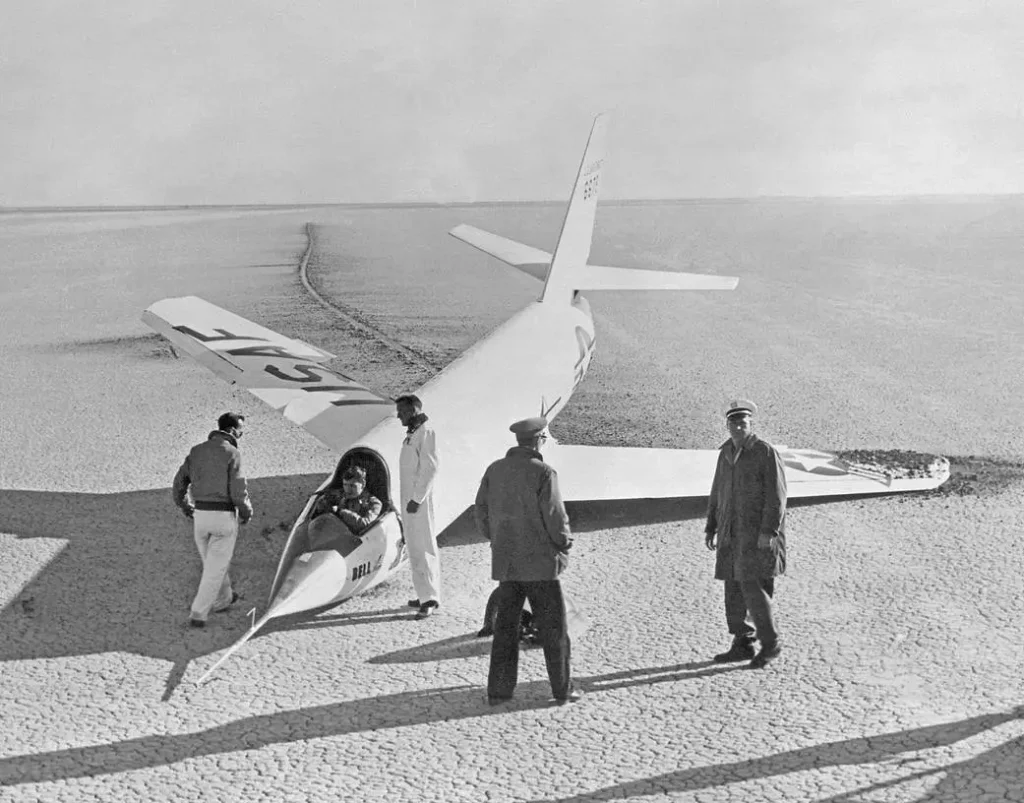
A second powered flight took place on March 24, 1956, this time igniting only the 10,000-pound-thrust rocket chamber. On April 25, 1956, Everest ignited both rocket engine chambers for the first time. The X-2 Starbuster reached Mach 1.40 and climbed to 50,000 feet. Several additional flights in May pushed the aircraft’s speed to Mach 2.53. On May 25, 1956, a new pilot, Captain Iven Kincheloe, made a successful supersonic flight, although a malfunction forced him to shut down the engine early. Modifications were later made to improve engine performance. On July 23, 1956, while gathering data on aerodynamic heating, Everest achieved a speed of Mach 2.87 at 68,000 feet, which earned him the title “Fastest Man Alive.” Kincheloe then assumed the role of X-2 project pilot for high-altitude missions. On August 3, 1956, he successfully reached an altitude of 87,750 feet while gathering stability data. On September 7, Kincheloe reached a record altitude of 126,200 feet, which earned Kincheloe the title “First of the Spacemen.” The record stood until the later flights of the X-15 research aircraft. By September 1956, the Air Force was preparing to transfer the X-2 to NACA for further research. Another pilot, Captain Milburn “Mel” Apt, who had been trained on a ground-based analog computer simulator known as the Goodyear Electronic Digital Analyzer (GEDA), joined the program. On September 27, 1956, Apt flew the X-2 on its most famous mission. The rocket burned slightly longer than expected, and the aircraft reached Mach 3.196, or 2,094 miles per hour. It was the first time a human had flown faster than three times the speed of sound. During the return portion of the flight, Apt began a turn back toward Edwards. The aircraft entered a violent phenomenon known as inertial coupling, in which motion in one axis causes uncontrollable motion in others, and the X-2 tumbled out of control. Apt separated the escape capsule, but he was unable to exit before the capsule struck the ground. Although the X-2 Starbuster program ended with the loss of its final aircraft, it produced valuable information about high-speed flight. In the Flight Test Files series, the program expanded knowledge about aerodynamic heating, stability at extreme speeds, and flight above Mach 3. The data collected during the X-2 Starbuster program helped guide the development of later research aircraft, including the X-15. Read more Flight Test Files articles HERE.