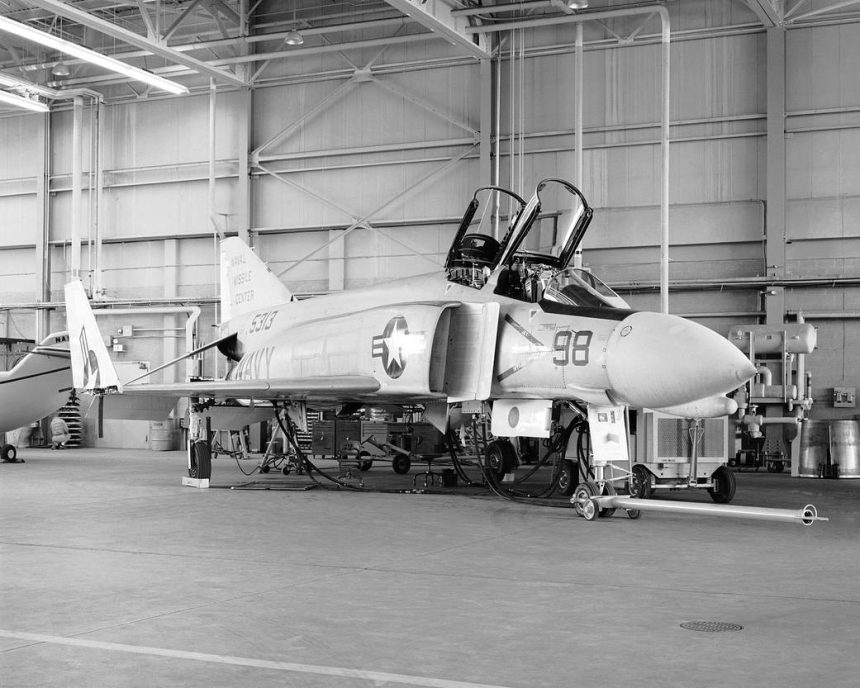

In late 1965, NASA’s Flight Research Center at Edwards Air Force Base acquired a McDonnell F-4A Phantom II, Bureau Number 145313, to conduct several short research programs, including serving as a chase aircraft during X-15 and lifting body flights. During its time at the center, the aircraft flew 55 research support flights. One of the most unusual research projects involving the F-4A focused on biomedical research. The aircraft supported a large monitoring program that studied how pilots reacted physically while flying high-performance aircraft. NASA research pilots and students from the US Air Force Aerospace Research Pilot School participated in the project. During these flights, the pilots were instrumented to record accurate, reliable data on electrocardiogram, respiration rate, and normal acceleration. In another bizarre test in 1966, the F-4A flew with monkeys riding in the second seat. The monkeys were instrumented to collect biomedical data that would be compared with the pilots’ data. The study also included flights in which a human passenger later occupied the second seat, and the results showed that the pilot, who was responsible for flying the aircraft, generally had a higher heart rate than the passenger. The main goal of this study was to gather reliable baseline information on potential astronaut candidates. Along with the 1,000-flight study, the methods and tools developed for this project have been effective and are now widely used in other programs, including monitoring NASA research pilots who fly experimental vehicles, such as the M2-F2 lifting body and the Lunar Landing Research Vehicle.
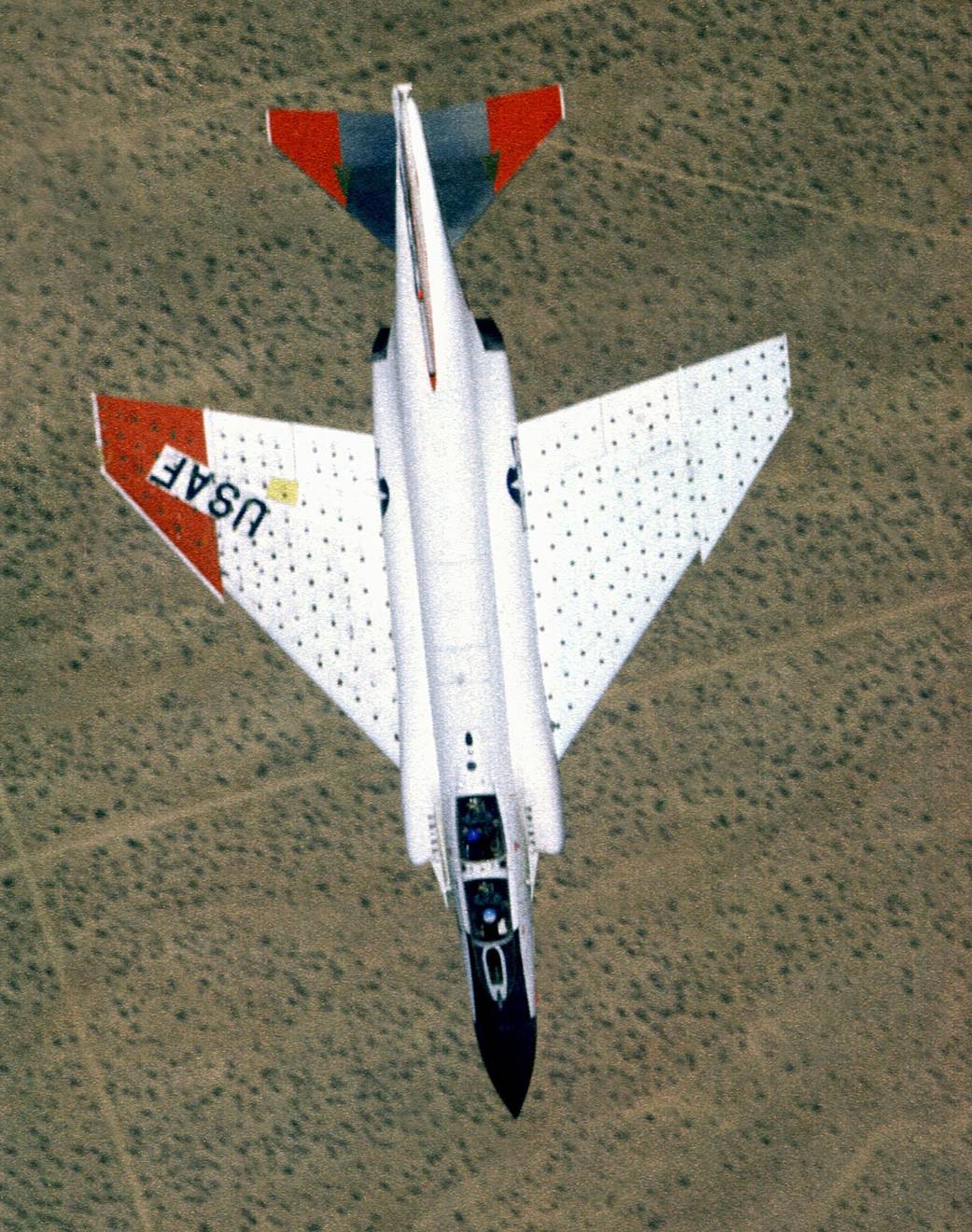
In 1967, the F-4A was involved in a short military project to determine whether an airplane’s sonic boom could be aimed and used as a weapon, or at least as a nuisance. The tests were conducted near Ely, Nevada, over a designated area that was instrumented to record the sonic boom. The aircraft flew repeated supersonic passes over the test range while instruments recorded the pressure waves. The research flights continued until July 25, 1967, when a fuel tank burst during takeoff, leaving a large hole in the aircraft’s wing. The pilot landed the aircraft safely, but the airplane was removed from the program, and the sonic boom tests were completed later using an F-104B Starfighter, serial number 57-1303. NASA used another Phantom variant, the F-4C Phantom II, for a different research program nearly a decade and a half later. The aircraft, serial number 63-7424 and NASA tail number 424, flew between 1983 and 1985 in a spanwise blowing study. The F-4C was a two-seat fighter aircraft powered by two General Electric J79-GE-15 turbojet engines. Earlier tests by the US Air Force and McDonnell Douglas used a J79 engine’s high-pressure compressor bleed air, piped forward along the inside of the fuselage, and expelled through a nozzle near the wing’s leading edge, just above the surface.
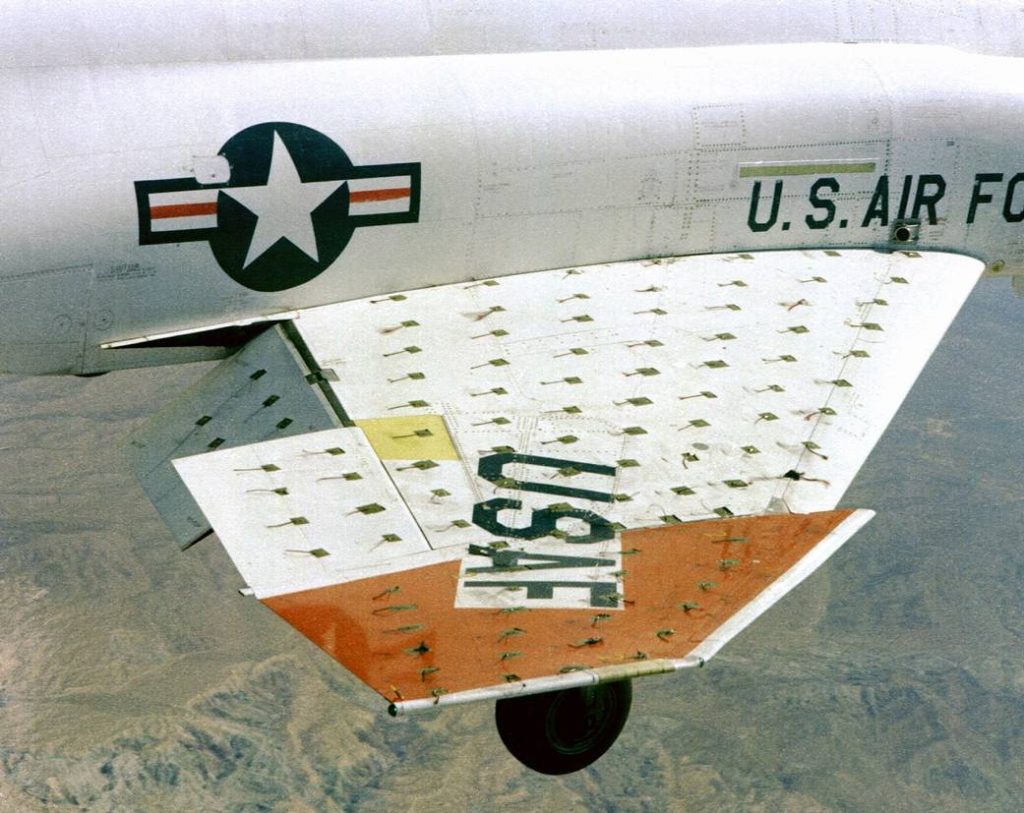
NASA engineers at the Ames-Dryden Flight Research Facility studied how to improve airflow over aircraft wings. The engineers explored extending the airflow from the engines farther out onto the wings’ upper surfaces. The extra airflow could help keep the boundary layer, the thin layer of air close to the wing, energized and maintain smooth (laminar) flow for a longer distance. The concept would delay the transition to turbulent flow, allowing higher lift at steeper angles of attack. To observe the airflow, small strings called “tufts” were attached to the wing’s surface. A chase aircraft photographed these tufts, showing the difference in airflow with and without the extended airflow from the engines. However, calculations showed that the long distance needed to transport air from the engines would reduce the benefits to the boundary layer. As a result, aircraft modifications and flight testing were never performed; only the tufting portion of the program was conducted during the mid-1980s. After the study ended in 1985, the aircraft was returned to the US Air Force. Whether for small but valuable research, such as biomedical research, or for vast testing, including the study of sonic booms and aircraft aerodynamics, the F-4 Phantom II proved to be NASA’s go-to plane. Starting as a chase plane for Titan missiles during Gemini launches and using belly-mounted cameras to film the rocket’s structural integrity during maximum dynamic pressure, to finishing as an aerodynamic research aircraft for spacecraft development, the F-4 Phantom II, in the Flight Test Files series, proved a valuable aircraft in supporting modern aviation. Read about more aircraft that helped NASA advance modern aviation, just like the F-4 Phantom II, HERE.