






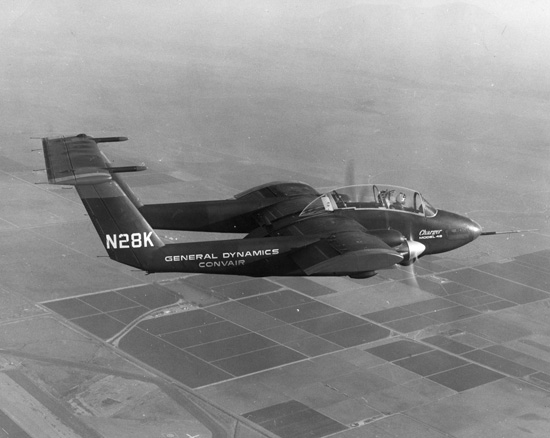


In the 1950s, the US Marine Corps needed an aircraft capable of providing close air support and operating from roads near the battlefield. In 1959, the service developed a new concept for such an aircraft and called it the Light Marine Attack Aircraft (L2VMA). By 1963, the US Army and the US Air Force also felt the need for a similar aircraft for counter-insurgency operations, and a tri-service designation for the L2VMA was changed to Light Armed Reconnaissance Aircraft (LARA). The US military then asked the industry for proposals, and nine companies responded, including the Convair Division of General Dynamics with its Convair Model 48 Charger. The Model 48 was 34.10 feet long, 13.7 feet high, with a wingspan of 30 feet and a wing area of 216 square feet. Its empty weight was 4,457 pounds, and the gross weight was 10,460 pounds. In addition to a crew of two, the aircraft could carry six paratroopers. It was powered by two Pratt & Whitney Canada T74-CP-8/10 turboprop engines, each producing 650 horsepower. The engines drove two three-bladed Hamilton Standard propellers, each 8.6 feet in diameter.
Design of Convair Model 48 Charger
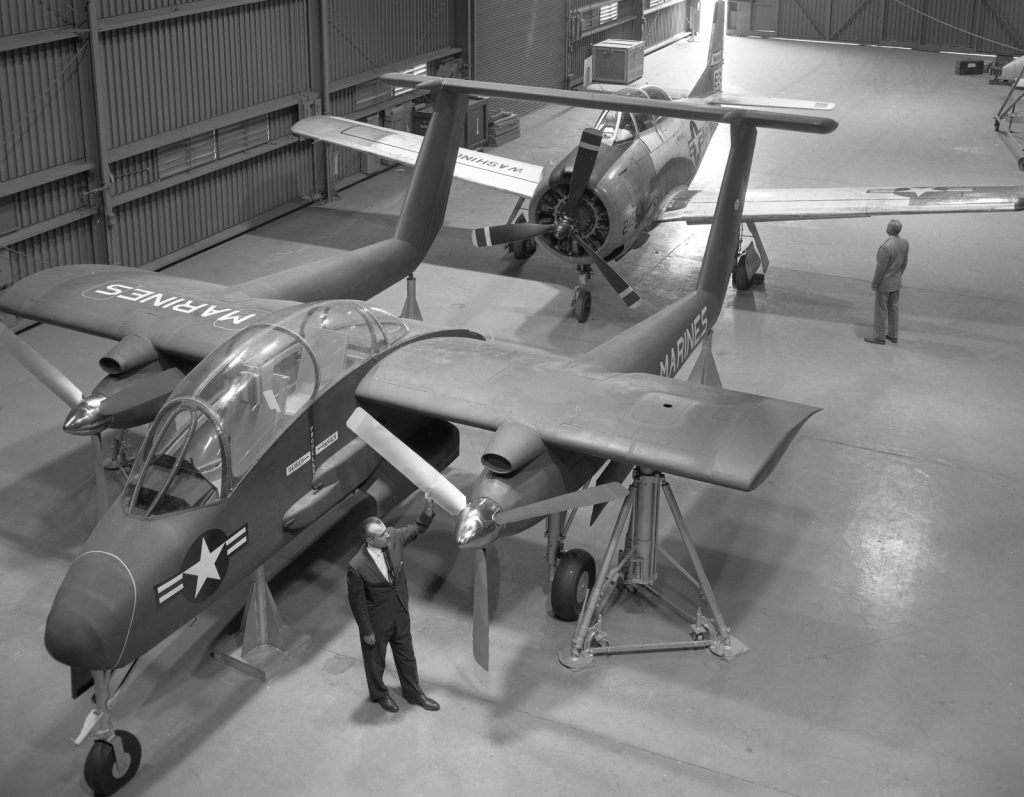
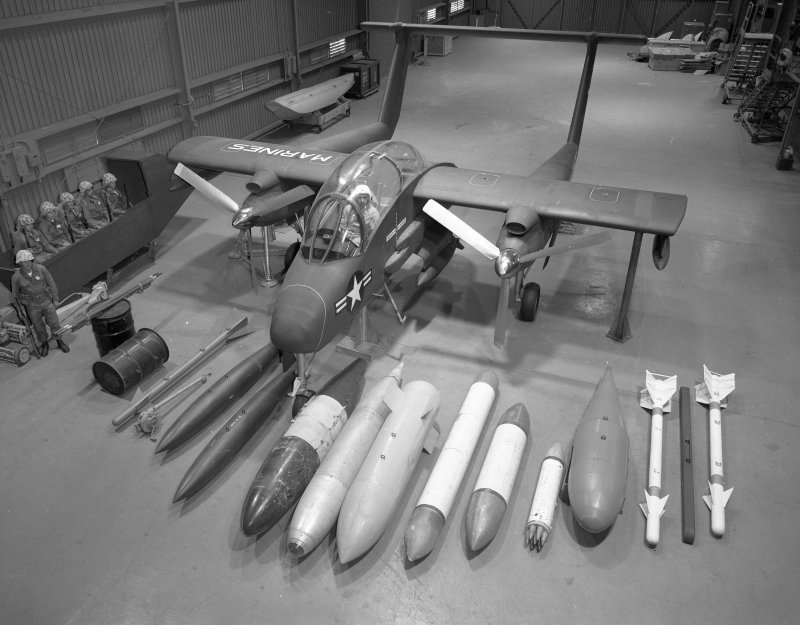
The Convair Model 48 Charger was a twin-boom monoplane made mostly of aluminum, with a fiberglass nose, a fiberglass rear fuselage, and fiberglass wingtips. The maximum speed of the aircraft was 319 mph, with a ferry range of 3,000 miles and a service ceiling of 21,300 feet. The aircraft had outer trailing-edge flaps that also acted as ailerons, supported by spoilers for better control at low speeds. It had a large tailplane that moved and was attached to the vertical fins on the ends of the tail booms. The rear fuselage included a cargo bay with a hinged tail cone that could carry 2,000 lbs of cargo. The aircraft was armed with four 7.62 mm machine guns mounted in pods on the sides. Convair began building the Convair Model 48 Charger prototype on its own before the LARA competition winner was announced. In August 1964, the US Navy chose North American Aviation’s NA-300 as the winner, which later became known as the OV-10 Bronco. However, the US Marine Corps and US Air Force preferred the Convair Model 48 Charger and protested the Navy’s decision. Despite this, Convair continued development of its prototype, which flew for the first time on November 25, 1964.
The Cancellation
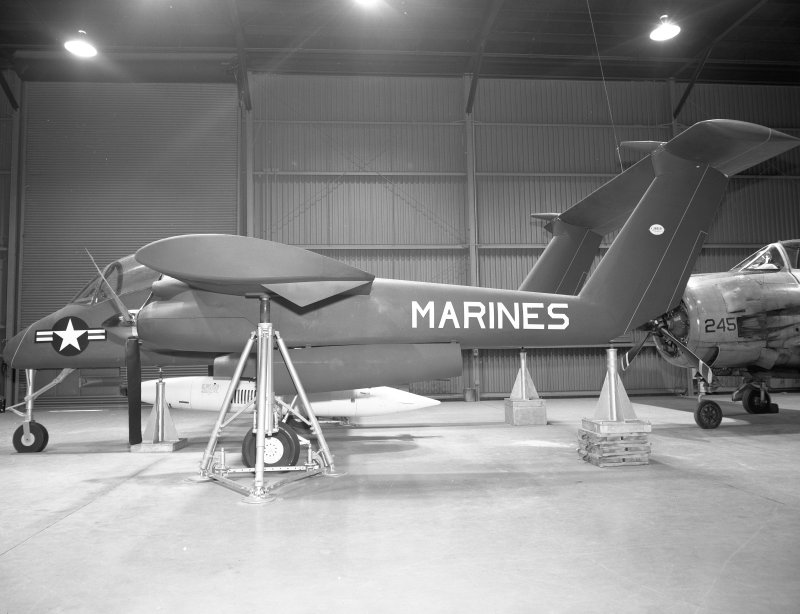
After the first flight tests, the Convair Model 48 Charger was changed to have a larger wingspan and a different tail design to improve its control at low speeds. The Charger showed good short takeoff and landing (STOL) capability, taking off over a 50-foot obstacle within 485 feet with a normal load. This performance was better than the LARA requirement of 800 feet (244 m) and also better than the Bronco. The Convair Model 48 Charger received a contract for a 100-hour flight test involving the US Navy, Marine Corps, Army, and Air Force. If there were orders, the production version would have a longer fuselage to include dual controls. However, the prototype crashed on its 196th test flight on October 19, 1965, due to an error by the US Navy test pilot, which ended further development of the aircraft. The Model 48 Charger prototype was the last aircraft built by Convair and was destroyed before a scheduled flight test could take place. Convair didn’t build another prototype of the aircraft. In the Grounded Dreams series, the Convair Model 48 Charger was a good aircraft that was canceled because it didn’t receive enough backing from the company or the US military. Ultimately, the OV-10 Bronco was selected and served with the US Air Force, Navy, and Marines. Read more Grounded Dreams articles HERE.








I was fortunate to have seen the Convair Model 48 Charger prototype frequently taxi, and perhaps take short hops, while going through Marine Corps boot camp at Marine Corps Recruit Depot (MCRD), San Diego from October through December 1964. Later benefited from occasional OV-10 support several times during Vietnam tours as a grunt although mistakenly thought it was the production version of Charger.