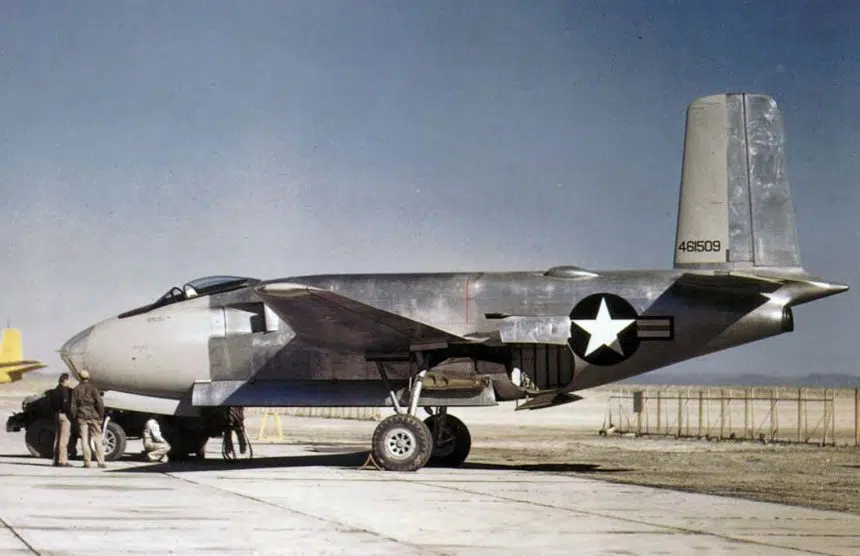

In October 1943, United States Army Air Forces (USAAF) leaders started to investigate the potential of jet-powered bombers. At that time, Douglas Aircraft was working on a new twin-engine bomber called the XB-42. The aircraft used reciprocating engines mounted inside the fuselage, keeping the wings clear of extra parts that could create drag, which made it a good candidate for testing turbojet engines. Douglas confirmed that the concept was feasible, and in March 1944, the USAAF changed the XB-42 contract. The service decided to develop two turbojet-powered prototypes called the Douglas XB-43 Jetmaster, reducing the original order from 13 aircraft. The Douglas design team convinced the Army that modifying the existing XB-42 test airframe into the first Douglas XB-43 Jetmaster was a simple way to save time and money compared with developing a new design. Douglas replaced the two Allison V-1710 engines with General Electric (GE) J35 turbojets, which were the first American axial-flow jet engines. The company cut two air intakes into each side of the fuselage, behind the pressurized cockpit. Removing the propellers and drive shafts created enough space for two long exhaust ducts. Without the propellers, there was no risk of hitting the blade tips on the runway, so the engineers removed the entire ventral fin/rudder unit from the XB-42’s four-surface cruciform tail.
Design of Douglas XB-43 Jetmaster

Douglas Aircraft wanted to mass-produce the new bomber, and the USAAF considered ordering 50 of them. The company was ready to produce up to 200 Douglas XB-43 Jetmasters each month in two versions, one with a plastic nose for the bombardier and another without the clear nose and bombing station. The second version would carry 16 forward-firing 12.7 mm machine guns and 127 mm rockets. However, these plans did not move forward. The USAAF was already focused on a new bomber, the XB-45 Tornado. The new model was designed to use turbojet power and promised performance improvements. Douglas predicted it would not be too difficult to get the aircraft ready to fly, but it took nearly two years due to delays in getting the J35 engines. After WWII, the aviation industry slowed down, and GE was late in delivering the engines. When the engines were finally installed and tested on the ground, one failed badly. Compressor blades broke through the engine casing, damaging the nearby airframe and injuring a technician on the ground. It caused another seven-month delay in repairs. America’s first turbojet bomber flew for the first time from Muroc Army Air Base on May 17, 1946. Douglas test pilot Bob Brush flew the plane, accompanied by engineer Russell Thaw.
The Cancellation

The Douglas XB-43 Jetmaster played an important role during a major technological shift. It helped develop procedures for flying new jet bombers and tested new turbojet engines. Douglas completed the second Douglas XB-43 Jetmaster prototype, known as AAF serial number 44-61509, which first flew on May 15, 1947. It was delivered to Muroc Air Force Base in California in April 1948. The USAAF replaced one of its J35 turbojet engines with a General Electric J47. Douglas then delivered this second prototype, called YB-43, in April 1948. USAAF personnel nicknamed the aircraft Versatile II. The clear plastic nose would crack due to temperature changes at high and low altitudes, and mechanics fashioned a stronger replacement from plywood. The US Air Force used parts from the first Douglas XB-43 Jetmaster, which was damaged in February 1951, to keep the aircraft flying. Versatile II flew for more than 300 hours before it was retired in December 1953. Though a good aircraft, the Douglas XB-43 Jetmaster faced stability issues and engine delays, which made it obsolete compared to the North American XB-45 Tornado. However, the Douglas XB-43 Jetmaster helped bombers prepare for the jet generation. Read more Grounded Dreams articles HERE.