






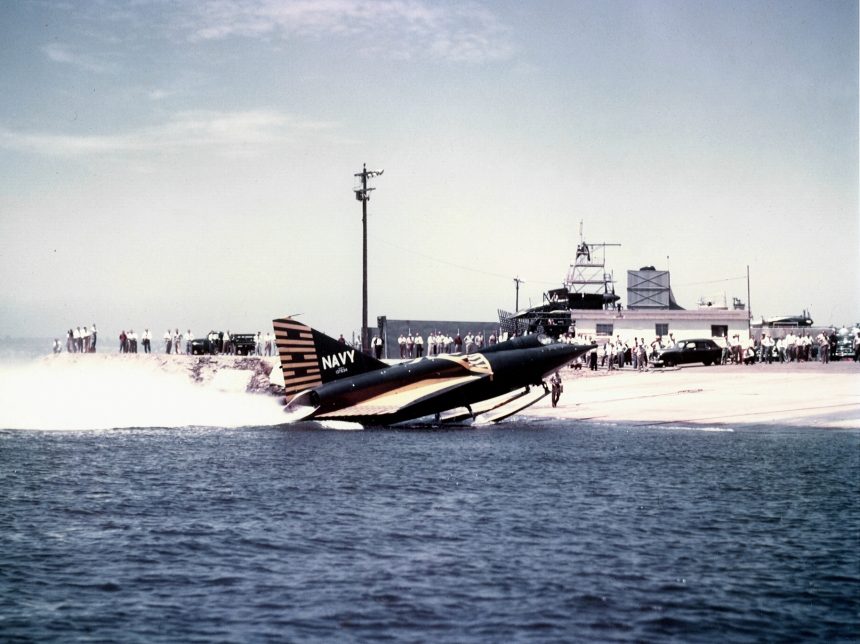


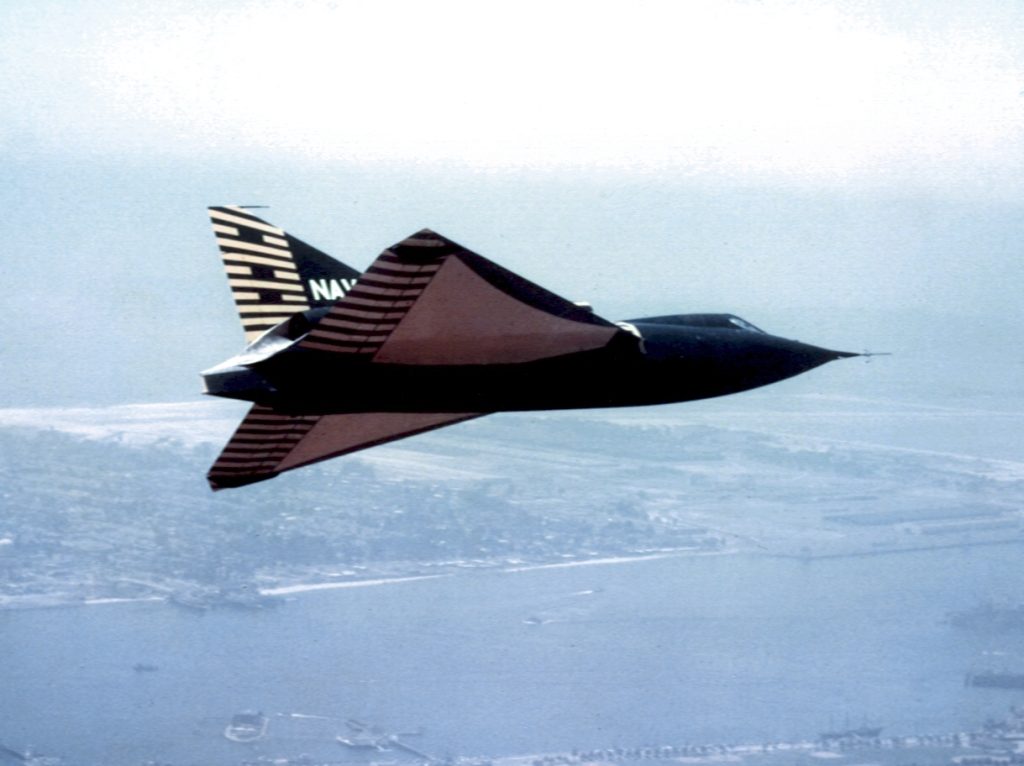
In the late 1940s, the US Navy wanted a supersonic interceptor aircraft. The Convair F2Y Sea Dart was Convair’s entry in the US Navy competition. At that time, many people doubted that supersonic aircraft could operate from aircraft carriers. To address this concern, the US Navy ordered several subsonic fighters. Ernest Stout’s team at Convair’s hydrodynamic research laboratory suggested putting a Delta Dagger on water skis. In late 1951, Convair received an order for two prototypes. Before the first prototype even flew, the service ordered 12 production aircraft. Although no weapons were ever installed on any Convair F2Y Sea Dart built, the plan was to equip them with four 20mm Colt Mk12 cannons and a set of folding-fin unguided rockets. Four of these were reclassified as service test vehicles, and soon after, they ordered eight more production aircraft. The aircraft was built as a delta-winged fighter. It had a watertight hull and twin hydro-skis that could retract for takeoff and landing. When the aircraft was still or moving slowly in the water, the trailing edge of the wings touched the water. The skis only extended when the aircraft reached about 10 miles per hour during takeoff. It was 51.1 feet long, with a wingspan of 35.4 feet and a wing area of 568 square feet. The Convair F2Y Sea Dart had a beam width of 5.5 feet and a draught of 40 inches when the skis were retracted. When the skis were extended, the draught increased to 96.5 inches. The height of the aircraft was 16 feet when it was on 3-point beaching gear, and 7.5 feet when it was in a horizontal position. Its empty weight was 16,725 pounds, and the gross weight was 24,373 pounds.
Design of Convair F2Y Sea Dart
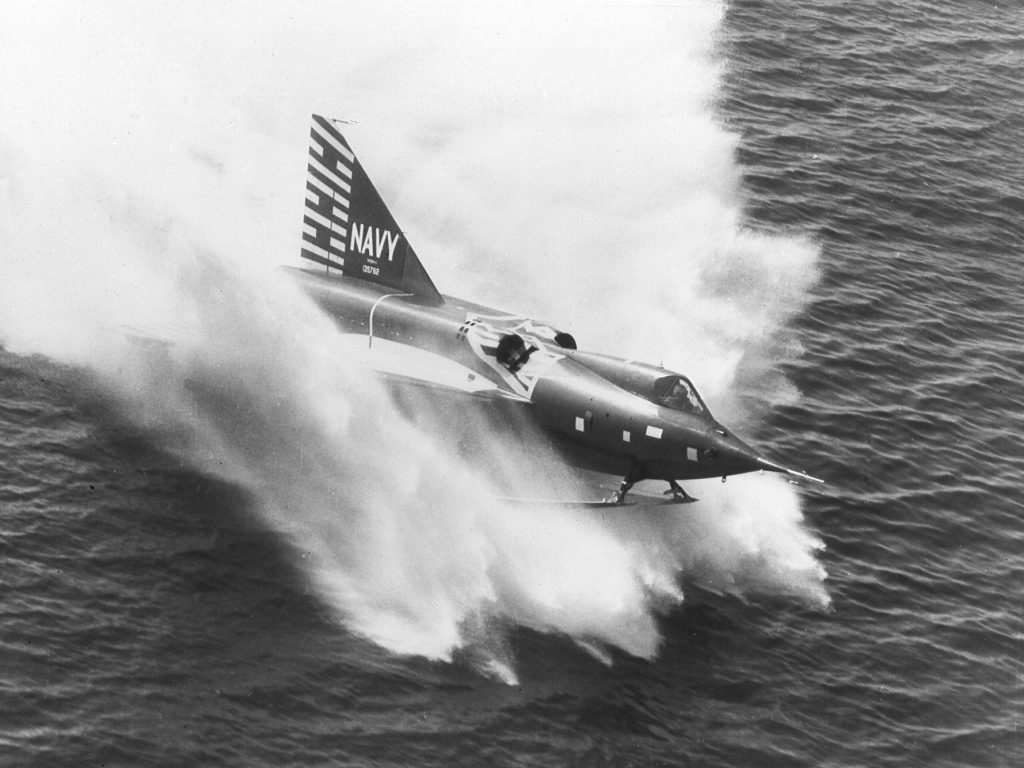
Its maximum speed was envisioned at Mach 1.25, with a range of 513 miles, and a rate of climb of 17,100 feet per minute. The two afterburning Westinghouse XJ46-WE-02 turbojet engines provided the necessary power. These engines had intakes placed high above the wings to prevent spray from being sucked in. When these engines were not available for the prototypes, twin Westinghouse J34-WE-32 engines, which provided just over half the power, were used instead. The prototype used an experimental single-ski configuration, which performed better than the twin-ski design in the second service-test aircraft. The aircraft was built at Convair’s San Diego facility and taken to San Diego Bay for testing in December 1952. On January 14, 1953, with E. D. “Sam” Shannon at the controls, the aircraft accidentally made its first short flight during a fast taxi run. Its official first flight took place on April 9, 1953. The Convair F2Y Sea Dart had weak engines, making it slow to respond, and the hydro-skis did not work as well as expected. They caused strong vibrations during takeoff and landing, even with the shock-absorbing legs they used. Improvements were made to the skis and legs, but they could not resolve the performance issues. The Convair F2Y Sea Dart could not fly at supersonic speed with the J34 engines, partly because its design increased drag at higher speeds.
The Cancellation
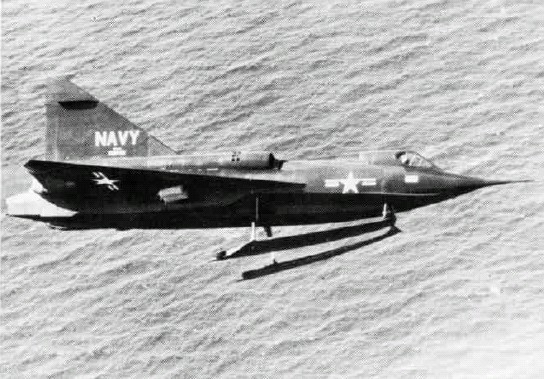
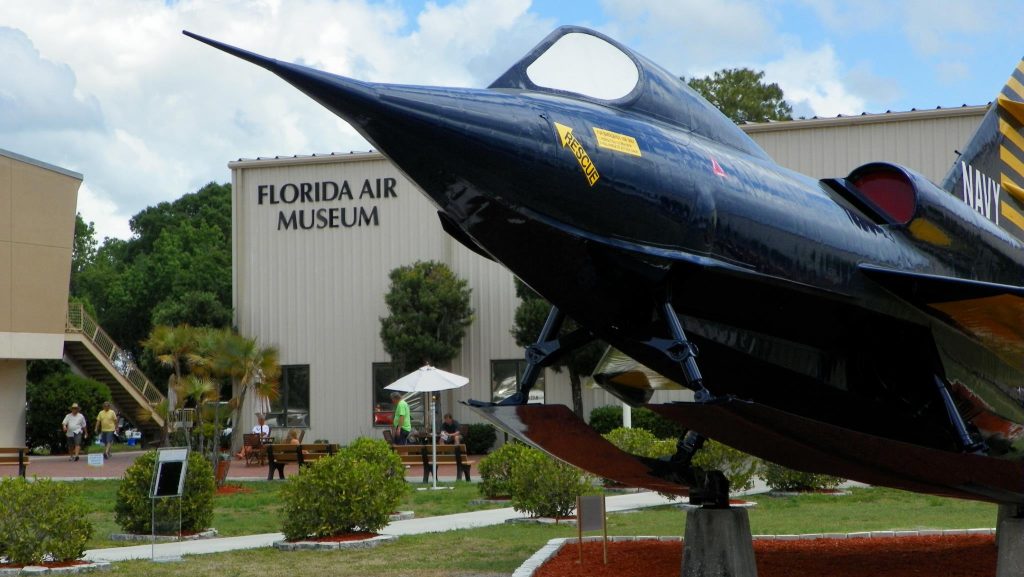
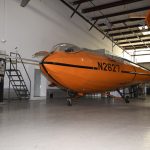
The second Convair F2Y Sea Dart prototype was canceled, resulting in the first service-test aircraft being built and flown. This aircraft had J46 engines that did not perform as expected. However, it managed to reach speeds over Mach 1 in a shallow dive, making it the only supersonic seaplane to date. On November 4, 1954, Convair F2Y Sea Dart broke apart midair over San Diego Bay during a demonstration for naval officials and the press. It led to the death of Convair test pilot Charles E. Richbourg when he accidentally exceeded the aircraft’s limits. Before the Sea Dart program was put on hold, the Navy had already begun to lose interest, especially after resolving issues with supersonic fighters on aircraft carriers. The crash of a test aircraft moved the Sea Dart program to experimental status, leading to the cancellation of all production aircraft, although three test models were still completed. The last two prototypes never flew. Because of the 1962 United States Tri-Service aircraft designation system, it was renamed YF-7A. All four surviving Sea Darts still exist today. The XF2Y-1 Sea Dart, Bureau Number 137634, is currently awaiting restoration at the Smithsonian Institution in Washington, DC, after a crane accident. The YF2Y-1 Sea Dart, Bureau Number 135763, is on display at the San Diego Air & Space Museum, loaned from the National Museum of Naval Aviation. Another YF2Y-1 Sea Dart, Bureau Number 135764, is located at the Wings of Freedom Aviation Museum at NAS Willow Grove, Pennsylvania, also on loan from the National Museum of Naval Aviation. Lastly, the YF2Y-1 Sea Dart, Bureau Number 135765, is on display at the Florida Air Museum at Lakeland Linder International Airport. Read more Grounded Dreams articles HERE.
(Image credit: VAN)









Wouldn’t it be a tragedy if the skis “retracted . . . during landing” as stated in the article?