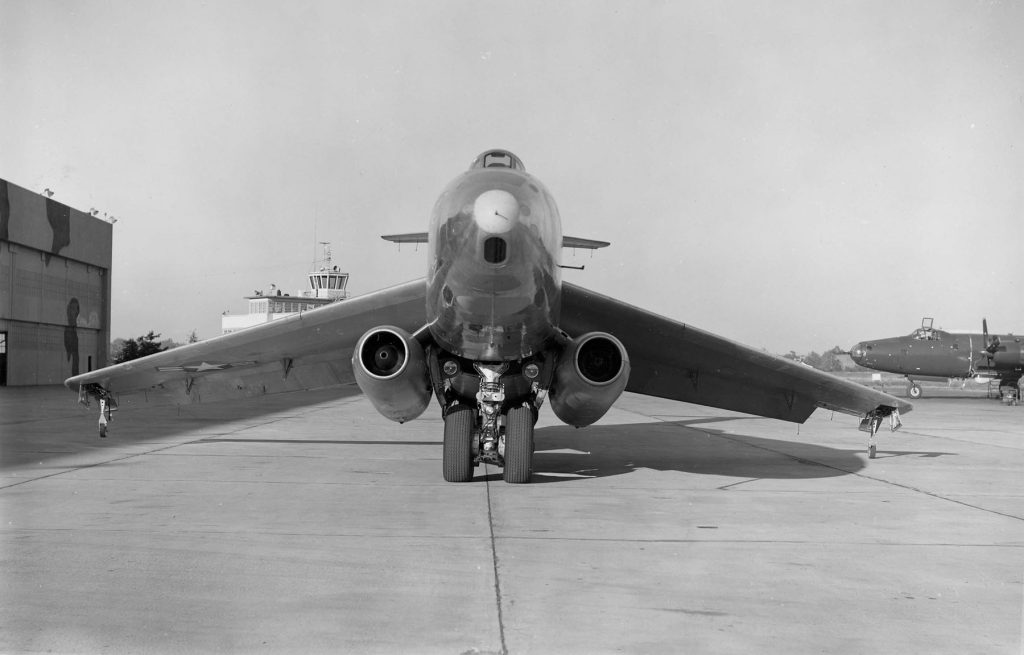
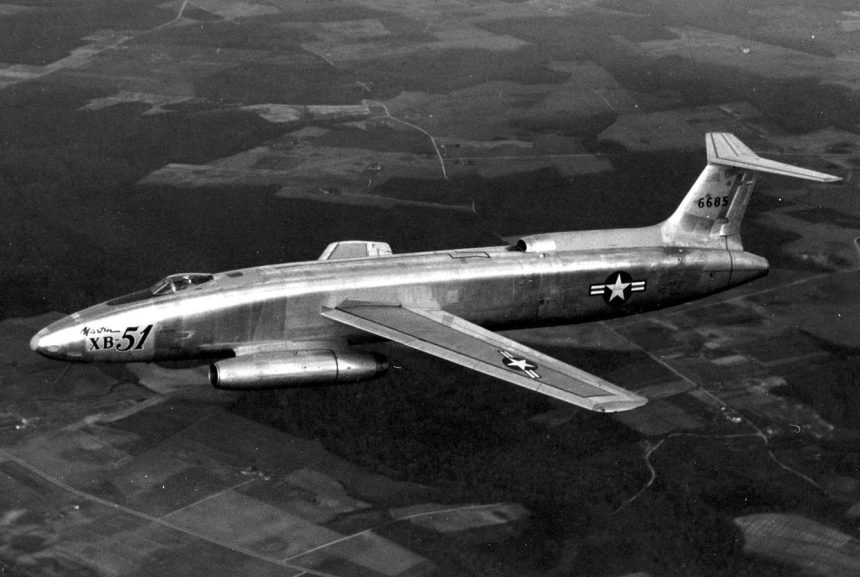


In the mid-1940s, the US Army Air Forces required a new bomber. As a result, Martin Aircraft Company developed a tri-jet aircraft known as the Martin XB-51. The unusual plane was powered by three General Electric J47 engines, each producing 5,200 pounds of thrust. The plane featured variable-incidence wings swept back 35 degrees and angled slightly downward. The wings had leading-edge slats and full-width flaps. Most of the roll control came from spoilers, while smaller ailerons helped the pilot feel the plane’s movements. The combination of adjustable wings and slotted flaps allowed for a shorter takeoff distance. To improve takeoff performance, four Rocket-Assisted Take Off (RATO) bottles, each producing 954 pounds of thrust for 14 seconds, could be attached to the rear.
Design of Martin XB-51
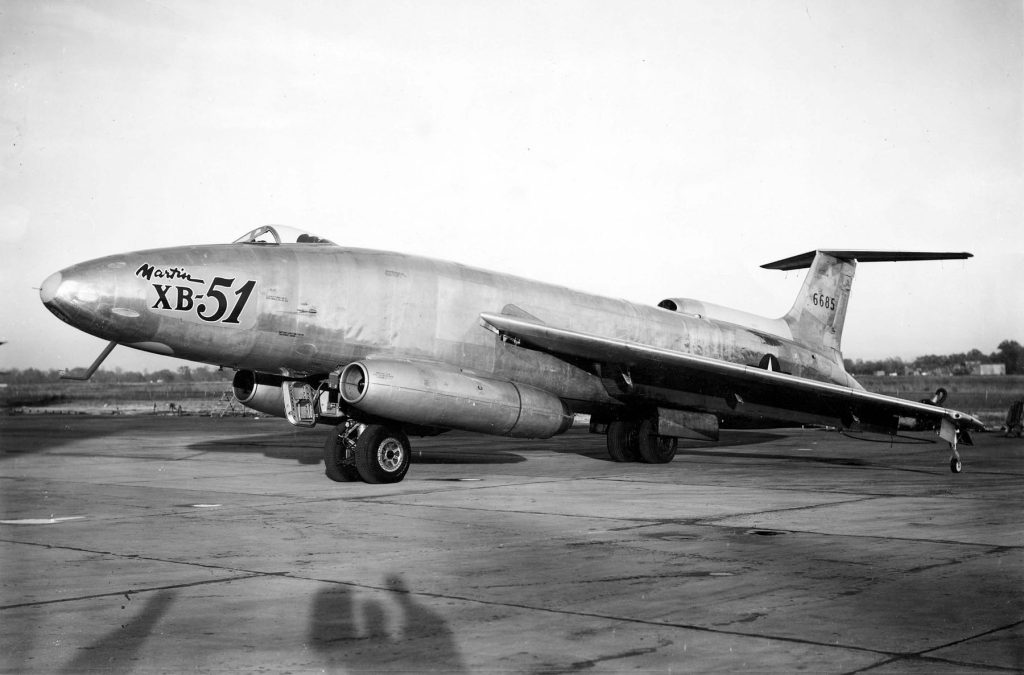
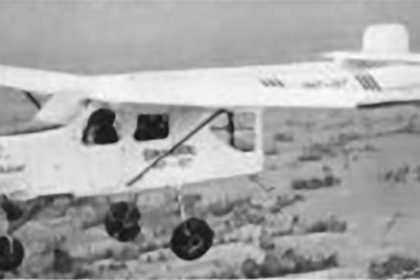
The Martin XB-51 flew for the first time on October 28, 1949. The two-person aircraft was 85.1 feet long, 17.4 feet high, with a wingspan of 53.1 feet, and a wing area of 548 square feet. The empty weight was 30,906 pounds, the gross weight was 57,874 pounds, and the maximum takeoff weight was 62,452 pounds. The maximum speed of the aircraft was envisioned at 644 mph, with a range of 1,075 miles, a ferry range of 1,444 miles, a service ceiling of 41,750 feet, and a rate of climb of 6,600 feet per minute. It could be armed with eight 20 mm M24 cannon, eight High-Velocity Aircraft Rockets (HVARs), and up to 10,400 pounds of bombs carried internally. The main landing gear of the Martin XB-51 had two sets of wheels in tandem located in the fuselage, identical to those of the Boeing B-47 Stratojet. It also included support wheels at the wingtips, which were first tested on a modified Martin B-26 Marauder called “Middle River Stump Jumper.” It was large but aerodynamically efficient, with most major systems housed within its structure. In 1950, the United States Air Force issued a requirement for a night intruder and bomber to replace the Douglas A-26 Invader, based on lessons learned during the early Korean War. The Air Force considered several aircraft, including the Martin XB-51, Avro Canada CF-100, and English Electric Canberra. The XB-51 and Canberra were the top choices from this group. Test flights showed that the XB-51 was highly maneuverable at low altitudes and faster than the Canberra and most fighters of its time.
The Cancellation
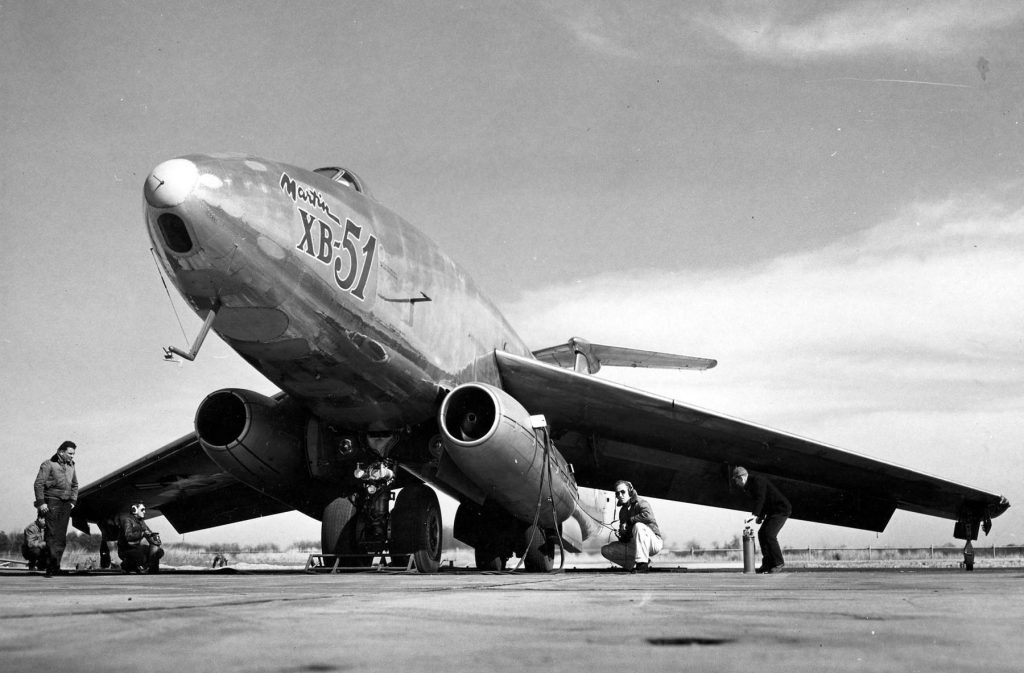
However, the Martin XB-51 had much shorter flight endurance compared to the Canberra, which led to its cancellation. Additionally, it could only handle a load limit of 3.67 g, meaning the airframe was not very strong and would struggle with tight turns when fully loaded. Also, the design of the main gear and outriggers was considered unsuitable for takeoff from emergency airfields. As a result, the XB-51 was not chosen for production. However, Martin was allowed to build 250 Canberras under a license, named the B-57. Martin’s rotating bomb bay feature was included in the production models of the B-57. They also suggested a “Super Canberra” with additional features from the Martin XB-51, such as swept wings and tail planes. In the Grounded Dreams series, the XB-51 could have offered better speed and low-level performance than the B-57, but it never entered production. The many changes needed would have taken too long to test before starting production. The Martin XB-51 prototype continued to fly for research after the US Air Force officially canceled the project. A second prototype, which first flew in 1950, crashed during low-level aerobatic testing on May 9, 1952, killing pilot Major Neil H. Lathrop. The first prototype, however, continued to fly and even appeared in the film “Toward the Unknown” as the “Gilbert XF-120” fighter. The surviving prototype was headed to Eglin AFB to film more footage when it crashed during takeoff after a refueling stop in El Paso, Texas, on March 25, 1956. Read more Grounded Dreams articles HERE.