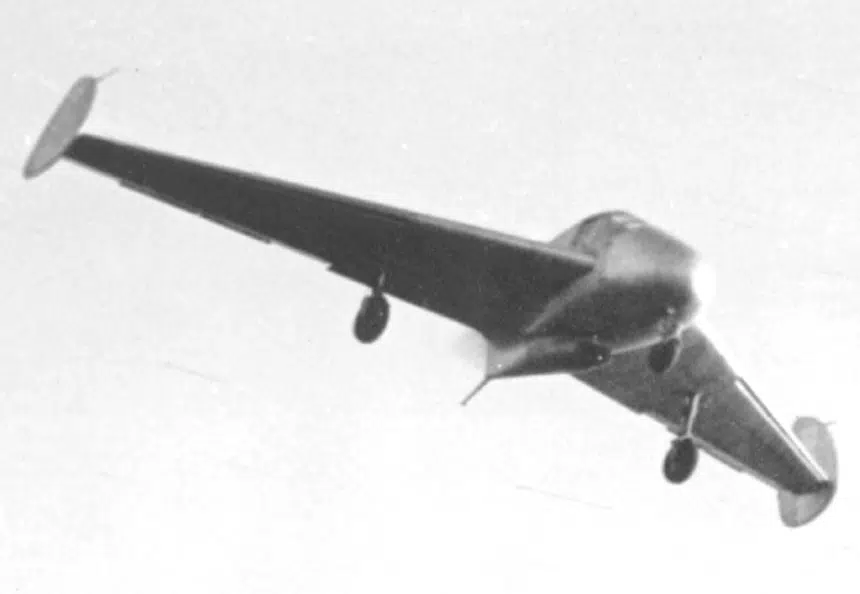

The SNCASE SE 2100 was a response to a 1943 request from the Vichy French Air Ministry for a two-seat touring aircraft, and the aircraft was designed by Pierre Satre, who later became the chief designer of the Concorde. The aircraft had an all-metal construction and had a low, straight wing that was tapered, with a 55° leading-edge sweep and a 10.43° upward angle. The wing was fitted with fixed leading-edge slots and trailing-edge ailerons but no conventional flaps. The wing tips were fitted with large rounded fins with parts moving outwards like rudders that controlled yaw individually but also worked in unison like flaps.
Design of SNCASE SE 2100

The SNCASE SE 2100 featured a short, blunt-nosed body designed to seat either one person in the center or two people side by side with dual controls. The seats were located just behind the front edge of the wings, and there was a baggage space behind them. Access to the cabin was through wide, deep doors that swung open from the front and were located on both sides; part of the wing structure was incorporated into each door to allow this. It was equipped with a 140 hp (104 kW) Renault Bengali 4-cylinder engine, mounted behind the cabin in a pusher configuration and air-cooled via a scoop at the bottom. The engine drove a two-blade propeller located just behind the back edge of the wings. The SNCASE SE 2100 had a fixed tricycle landing gear with shock absorbers and brakes on the main wheels, while the nose wheel could swivel freely. At different times, the landing gear legs and wheels were either covered or exposed.
The Cancellation

The SNCASE SE 2100 was 16.1 feet long, 6.2 feet high, with a wingspan of 32.5 feet and a wing area of 162.6 square feet. The empty weight of the aircraft was 1,142 pounds, and the gross weight was 1,764 pounds. The SNCASE SE 2100 was envisioned to reach a maximum speed of 140 mph, a cruise speed of 123 mph, a range of 310 miles, and a service ceiling of 16,000 feet. The SNCASE SE 2100 made its first flight on October 4, 1945. It showed good performance and high maneuverability during the 1946 Paris Air Show. However, no production models were made, and the prototype lasted into the early 1950s. The SNCASE SE 2100 was never put into production because it was designed as an experimental flying-wing model. It was not made for commercial use or public sale in its original form, though, given its strong performance, it could have been. Read more Grounded Dreams articles HERE.