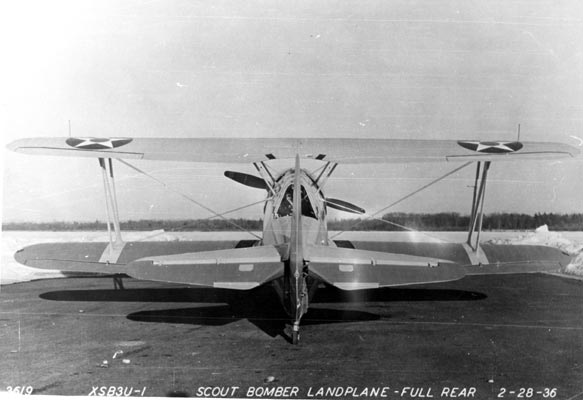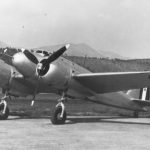
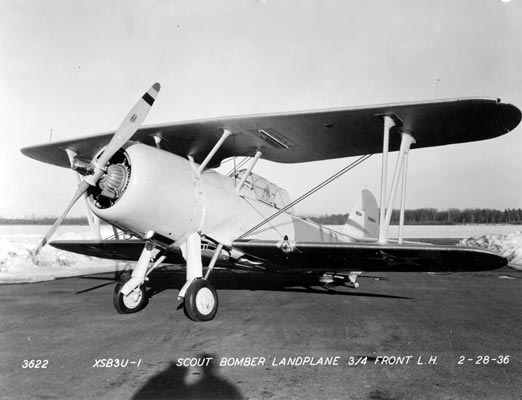

In late 1934, the US Navy’s Bureau of Aeronautics requested companies to submit new designs for scout bombers and torpedo bombers. Eight companies responded with ten designs, which were evenly split between monoplanes and biplanes. In October 1934, the Navy ordered a prototype, the Vought XSB2U, a monoplane. However, the service was concerned that this monoplane’s high landing speed would make it difficult to operate on aircraft carriers. So, less than three months later, the Navy decided to order a similar biplane scout-bomber, the Vought XSB3U, for testing.
Design of Vought XSB3U
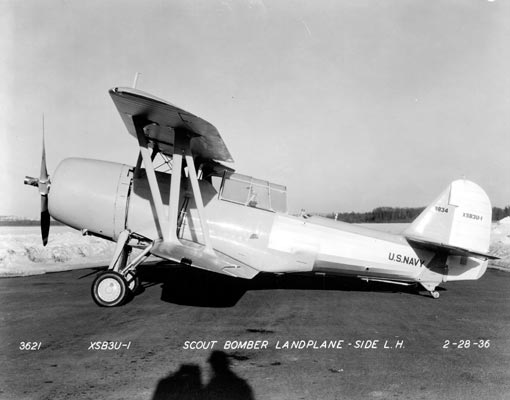
The Vought XSB3U was based on the last production model of the SBU Corsair. It used the same basic airframe, which featured a fully enclosed cockpit, and was powered by a Pratt & Whitney R-1535 radial engine that produced 750 horsepower. However, the XSB3U had a more streamlined fuselage and engine cowling. Additionally, it included fully retractable landing gear. The US Navy received the Vought XSB3U at Naval Air Station Anacostia for testing in April 1936 at the same time as its main competitor, the XSB2U. The two-seater XSB3U was 28.2 feet long, with a wingspan of 33.3 feet and a wing area of 327 square feet. Its empty weight was 3,876 pounds, and the gross weight was 5,837 pounds. It was equipped with a two-bladed Hamilton Standard variable-pitch propeller. Its projected maximum speed was 215 mph at 8,900 feet, with a stall speed of 66 mph, a range of 525 miles, a combat range of 590 miles, and a service ceiling of 26,500 feet. It was armed with a 12.7 mm machine gun and a 7.62 mm machine gun. It could also carry 500 pounds of bombs.
The Cancellation
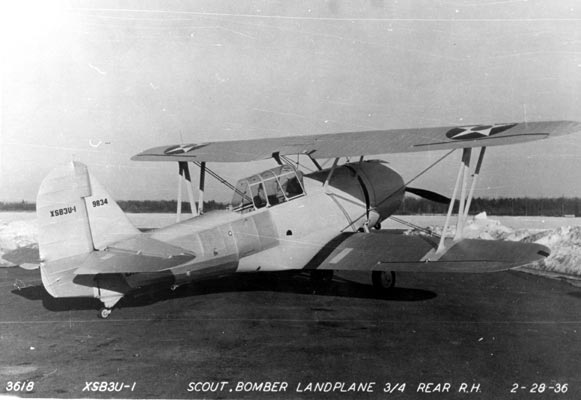
In 1936, testing showed that the monoplane design was better than the biplane. The SB2U was 15 miles per hour faster, even though it was larger and heavier. The Navy liked the way the Vought XSB3U retracted its landing gear, as it created a smoother surface than most other designs at that time. After the evaluation, the Navy kept the Vought XSB3U for experiments and communication. From August 1938 to January 1939, NACA used it at Langley Field to test tail loads. The aircraft arrived at NACA Langley in Virginia on December 1, 1938, for evaluation. It was equipped with a test boom attached to the left upper wing to study the tail loads and aerodynamic forces. Then the aircraft was returned to the Navy and was retired shortly after. In the Grounded Dreams series, the Vought XSB3U was an experimental biplane that failed to outperform a monoplane. Read more Grounded Dreams articles HERE.