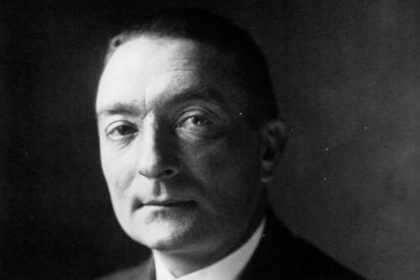

One of the most important figures in the history of the NASA Glenn Research Center was Abe Silverstein, who also helped establish the agency in the late 1950s. Silverstein contributed to many important areas, including studying complete engine systems, developing early jet engines, building large supersonic wind tunnels, and using liquid hydrogen as a fuel. Abe Silverstein was born on September 15, 1908, in Terre Haute, Indiana. He graduated from Rose Polytechnic Institute in 1929 with a degree in mechanical engineering and returned in 1934 for more studies. After graduation, he began working as an engineer at the National Advisory Committee for Aeronautics (NACA) at the Langley Memorial Aeronautical Laboratory. There, Abe Silverstein collaborated with Smith DeFrance to design the Full-Scale Tunnel (FST). Silverstein built the tunnel’s supporting framework to prevent turbulence. In 1940, he became the chief of the FST and led efforts during WWII to reduce drag on US military aircraft. During the war, the NACA set up the Aircraft Engine Research Laboratory in Cleveland. In 1943, Silverstein started managing the Altitude Wind Tunnel there. The military decided on the Bell YP–59A Airacomet as the first experimental aircraft at this new facility. Most people at NACA did not know that the United States was developing jet engines at this time. Even though the General Electric I–16 engines had problems, this innovation would have a great impact on the aviation industry. Abe Silverstein solved an important cooling problem for the Wright R–3350 engines used in the B–29 Superfortress by adding baffles.
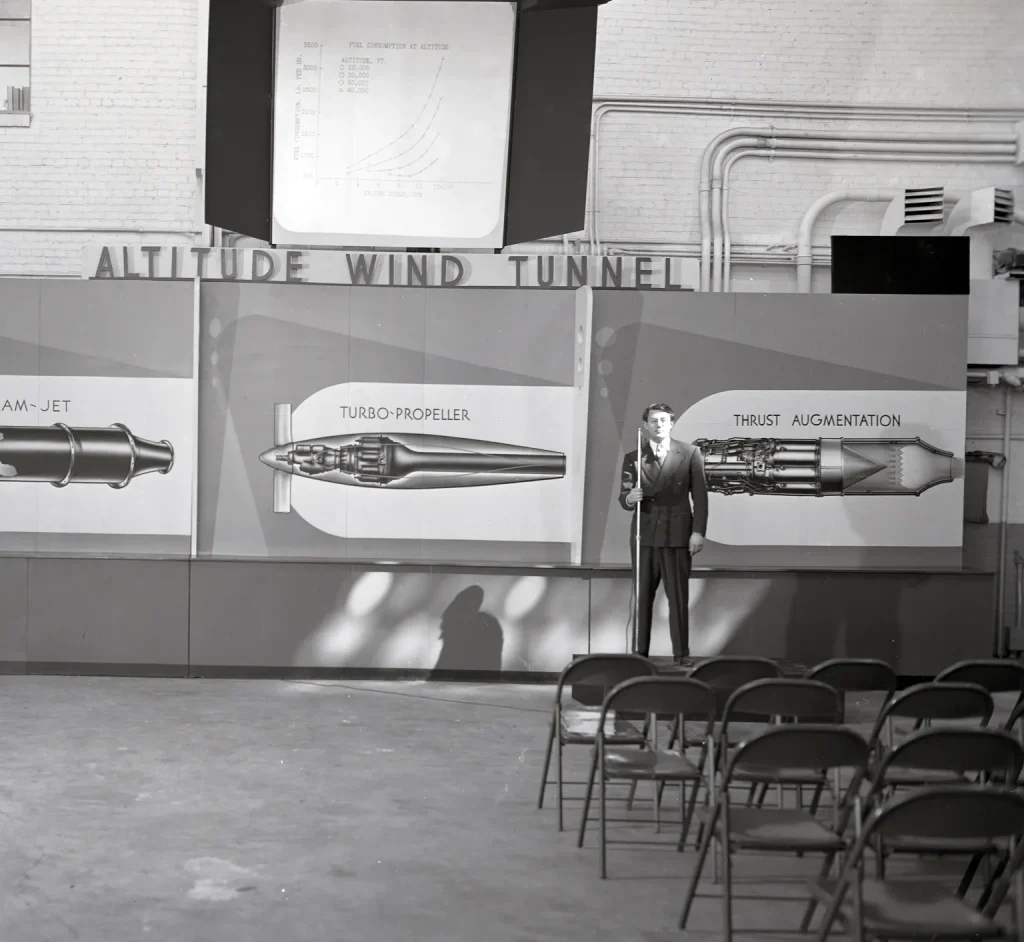
Throughout the war, Abe Silverstein and his team worked on early turbojet engines and achieved a milestone with the first successful afterburner operation in 1945. In October 1945, Silverstein became the head of the new Wind Tunnels and Flight Division at the lab. He was one of the first to understand the importance of the jet engine and high-speed flight. To help everyone learn more about these topics, he started a series of evening classes for the staff. The NACA appointed him to its High Speed Research Panel, where he worked with John Stack, Russell Robinson, and Julian Allen. During this time, Abe Silverstein planned several small supersonic wind tunnels and the NACA’s largest supersonic tunnel, the 8- by 6-Foot Supersonic Wind Tunnel. He also pushed for the creation of the nation’s largest propulsion tunnel, the 10- by 10-Foot Supersonic Wind Tunnel. In 1949, Abe Silverstein became the head of research at the lab and was named associate director in 1952. He expanded the research to include high-energy propellants and nuclear propulsion. In the mid-1950s, he shut down the Compressors and Turbines division and created the Nuclear Reactor Division and the Fluids Systems Components Division to focus on nuclear propulsion and cryogenic fuels. He also persuaded the NACA to establish the Plum Brook Reactor Facility to study how radiation affected nuclear aircraft and rocket components. Abe Silverstein played an important role in promoting liquid hydrogen as a fuel. Early rocketeers had thought about it, but the technology was not ready until the early 1950s. That was when researchers at Lewis started looking into high-energy fuels. In 1954, successful tests led Silverstein and Eldon Hall to predict that missions using liquid hydrogen would perform much better than those using traditional fuels. The Air Force then assigned Silverstein to create a flying version of this technology.
In 1957, they successfully flew the B–57 Canberra using liquid hydrogen. Although they did not continue developing the hydrogen-fueled aircraft, Abe Silverstein continued advocating for liquid hydrogen in the space program. In the mid-1950s, people became more interested in space research. Initially, the management at NACA thought space research was not part of their job. However, Abe Silverstein and his team at Lewis believed it was a natural part of aeronautics. After the launch of Sputnik in the fall of 1957, NACA Director Hugh Dryden asked Silverstein to help create a new space agency. Silverstein officially moved to Headquarters in May 1958 after commuting for several months. At Headquarters, Abe Silverstein worked with Robert Gilruth, Morton Stoller, Edgar Cortright, and Newell Sanders to plan a budget for future satellite, space probe, and human missions. By mid-July, they created a budget for the fiscal year 1960 and outlined various missions. When NASA officially started on October 1, 1958, T. Keith Glennan was the Administrator, Hugh Dryden was the Deputy Administrator, and Abe Silverstein was the Chief of Space Flight Programs. Silverstein made important contributions in Washington, DC, including planning space missions and helping establish the NASA Goddard Space Flight Center. He chaired the board that selected the source for the Mercury capsule. He played an important role in naming the Mercury and Apollo programs and coauthored a 1961 paper on the logistics of lunar landings. His greatest achievement was promoting liquid hydrogen as a fuel.
In 1958, Abe Silverstein led a review that showed NASA needed high-energy fuels for its missions. The effort resulted in the formation of the Saturn Vehicle Team, also known as the “Silverstein Committee,” in 1959. Abe Silverstein successfully persuaded Werner von Braun to develop stages that could use liquid hydrogen, despite some initial doubts. In 1961, NASA Administrator James Webb reorganized the agency, and Silverstein returned to the Lewis Research Center as its director. When he arrived, he had to hire many new staff, design new facilities, and manage development programs, such as the Centaur rocket. Originally, the Marshall Space Flight Center managed the Centaur program, but after its first launch failed, it was handed over to Lewis. Silverstein took charge of the program, which successfully launched in November 1963. The Centaur rocket not only supported the Surveyor missions but also launched numerous satellites and probes throughout the solar system. Abe Silverstein contributed to more than 50 technical reports and spoke at numerous important conferences worldwide. He received several honorary degrees, NASA’s Outstanding Leadership Medal, the Exceptional Service Medal, and the Guggenheim Medal. He retired in the summer of 1969, during the height of the Apollo program, but later pushed for a new jetport in downtown Cleveland. In 1994, NASA established the Abe Silverstein Award for outstanding research and renamed its 10-by-10-foot tunnel in his honor. Silverstein passed away on June 1, 2001, at the age of 92. As one of the Pioneers of Aeronautical Engineering, only a few have made as big an impact on NASA as Abe Silverstein has. Read more such stories HERE.