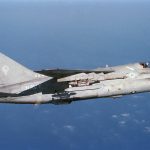
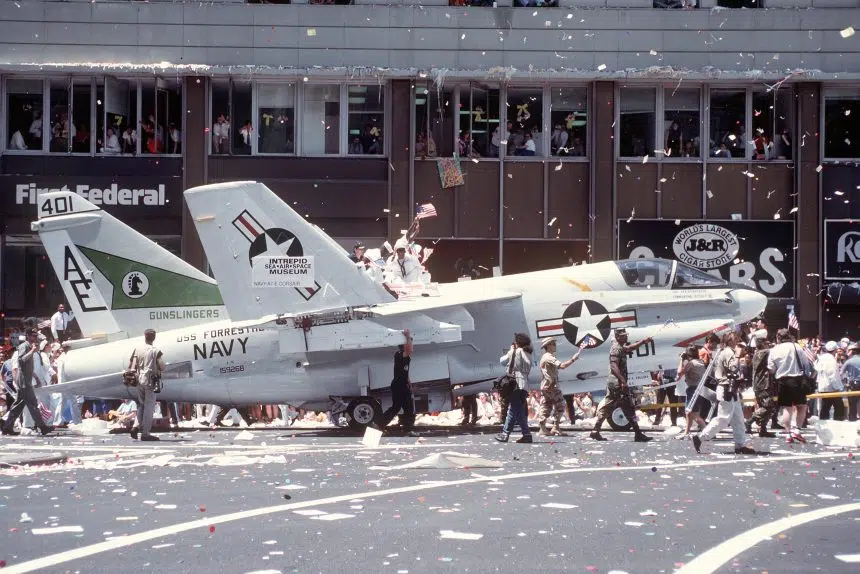

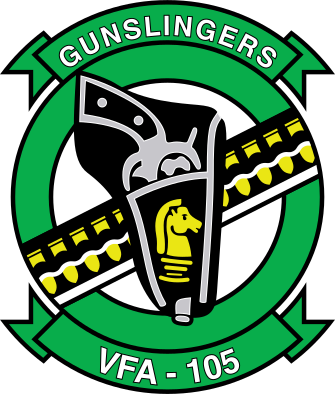
Strike Fighter Squadron 105 (VFA-105), called the “Gunslingers,” is a US Navy strike fighter squadron based at Naval Air Station Oceana in Virginia. The squadron flies the F/A-18E/F Super Hornet, and it uses the radio callsign “Canyon” with the tail code AG. It was formed as Attack Squadron 105 (VA-105) on November 1, 1967, and changed to VFA-105 on December 17, 1990, when it began flying the F/A-18C Hornet. The Navy previously used the VA-105 name for a different squadron that operated from 1952 to 1959, but they do not officially connect the two units. The squadron’s emblem was approved on September 20, 1968. It shows a gun belt and a six-shooter, with a gold knight chess piece on the holster. During the Vietnam War, the squadron humorously used the nickname “105th Light Attack and Twilight Pursuit Squadron,” which referred to its A-7 Corsair II attack aircraft and the AIM-9 Sidewinder missiles it carried. The nickname became popular in the squadron and appeared on patches, belt buckles, and other items. The Gunslingers still informally use the “Twilight Pursuit” reference. VA-105 started its operations at NAS Cecil Field, Florida, flying the A-7A Corsair II. After finishing its training with VA-174 in March 1968, the squadron became part of the Atlantic Fleet. Its first deployment was in 1969 on the USS Kitty Hawk, where it conducted missions in the Gulf of Tonkin and over Southeast Asia. After North Korea shot down a US Navy EC-121 reconnaissance aircraft in April 1969, Kitty Hawk also joined the US naval presence near the Korean Peninsula. During the 1970s, the squadron responded to various crises. In September and October 1970, VA-105 deployed on the USS Saratoga to the eastern Mediterranean following airliner hijackings and fighting in Jordan. The carrier was ready to help evacuate American citizens from Jordan and show US support for the Jordanian government. In 1972, VA-105 returned to combat in Vietnam, taking part in Operation Linebacker and Operation Linebacker II, which were US bombing campaigns against North Vietnam. In May 1973, the squadron received the more advanced A-7E Corsair II.
By the end of the 1970s, VA-105 had completed two deployments to the Pacific and six to the Mediterranean. The squadron’s regular deployments reflected the changing needs of the US Navy during the Cold War, as carrier forces often responded to crises in Europe, the Middle East, and the Pacific. The Gunslingers were active in overseas missions during the 1980s. In June 1982, after Israel invaded Lebanon, VA-105 operated from the USS John F. Kennedy to help evacuate American citizens. From July to December 1984, the squadron had a unique deployment to MCAS Iwakuni, Japan, where it worked with the U.S. Marine Corps’ MAG-12 of the 1st Marine Aircraft Wing. The deployment was important because VA-105 became the first US Navy squadron to join the Marine Corps Unit Deployment Program. It was also the first Navy squadron since WWII to be led by a Marine Corps officer. While working with the Marines, the squadron focused on close air support. Throughout the 1980s, VA-105 completed eight overseas deployments, including six to the Mediterranean and a world cruise aboard the USS Carl Vinson during its first trip in 1983. On December 17, 1990, VA-105 changed its name to Strike Fighter Squadron 105 (VFA-105) as it switched from the A-7E Corsair II to the F/A-18C Hornet. The squadron joined Carrier Air Wing Three (CVW-3) aboard the USS John F. Kennedy in September 1991 and flew its first Hornet deployment in October 1992. The Gunslingers kept a regular schedule of carrier deployments in the 1990s. They deployed on the USS Dwight D. Eisenhower in 1994 and the USS Theodore Roosevelt in 1996. In 1998, Strike Fighter Squadron 105 and CVW-3 deployed on the USS Enterprise to support Operation Southern Watch and Operation Desert Fox, helping to enforce the no-fly zone over southern Iraq.

In November 2000, the Strike Fighter Squadron 105 began a new chapter when it boarded the USS Harry S. Truman for its first deployment to the Mediterranean and Persian Gulf. Strike Fighter Squadron 105 later supported Operation Iraqi Freedom during a 2003 deployment from the Mediterranean. In July 2006, Strike Fighter Squadron 105 became the first Navy strike fighter squadron on the East Coast to start using the F/A-18E Super Hornet. It improved the squadron’s capabilities by replacing the single-seat F/A-18C with a newer Hornet variant. In March 2007, Strike Fighter Squadron 105 made history again when Commander Sara Joyner became its commanding officer. It made the Gunslingers the first operational Navy strike fighter squadron to be led by a woman. The squadron continued its carrier deployments throughout the 2010s. In 2010, Strike Fighter Squadron 105 was deployed on the aircraft carrier Harry S. Truman for seven months, returning home in December. In July 2013, the squadron began a nine-month deployment on the same carrier in support of Operation Enduring Freedom. During this deployment, two of its F/A-18Es operated temporarily from the French aircraft carrier Charles de Gaulle in January 2014. This was the first time the squadron had worked from the French carrier. The Gunslingers resumed combat operations in the 2020s. In October 2023, VFA-105 deployed with Carrier Air Wing Three on the USS Dwight D. Eisenhower, mainly focusing on the US Central Command area. During much of this deployment, the squadron operated from the Red Sea, carrying out defensive and offensive missions against Houthi forces in Yemen. On January 12, 2024, Strike Fighter Squadron 105 F/A-18Es participated in US air strikes against targets in Yemen. After over 30 years with Carrier Air Wing Three, the Gunslingers moved to Carrier Air Wing Seven and the USS George H.W. Bush in October 2024 along with VFA-83. In late April 2026, the squadron was deployed with CVW-7 on the USS George H.W. Bush to the CENTCOM area, and its Super Hornets began combat operations against Iranian forces and carried out naval blockade missions as part of Operation Epic Fury.