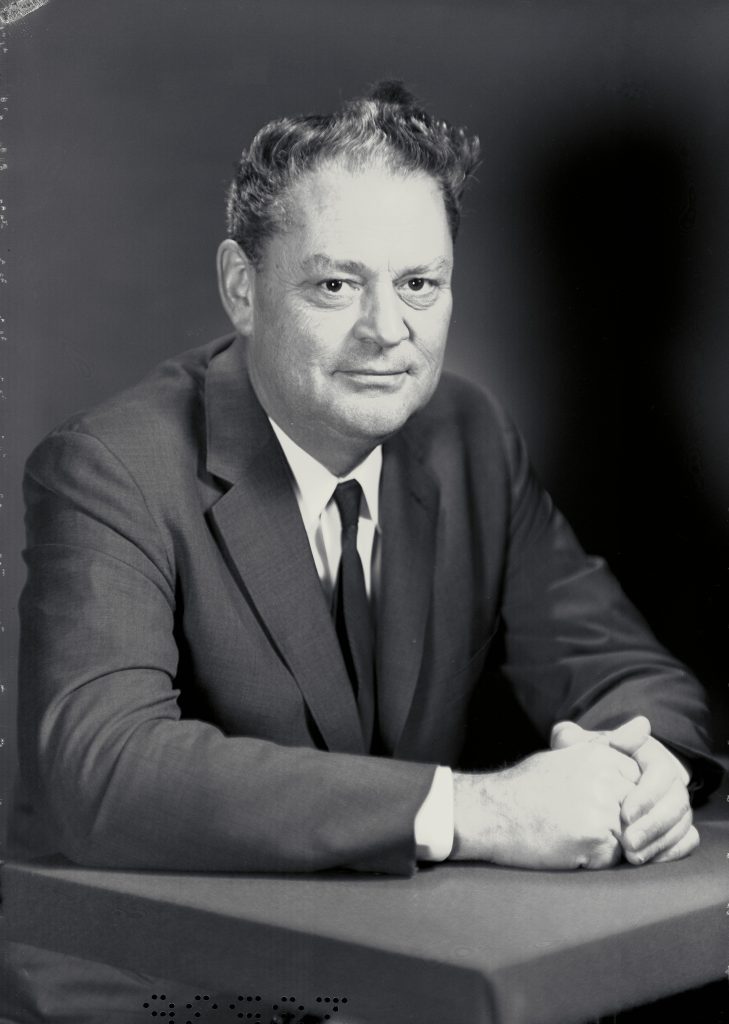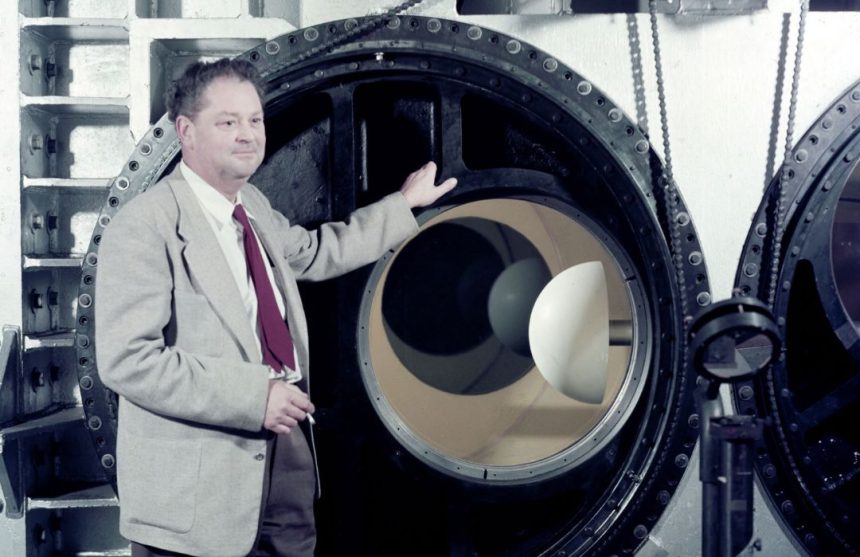

Harry Julian Allen, an aeronautical engineer and director of the NASA Ames Research Center, is best known for developing the “blunt-body” theory of atmospheric entry. The theory helped successfully recover orbiting spacecraft and is still used in aerospace engineering today. Allen was born on April 1, 1910, in Maywood, Illinois. He attended Stanford University, earning a Bachelor of Arts degree in engineering in 1932. In 1935, he received a professional degree in Aeronautical Engineering. In 1936, he started working at the Langley Memorial Aeronautical Laboratory, part of the NACA. Allen joined the Ames Research Laboratory on April 13, 1940, after moving from the Langley Memorial Aeronautical Laboratory, where many early Ames staff had also worked. At Ames, Harry Julian Allen held several key positions, including the Chief of the Theoretical Aerodynamics Branch from 1941 to 1945, the Chief of the High-Speed Research Division from 1945 to 1959, the assistant director for Astronautics from 1959 to 1965, and finally, the Center Director from 1965 to 1969. While at Langley, Allen worked in the Variable Density Tunnel Section, which Eastman Jacobs led. Harry Julian Allen played an important role in developing laminar-flow airfoils, making previously complicated calculations easier.
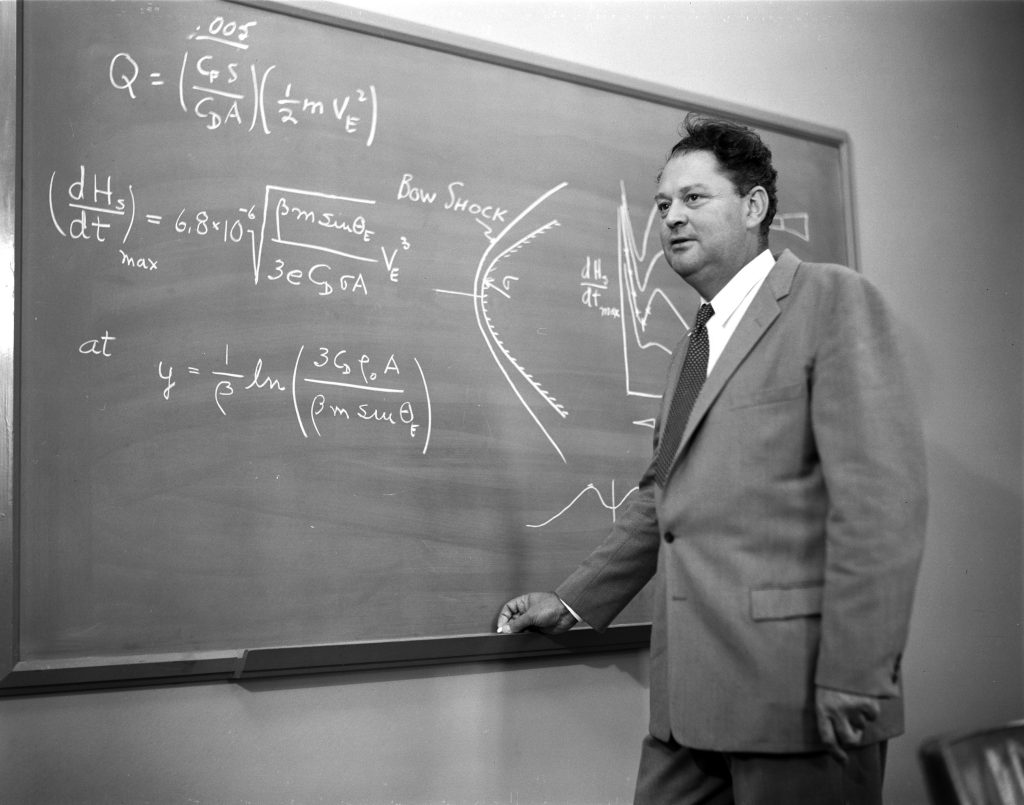
His work resulted in the report titled “General Theory of Airfoil Sections Having Arbitrary Shape or Pressure Distribution.” It was published after Harry Julian Allen became the head of the Theoretical Aerodynamics Section at Ames. Allen was known for his elegant math work that simplified and generalized problems. His most enduring idea is the blunt-body concept, which remains important for hypersonics and spaceflight today. In 1953, Allen and his colleague Alfred Eggers published a paper on blunt bodies. He continued his research in hypersonics, designed new wind tunnels for this work, and led much of the center’s efforts as assistant director. Harry Julian Allen was interested in many areas of aerodynamics research. He studied how air moves in different situations, like slow speeds (subsonic), near the speed of sound (transonic), faster than sound (supersonic), and much faster (hypersonic). While the United States was developing ballistic missiles, Allen studied the behavior of objects re-entering the atmosphere. He also looked into how radiation and meteorites could affect space vehicles. Earlier ballistic missiles, used by the United States and the Soviet Union, had long, narrow tips that created less aerodynamic drag as they entered the atmosphere at high speeds. However, Harry Julian Allen showed that a blunt design, though it created more drag, would produce a detached shock wave.
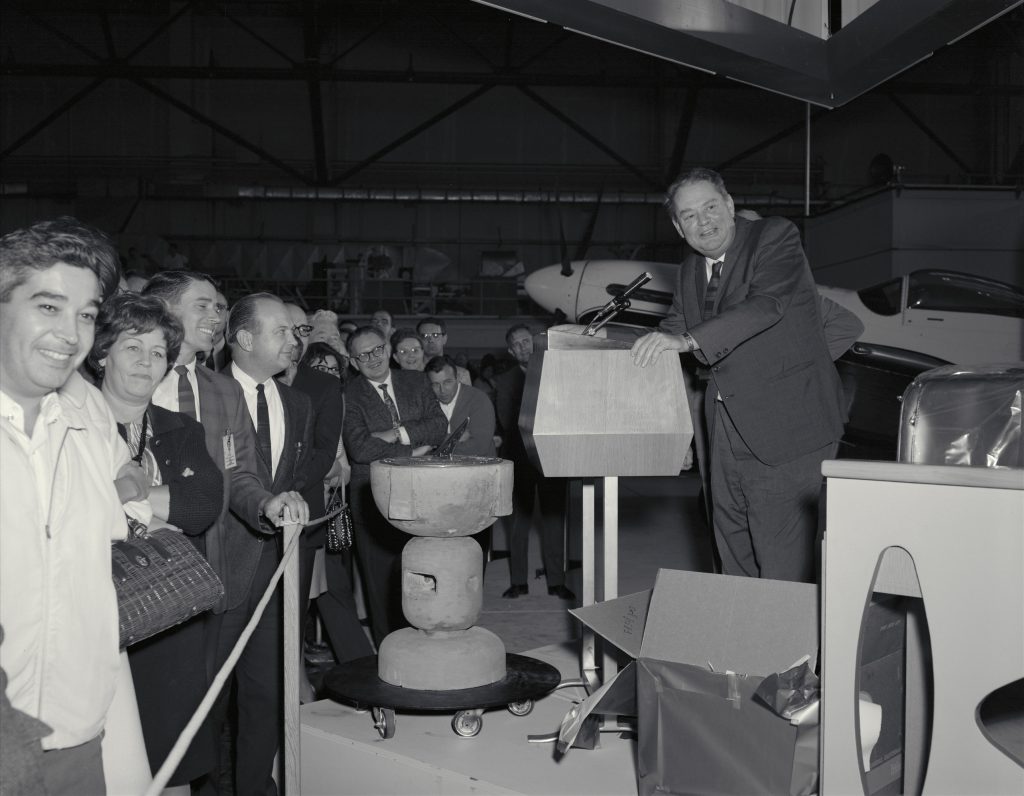
The shock wave would transfer much less heat to the vehicle compared to the traditional shape with an attached shock wave. Excessive heat was a major concern for designing ballistic missiles and spacecraft because it could melt their surfaces. The blunt body design addressed this issue. Allen’s theory led to the creation of ablative heat shields that protected astronauts during the Mercury, Gemini, and Apollo programs when their space capsules re-entered the atmosphere. During the Apollo program, Harry Julian Allen focused Ames on research and avoided too much involvement with Washington, which had helped during the NACA period. Before retiring, Allen chose his colleague Clarence Syvertson to be his deputy and Hans Mark to succeed him. Mark kept Syvertson as his deputy, and after retirement, Allen maintained strong connections with people at the center while he returned to his research, free from management duties. Always curious, Allen studied owl feathers in retirement to learn why their flight is so silent. Harry Julian Allen was a lifelong bachelor known for enjoying life. He loved classical music, played the piano, cooked, and drove luxury cars. The Ames staff held him in high regard, which is shown in their naming of the retiree group, “The Owl Feather Society,” and the top research award, the Harry Julian Allen Award. He passed away in 1977. As one of the Pioneers of Aeronautical Engineering, Harry Julian Allen contributed many important aerodynamic concepts that are still used today. Read more similar stories HERE.