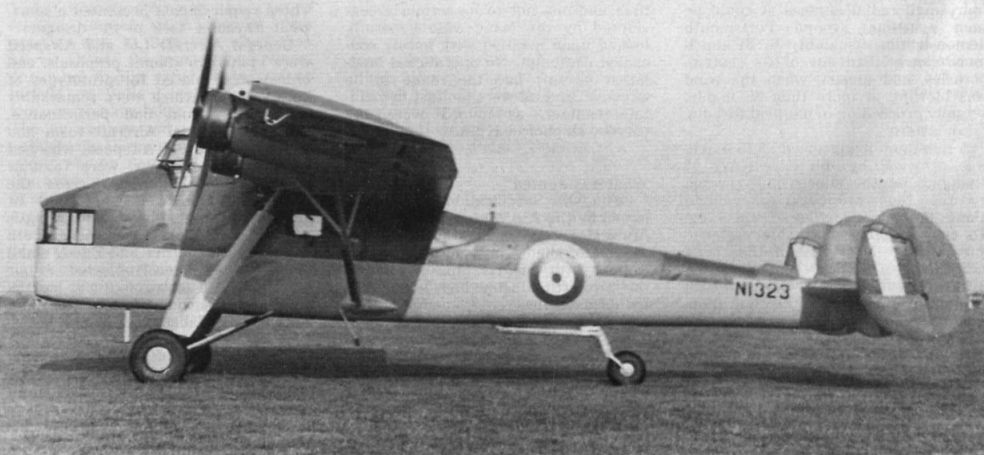
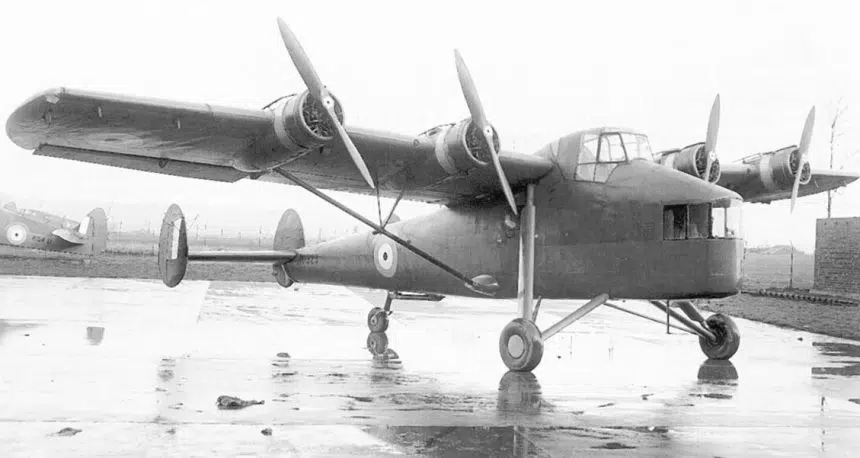

On this day in aviation history, 86 years ago (October 17, 1940), the Airspeed A.S.39 Fleet Shadower took flight for the first time. Developed for Britain’s Royal Navy, the unusual four-engine aircraft was designed to quietly patrol above enemy naval formations at night, tracking their movements and reporting their positions back to friendly forces. Development began in response to Royal Navy Operational Requirement OR.52 and Specification S.23/37, which called for a carrier-capable aircraft able to remain airborne for at least six hours while flying as slowly as 38 knots at 1,500 feet. Airspeed’s solution featured a high-mounted folding wing, fixed landing gear, and four small Pobjoy Niagara radial engines. Positioning the engines across the wing allowed their propwash to increase lift at very low speeds.

Only one of two planned prototypes was completed. Flight testing revealed stability and poor stall-handling problems, while the Niagara engines provided insufficient power. Airspeed was asked to redesign the aircraft with two Armstrong Whitworth Cheetah engines, but rapidly improving airborne radar made the entire Fleet Shadower concept obsolete. The Royal Navy cancelled the program in February 1941, and both the prototype and incomplete second aircraft were ordered scrapped. The A.S.39 measured 40 feet in length with a wingspan of 53 feet 4 inches and was powered by four Pobjoy Niagara V radial engines producing approximately 140 horsepower each. It could reach about 126 mph, cruise at approximately 113 mph, and remain airborne for six hours. Its service ceiling was approximately 14,700 feet, with a crew of three consisting of a pilot, observer, and radio operator.