







|
Original Italian Article by: Enrico Peschiera Originally published in Osservatorio Artico on April 9, 2026 Official English Translation and Expanded Illustrated Edited by:Luciano A. Sapienza Photographs by: Luciano A. Sapienza |
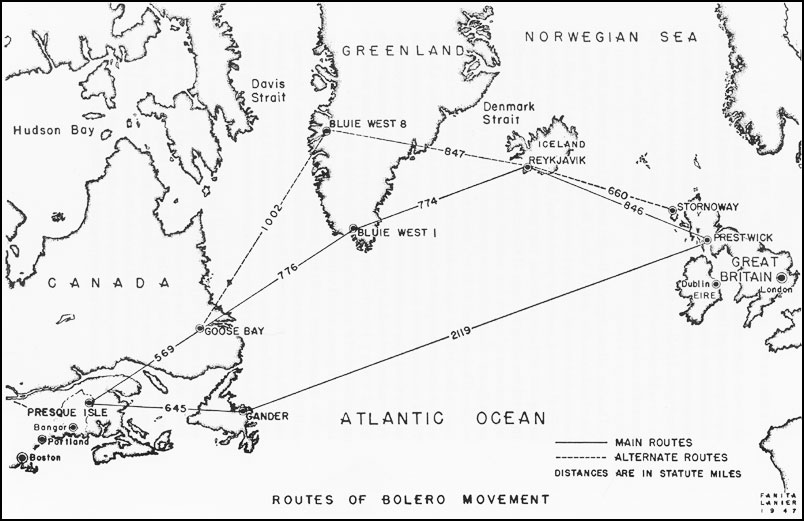
In July 1942, a formation of American aircraft disappeared into the frozen wilderness of Greenland—victims not of enemy action, but of weather, navigation, and fuel exhaustion. The flight, consisting of six Lockheed P-38 Lightnings and two Boeing B-17 Flying Fortresses, was part of the vital transatlantic pipeline delivering aircraft to Britain. As conditions deteriorated over the ice cap, the formation became disoriented and dangerously low on fuel, leaving the crews with no option but to attempt emergency landings on the vast, unforgiving surface below. It was a desperate decision, yet remarkably, every crew member survived. Rescue efforts succeeded, but the aircraft themselves were abandoned where they sat, silent against the ice.
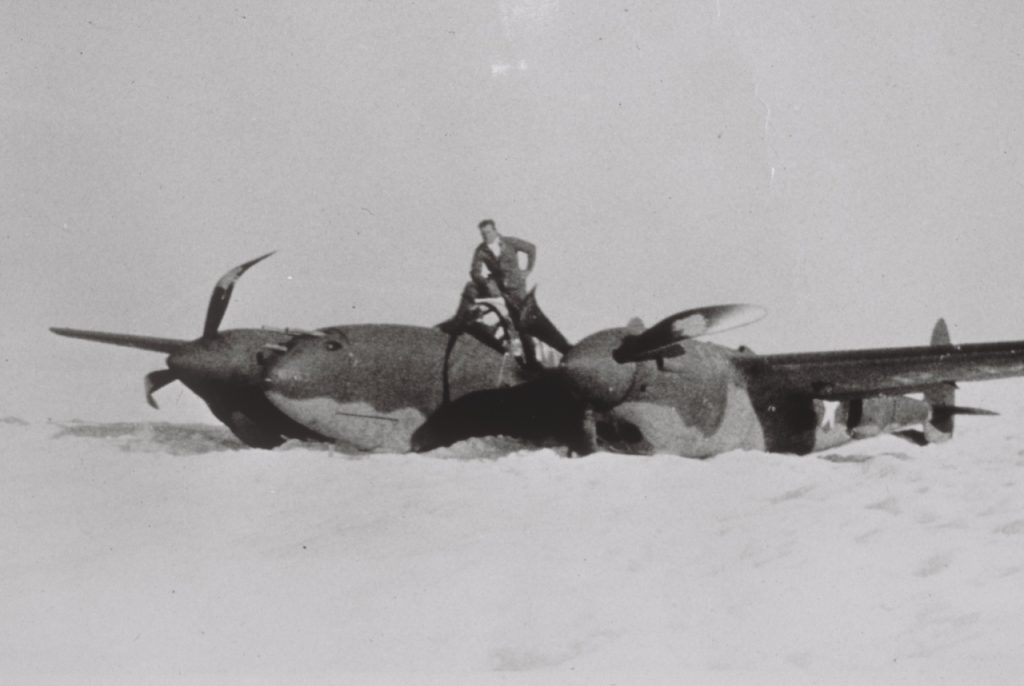
For a time, it seemed the story might not end there. Pilots flying over the region in the 1950s and early 1960s reported seeing the aircraft still resting on the surface, leading to speculation that they might one day be recovered with relative ease. But Greenland’s ice sheet is never static. Snowfall accumulated year after year, compacting into dense layers that gradually entombed the aircraft. They did not sink—the world rose above them. By the mid-1960s, the last visible traces had disappeared, and the Lost Squadron passed from reality into legend, buried more than 260 feet beneath the ice.
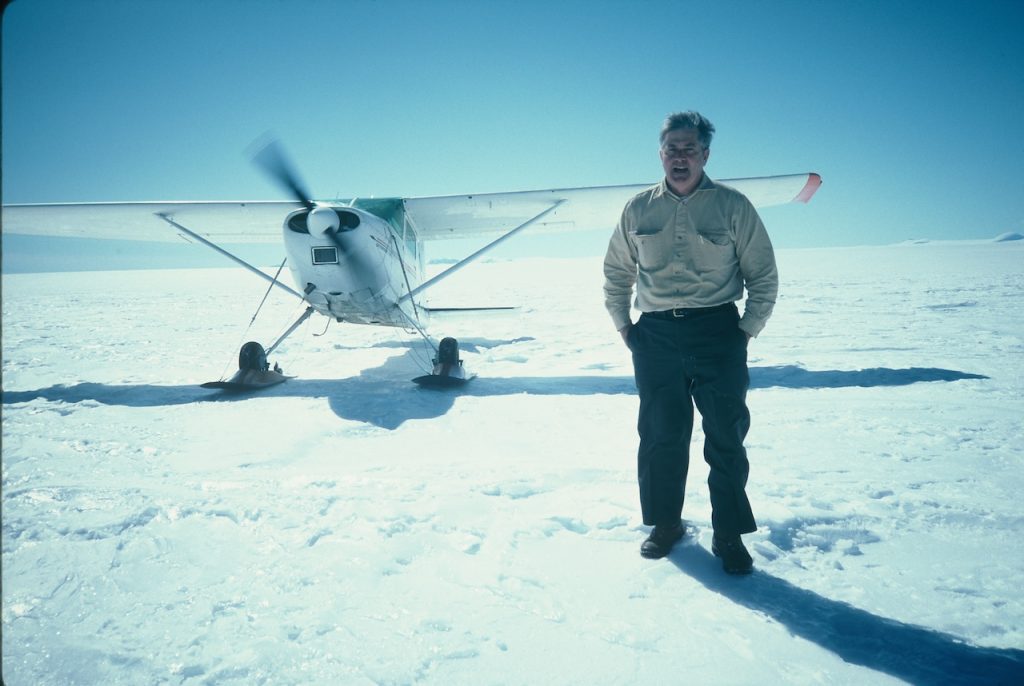
That legend persisted until the early 1980s, when a determined group led by Pat Epps and Richard Taylor set out to locate the buried aircraft. What followed was a long and uncertain search complicated by the slow movement of the glacier, which had shifted the aircraft miles from their original landing sites. Early ice-penetrating radar produced only faint and ambiguous returns, but persistence eventually paid off. The signals strengthened, revealing the aircraft still present deep beneath the surface, arranged much as they had been when they landed in 1942. To confirm their discovery, the team devised a hot-water probe system, melting narrow shafts into the ice until they struck metal. The recovery of a small section of engine tubing provided the proof they needed—the Lost Squadron had been found.
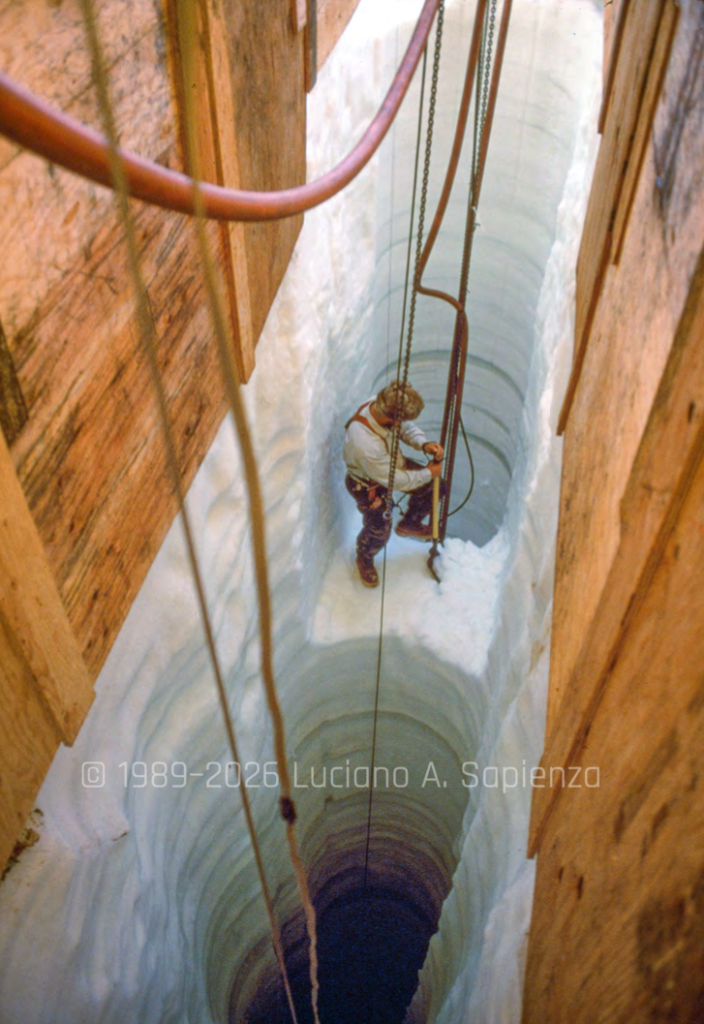
Reaching the aircraft, however, presented an entirely new challenge. The team developed a thermal drilling system capable of melting a vertical shaft more than 80 meters down through solid ice. It was an unprecedented undertaking, requiring ingenuity, endurance, and a willingness to operate at the limits of what was possible in such an environment. As Luciano Sapienza, who would later join the expedition, put it, “We weren’t just searching for aircraft—we were literally digging through time.”
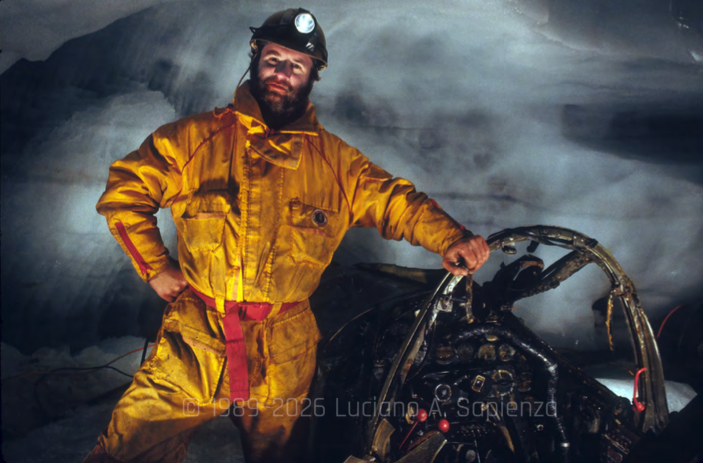
Sapienza became involved after seeing a news report about the expedition, recognizing immediately that it represented a rare and extraordinary story. “It all happened almost by accident,” he recalled. “I saw a CNN report… and knew I had to be there—it could be the opportunity of a lifetime.” Selected as the expedition’s photographer, he joined the team during its final recovery seasons, though his role would quickly extend beyond documentation into active participation in the recovery effort itself.
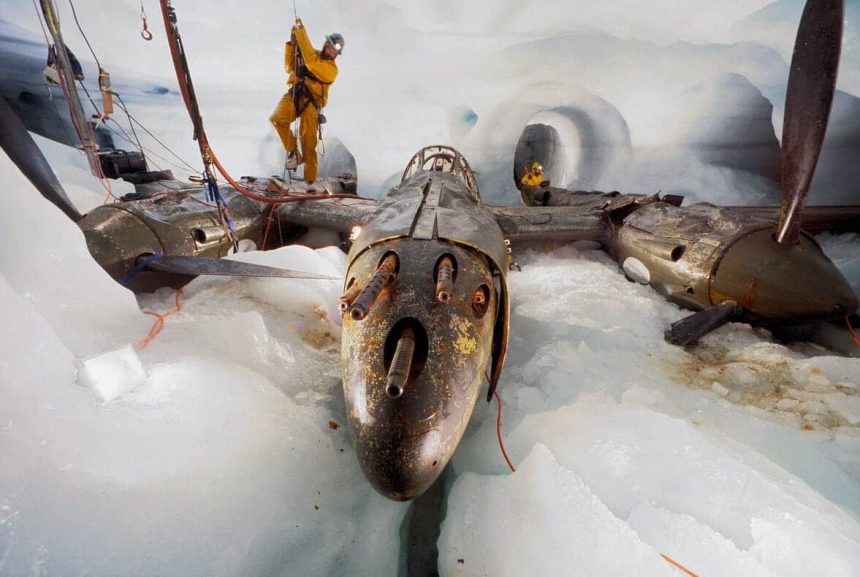
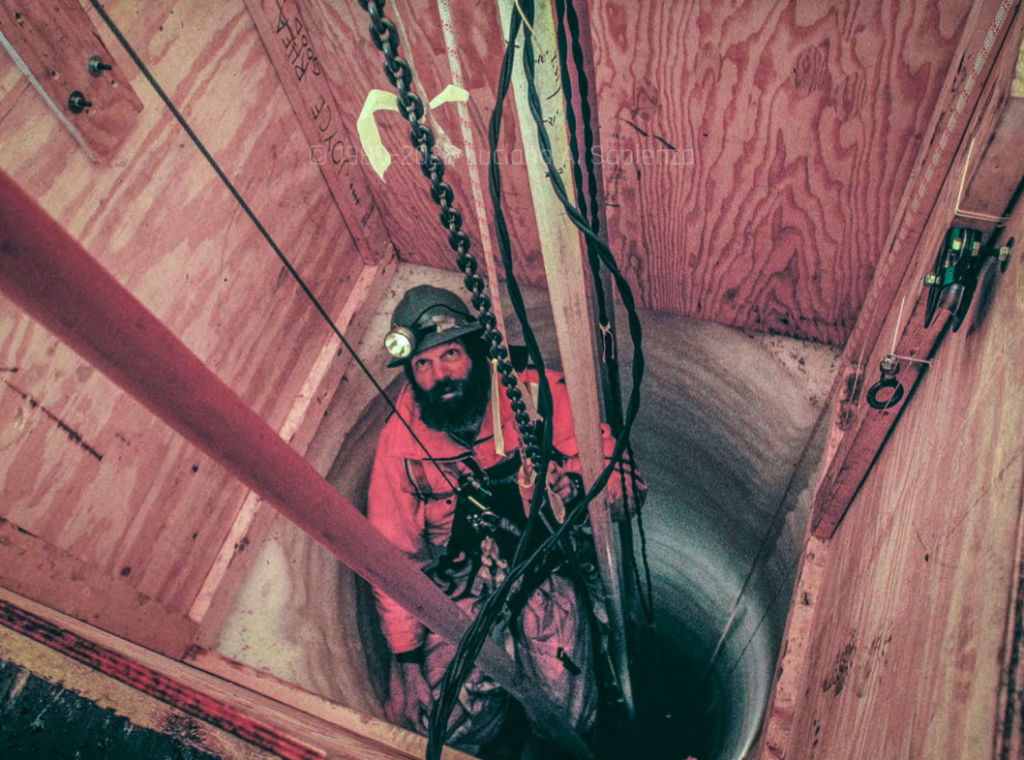
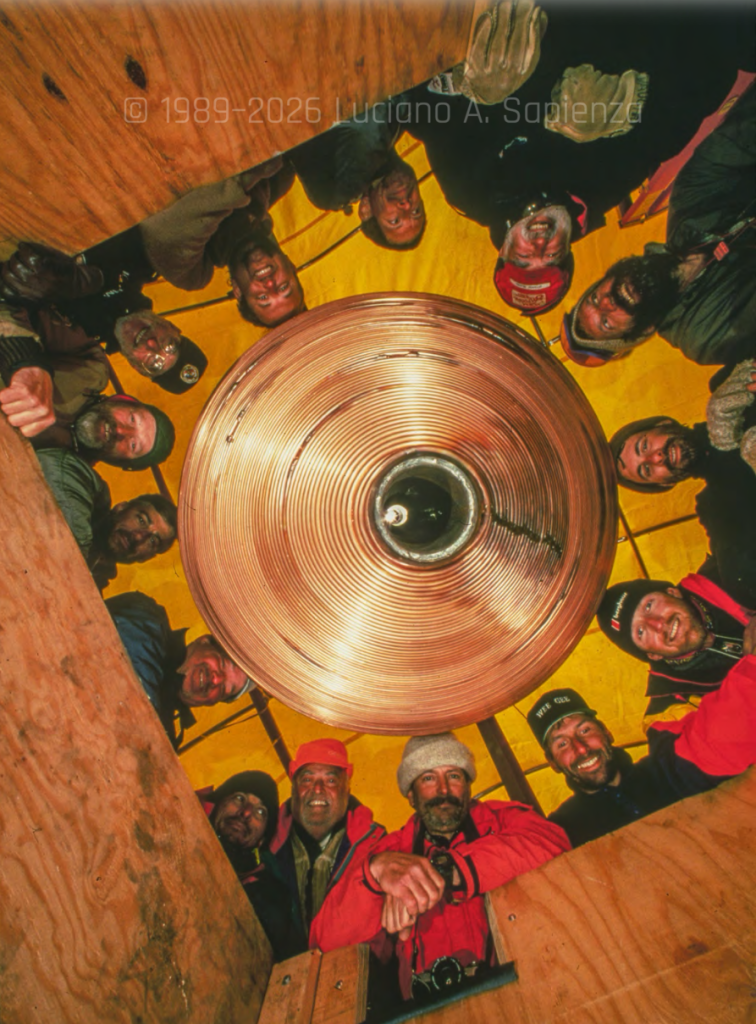
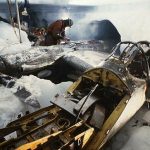
By the early 1990s, the expedition focused on a single aircraft—a P-38 Lightning that would later be known as Glacier Girl. Reaching it required descending a narrow, ice-lined shaft barely wide enough for a person, a slow and claustrophobic journey into the depths of the glacier. “The descent was slow and claustrophobic,” Sapienza recalled. “We were suspended from a single chain winch, surrounded by electrical cables, high-pressure hoses, and cases of photographic equipment.” At the bottom, the team carved out a cavern around the aircraft, revealing a scene that seemed almost unreal: a WWII fighter frozen in place, preserved within a chamber of ice for half a century.
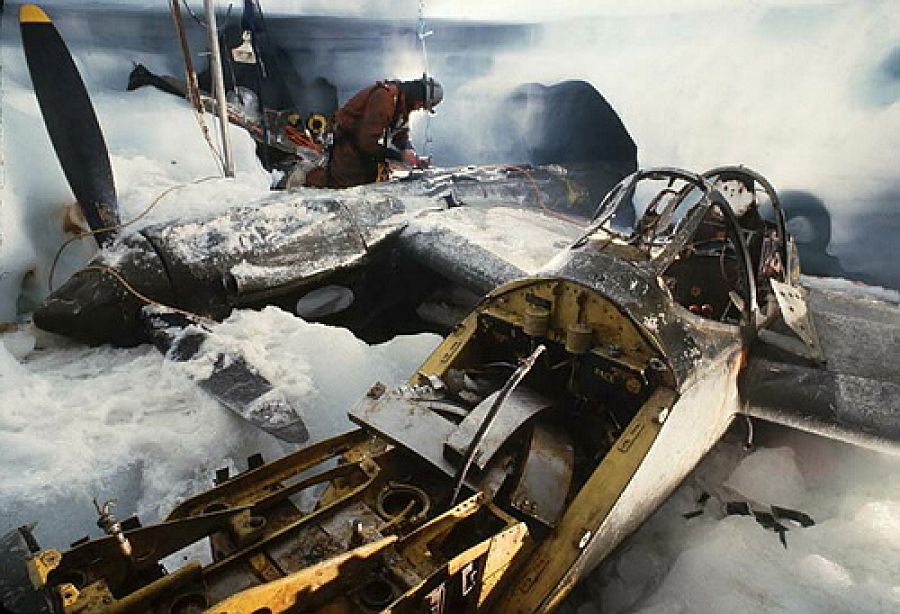
Conditions inside the cavern were harsh and unpredictable. Meltwater fell constantly from the ceiling, the air was thick with fumes from long-trapped engine oil, and there was no ventilation. The glacier itself creaked and cracked under shifting pressures, a constant reminder of the danger overhead. “The glacier cracked with thunderous reports,” Sapienza said. “If the ceiling caves in, it’s over.” Despite these risks, he pushed to fully expose the aircraft before disassembly, recognizing the importance of capturing it intact. The resulting photographs—carefully lit under difficult and hazardous conditions—would become some of the most iconic images ever taken of a recovered warbird.
Once documentation was complete, the painstaking process of dismantling the aircraft began. Working in tight quarters, the team removed engines, wings, and structural components piece by piece. The preservation was remarkable, with even the aircraft’s original armament and ammunition still intact after decades in the ice. Each component had to be carefully hoisted to the surface through the narrow shaft, a slow and precise operation with little margin for error. The final lift, involving the cockpit section, proved the most challenging, requiring additional excavation to allow the structure to pass safely upward. When it finally emerged into daylight, the recovery phase was complete—the first time in fifty years that parts of the Lost Squadron had seen the surface again.
Reflecting on the achievement, Sapienza later noted, “This reflects nearly a decade of patience, perseverance, risk, and innovation… At the time, no one had ever recovered an aircraft from such depths.” Yet even then, the story was far from over. Transported to the United States, the aircraft underwent a meticulous restoration process that would span nearly a decade. Piece by piece, Glacier Girl was rebuilt, eventually returning to flight and transforming from a frozen relic into a living piece of history. Sapienza’s connection to Greenland continued long after the recovery, leading to further expeditions and the founding of the Fallen American Veterans Foundation, dedicated to locating missing servicemen. His experiences on the ice left a lasting impression. “The Arctic rarely gives second chances,” he said. “You are always just one step away from becoming part of the glacier itself.”
Glacier Girl was never the end of the story. It became the basis for future missions with real consequences—honoring our WWII missing with the intent to return them home, and in doing so, honoring their families for their endurance and patience over decades. All of this reinforces the idea that Glacier Girl was not just a remarkable recovery—it demonstrated what was possible and set the stage for ongoing efforts to locate and recover missing WWII airmen in some of the most remote regions on earth. That legacy continues through subsequent expeditions in Greenland and beyond, where advances in technology and hard-won field experience are now being applied to the recovery of missing servicemen. These missions carry a profound sense of purpose. More than 83,000 Americans remain missing in action from WWII alone, many lost in remote and unforgiving environments where recovery remains extraordinarily difficult.
The work is ongoing—not only in Greenland, but also in similarly extreme regions such as Antarctica, where teams continue to push the limits of exploration, logistics, and endurance in the effort to bring the fallen home. It is a mission that extends beyond aviation history into remembrance, accountability, and national commitment. As Sapienza notes, this broader continuity—from Glacier Girl through later missions—is an essential part of the historical record, one that deserves to be fully told. For more information about ongoing recovery efforts and ways to support the mission, visit www.FallenAmerican.org.









Wow just incredible, so much for global WARMING.
Fantastically brave crew ,going the limits for a worthy cause 👏 brilliant
Two stories of Downed aircraft.
One, an ‘Unfortunate Lucky Loss’; the second a rescue of Survivors that left dead Comrades Behind.
With ‘Glacier Girl’ an unfortunate mishap bequeathed Us a valuable WW2 aircraft; albeit one recovered at great effort – and considerable risk.
The second loss led to the immediate recovery of Survivors, but left their Dead Crew Mates Behind; surprising, as the wreckage lay upon the surface.
I gather the video report dates from 2007 (61 years on from 1946) and talks of ‘Possibilities’.
Did the – awaiting permission – recovery ever take place; and, if not, for what reason?