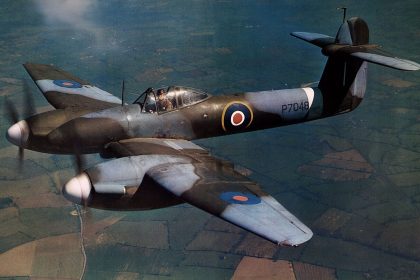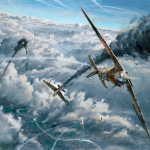


On this day in aviation history, 88 years ago (October 11, 1938), the Westland Whirlwind took flight for the first time. Westland chief test pilot Harald Penrose was at the controls of prototype L6844. Developed as a heavily armed twin-engine fighter for the Royal Air Force, the Whirlwind was among the fastest combat aircraft in the world when it first flew and became the RAF’s first single-seat, twin-engine, cannon-armed fighter.

Development of the Whirlwind began in response to Air Ministry Specification F.37/35, which called for a high-performance fighter armed with four 20 mm cannons. Designed under the direction of W. E. W. Petter, the compact aircraft featured a clean, streamlined airframe, retractable landing gear, a T-tail, and one of the world’s earliest full bubble canopies. Its four Hispano cannons were concentrated in the nose, eliminating the convergence issues associated with wing-mounted guns.

The Whirlwind entered RAF service in 1940, but difficulties surrounding its Rolls-Royce Peregrine engines delayed production and limited the aircraft’s future. Only 114 aircraft, including two prototypes, were completed. Despite its limited numbers, the Whirlwind proved effective as both a fighter and ground-attack aircraft, serving primarily with Nos. 263 and 137 Squadrons. The type was withdrawn from RAF service in December 1943, and no complete original Whirlwinds survive today. A replica is being built by the Whirlwind Fighter Project of Kent, UK.

The Whirlwind measured 32 feet 3 inches in length with a wingspan of 45 feet and was powered by two 885-horsepower Rolls-Royce Peregrine I engines. It could reach a maximum speed of 360 mph, had a range of approximately 800 miles, and a service ceiling of 30,300 feet. Armament consisted of four nose-mounted 20 mm Hispano cannons with 60 rounds each, while fighter-bomber variants could carry two 250- or 500-pound bombs.