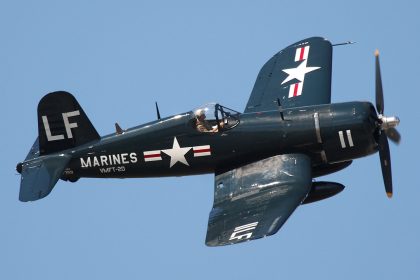
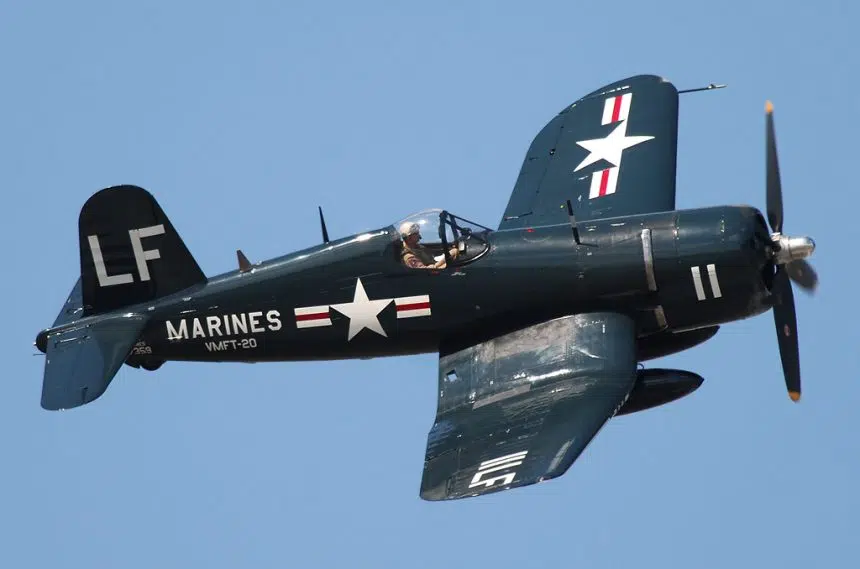

In 1917, aviation pioneer Lewis and former chief engineer of the Wright Company, Vought, formed the Lewis and Vought Corporation to capitalize on the post-WWI aviation industry. The company started in Astoria, New York, and moved to Long Island City, New York, in 1919. After Lewis retired in 1922, the company changed its name to Chance Vought Corporation. In 1922, Vought made history when the VE-7 trainer became the first aircraft to take off from the USS Langley, the first American aircraft carrier. The VE-11 naval fighter and Vought’s O2U Corsair, the first Corsair aircraft, followed. In 1928, United Aircraft and Transport Corporation bought the company, but it remained a separate division with Pratt & Whitney and Boeing. Vought died of sepsis in 1930, having overseen the production of various fighters, trainers, surveillance aircraft, and flying boats for the US Navy and the Army Air Service. Vought continued to design and build aircraft during the Great Depression. After the death of Chance Vought in 1930, the company moved to East Hartford, Connecticut. In 1934, the government required United Aircraft and Transportation Corp. to split its businesses, creating Boeing Aircraft, United Airlines, and United Aircraft Corp., with Vought becoming part of the latter. In 1939, United Aircraft moved the company to Stratford, where it merged with the Sikorsky division to form Vought-Sikorsky Aircraft. Work on the XF4U began in 1938 under chief engineer Rex Beisel. The F4U Corsair first flew in 1940, and over 15,000 were built for the Navy and Marine Corps during WWII. In 1942, Vought was reestablished as a separate division within United Aircraft.

In 1949, Vought moved operations to the old North American Aviation “B” plant in Dallas, Texas. The Navy encouraged the move because it thought having both of its main aircraft suppliers on the East Coast was too risky. Vought successfully moved 27 million pounds of equipment and 1,300 employees in 14 months, a record for industrial moves at the time. In 1954, Vought split from United Aircraft and became a separate company, Chance Vought Aircraft, Inc. Vought began producing the F-8 Crusader for the Navy in 1957, which was one of the Navy’s first supersonic planes and the last to rely solely on guns. The design was later modified to create the A-7 Corsair II, used for close air support and attack missions. The A-7 entered service in 1965 and played an important role in various operations, including the Vietnam War, which began in 1967. The aircraft also took part in the US invasion of Grenada in 1983, raids against Syrian missile sites in 1983, strikes against Libya during Operation El Dorado Canyon in 1986, attacks on Iranian naval forces during Operation Praying Mantis in 1988, the invasion of Panama in 1989, and throughout Operation Desert Storm in 1991. The US Navy used the A-7A, A-7B, A-7C, and A-7E. The US Air Force and Air National Guard purchased the A-7D. Two-seat versions called TA-7C/Es served with the US Navy, while the US Air Force bought the TA-7K. Greece and Thailand also used a limited number of A-7s. In 1962, James Ling purchased Vought and created a conglomerate called Ling-Temco-Vought (LTV). Vought Aeronautics and Vought Missiles and Space continued to work on projects for the Air Force and Navy as part of LTV Aerospace.

In 1972, Vought began reorganizing by merging its Missiles, Space, and Aeronautics divisions to form Vought Systems. In 1976, all of LTV Aerospace was renamed the Vought Corporation. However, by 1983, the company split again into aeronautics and missile divisions under LTV Aerospace and Defense. By the early 1980s, LTV faced challenges and had to lay off many employees. In 1992, LTV sold Vought to Northrop and the Carlyle Group, each owning about half of the company. The missile division was sold to Loral Corporation, which is part of Lockheed Martin Missiles and Fire Control. In 1994, Northrop Grumman, which succeeded Northrop and Grumman, bought the Carlyle Group’s interest in Vought for $130 million. The Carlyle Group revived the Vought name in 2000 when it formed Vought Aircraft Industries, Inc. and acquired Northrop Grumman’s aerostructures business. Vought works mainly as a subcontractor for aerostructures, with work on the Boeing 747 and 787 and providing components for the F-22 Raptor, F-35 Lightning II, and V-22 Osprey. In July 2003, the Carlyle Group’s Aerostructures Corp., located in Nashville, Tennessee, merged with Vought. Vought’s Nashville site makes wing components for the Airbus A319, A320, A330, and A340. In July 2009, Boeing announced it would buy Vought Aircraft Industries’ facility in North Charleston, South Carolina, where Vought makes sections 47 and 48 of the aft fuselage for the Boeing 787 Dreamliner. Boeing agreed to pay $580 million for this facility. In June 2010, the Carlyle Group sold Vought to the Triumph Group, which makes aerospace components. Vought now operates as Triumph Aerostructures – Vought Aircraft Division. The facility in Dallas/Grand Prairie closed, and operations moved to a new site in Red Oak, Texas.