








This article is based on and translated from an original Japanese report by Yahoo News Japan and TV Asahi NEWS and verified by Japanese sources. Off the coast of Kagoshima Prefecture, Japan, a remarkable piece of aviation history has resurfaced after more than eight decades beneath the waves. On April 8, recovery teams successfully raised a Kawanishi N1K2-J Shiden-Kai—one of the Imperial Japanese Navy’s most capable late-war fighters—bringing an end to its long underwater slumber.
Recovered from a depth of approximately three meters and located just a few hundred meters offshore near Akune City, the aircraft emerged from the seabed at around 2:30 p.m., watched by a gathered crowd of historians, volunteers, and local residents. Despite its prolonged exposure to the marine environment, the aircraft’s overall form remained strikingly intact, with wings and structural features still clearly identifiable.

The Shiden-Kai, known to Allied forces by the reporting name “George,” was introduced in the final phase of the Pacific War and quickly earned a reputation as one of Japan’s most formidable land-based fighters. Designed as an evolution of the earlier N1K1 floatplane fighter, the N1K2-J featured improved aerodynamics, powerful armament, and excellent maneuverability—qualities that allowed it to compete effectively with contemporary Allied aircraft.

According to historical accounts, this particular aircraft was lost in April 1945 during an engagement with U.S. B-29 bombers. Piloted by Captain Hayashi, the fighter was forced into an emergency landing at sea off Kagoshima, where it sank and remained undisturbed for 81 years. The effort to recover the aircraft was led by a local preservation group headed by Eisuke Himoto, who emphasized the project’s educational significance. “Fewer people today have a direct awareness of the war,” Himoto explained. “We want future generations to see the real thing—to understand history through something tangible.”

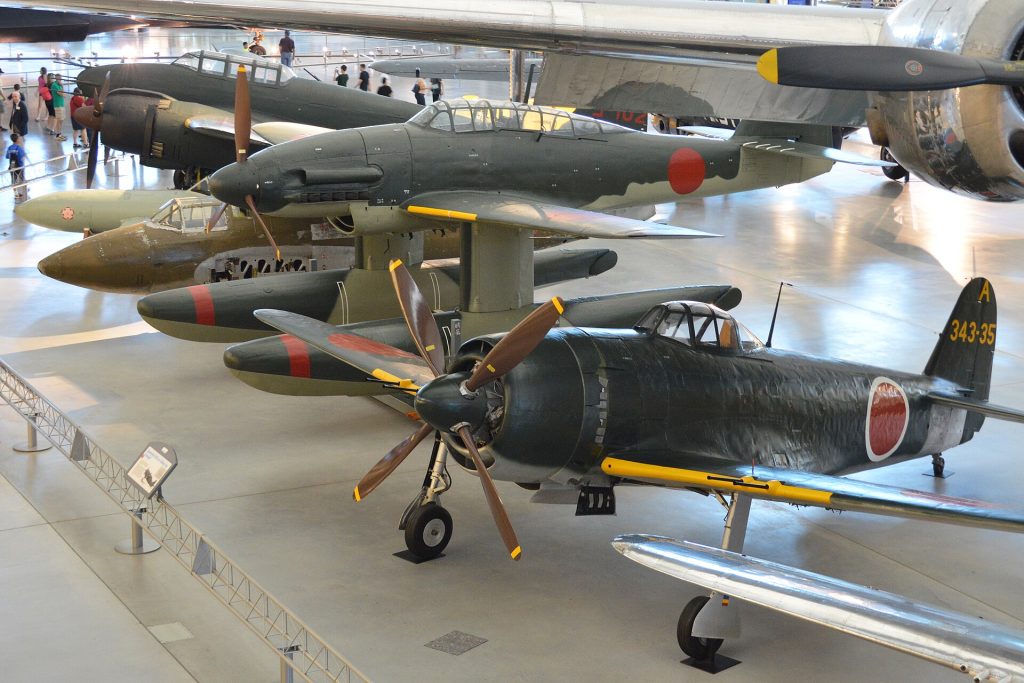
Following several hours of careful lifting operations, the aircraft was brought safely to the surface. Observers noted that while corrosion and structural damage were evident, the Shiden-Kai retained a surprisingly graceful outline. “It’s truly beautiful,” Himoto remarked after the recovery. “The body is damaged, of course, but I’m grateful it survived in such a recognizable form.” Plans are now underway to conserve, restore, and ultimately display the aircraft, ensuring that this rare survivor of Japan’s wartime aviation industry will serve as a lasting artifact of both technological achievement and historical reflection. Today, only a handful of Shiden-Kai and its predecessor, the N1K1 Kyōfū, survive. Four authentic Shiden-Kai fighters are preserved in museum collections, split between the United States and Japan, including examples at the National Naval Aviation Museum in Pensacola, the National Museum of the U.S. Air Force in Ohio, and the Smithsonian’s Steven F. Udvar-Hazy Center in Virginia. A fourth aircraft, recovered from the sea and linked to the elite 343rd Kōkūtai, is displayed in Ehime Prefecture, Japan. Meanwhile, the three surviving Kyōfū floatplanes are all held in American collections, with examples in storage, on display, and under restoration. Together, these rare survivors serve as enduring reminders of Japan’s wartime aviation development and the global effort to preserve its legacy.








If common reason suggests WW2 restored Japanese AC be returned to Japan, then, what are we waiting for?