






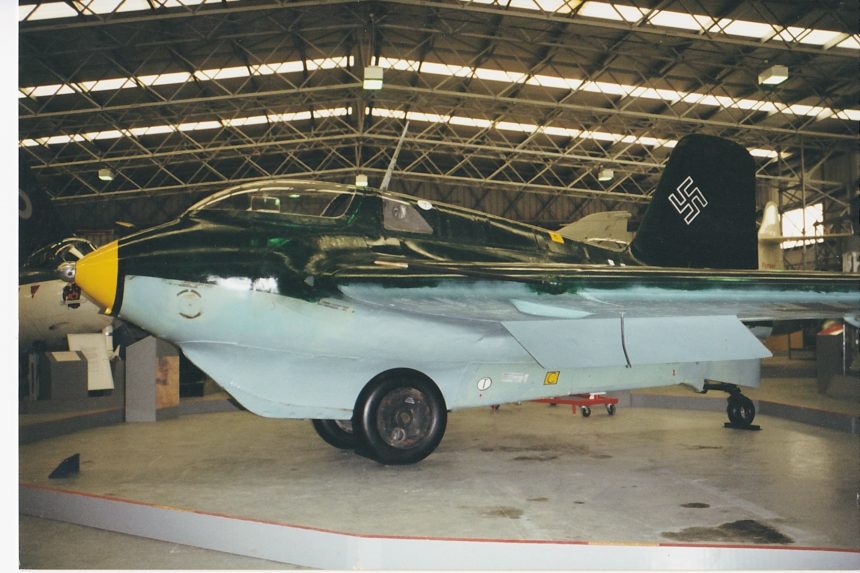

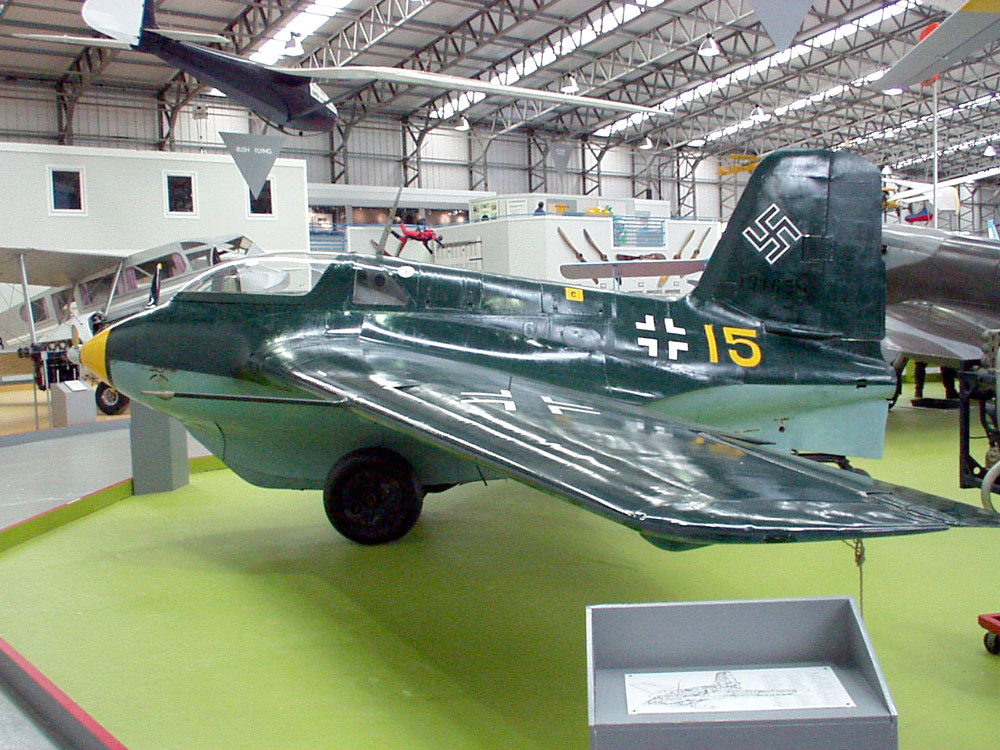
The Messerschmitt Me 163 Komet on display at the National Museum of Flight at East Fortune, Scotland, is an aircraft that both author Grant Newman knows particularly well. Grant researched the aircraft extensively during his time with the Scottish Museum of Flight, while he was directly involved in discussions surrounding the aircraft’s loan agreement in 2003. As a result, this remarkable survivor is more than just another museum exhibit—it is an aircraft with which we both share a personal connection. In the following article, Grant examines the history, technical details, and postwar journey of Me 163B-1a Werk Nummer 191659, one of the most original surviving examples of Alexander Lippisch’s revolutionary rocket-powered fighter.
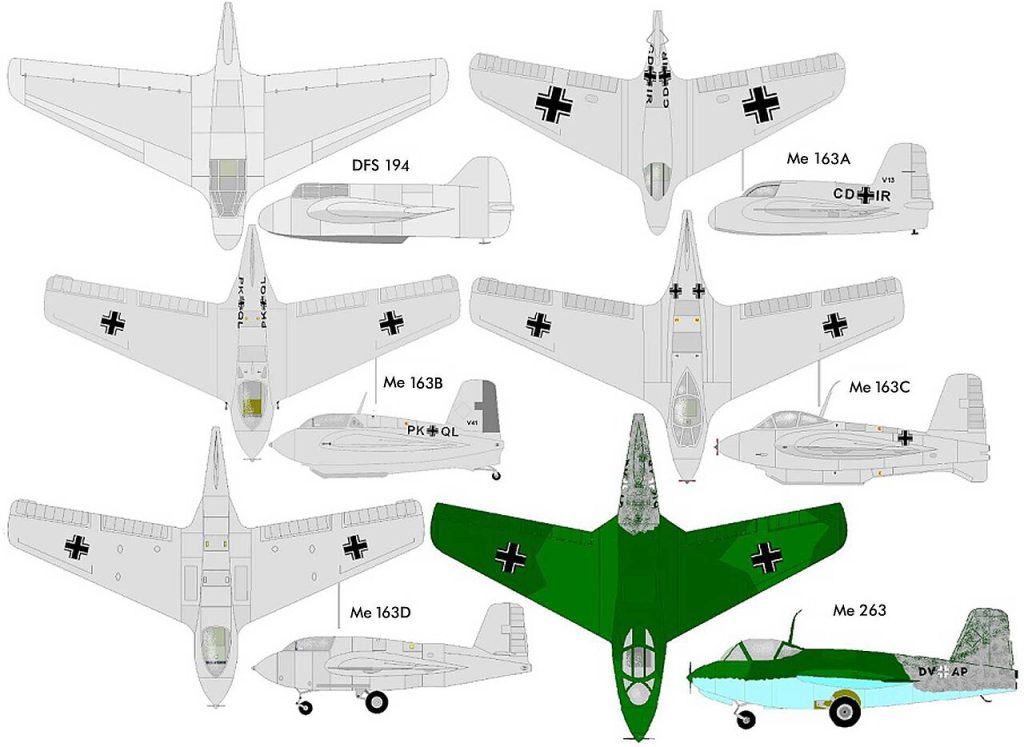
“Wie ein floh, aber oho…!”, Only a flea, but oho…! The logo was somewhat appropriately assigned to Jagdgeschwader (JG) 400’s diminutive Messerschmitt Me 163 Komet rocket-powered interceptors in 1944. The story of this mercurial example of German excess is one of technological advance, mated to a palpable sense of desperation by a regime clinging to the vain hope of victory in a war it was desperately losing. Its roots go back to tailless rocket-powered experimental aircraft designed by Munich-born aeronautical engineer Alexander Lippisch while with the Deutsches Forschungsanstalt fur Segelflug (DFS), German Institute for Sail Flight. In January 1939, Lippisch was assigned to Messerschmitt AG and, powered by Helmut Walther’s liquid-fuelled HWK-109-509A-1.0 bi-propellant rocket motor, the Me 163B-1a interceptor was born. In this article, we will examine the history and technical details of the Scottish Museum of Flight’s Messerschmitt Me 163B-1a Komet Werk Nummer 191659, one of the most original surviving examples of this extraordinary aircraft.

Constructed in September 1944 under licence by Junkers Flugzeug-und Motorenwerke AG and assembled in a production facility near Nagold in the Black Forest, Bad-Wurttemburg as Wk Nr 191659. Early Me 163Bs were originally manufactured under licence by Leichtflugzeuwerke Klemm at Stuttgart-Böblingen, with final assembly at Lager Lechfeld, a satellite to Messerschmitt’s airfield at Augsburg. Apparently, production quality at the Böblingen factory was poor, owing to the workforce being largely French slave-labourers. Air raids in late 1943 on Stuttgart, causing severe damage to the Böblingen factory, convinced the RLM to transfer production to Junkers, who dispersed it widely. Wooden wings were manufactured by furniture-making factories at Zeulenroda, as well as Deutsche Lufthansa at Ebhausen, Pucklitzsch at Zeitz, Schwarz at Themar, and Tippman at Triebes. Fuselages were manufactured by C. Fleischer & Sohn at Eilenburg, Deutsches Lufthansa at Staaken, and Junkers at Dessau, while propellant tanks were supplied by NKF at Berlin Tempelhof inside the big semi-circular airport terminal designed by Ernst Sagebiel but never used for its intended purpose, Wächter at Orla, and Wiest at Kirchheim/Teck. Undercarriage assemblies were built at Heilbronn and Leipzig.
(Image credit: Grant Newman)
After completion, which is likely to have been as one of a batch of 30 completed in January, or 20 in February 1945, the aircraft was transferred to Fliegerhorst Waldpolenz at Brandis to the east of Leipzig, where it was flight tested by Flaklehr-und Versuchsabteilung 700. This was a specialised Luftwaffe unit tasked with researching anti-aircraft missile development, but also undertook the first flights of Me 163Bs once they had been delivered to Brandis. Following service readiness, 191659 might have been inducted into JG 400, which was based at Brandis and whose personnel were working up on the type. It is uncertain which Staffel, or Gruppe 191659, was assigned to, but it was captured at Husum, Schleswig-Holstein, which points to its use by II Gruppe. After trials, the aircraft was likely transferred to Fliegerhorst Stargard-Klutzow in Western Poland, where II/JG 400 had been working in support of Me 163 operations since October 1944, to be officially declared operational in December. At this time, II/JG 400 was under the command of Gruppenkommandeur Paul Rudolf “Rudi” Opitz, who was the Luftwaffe’s chief test pilot of the Me 163B with Erprobungskommando 16 at Peenemünde.
(Image credit: Grant Newman)
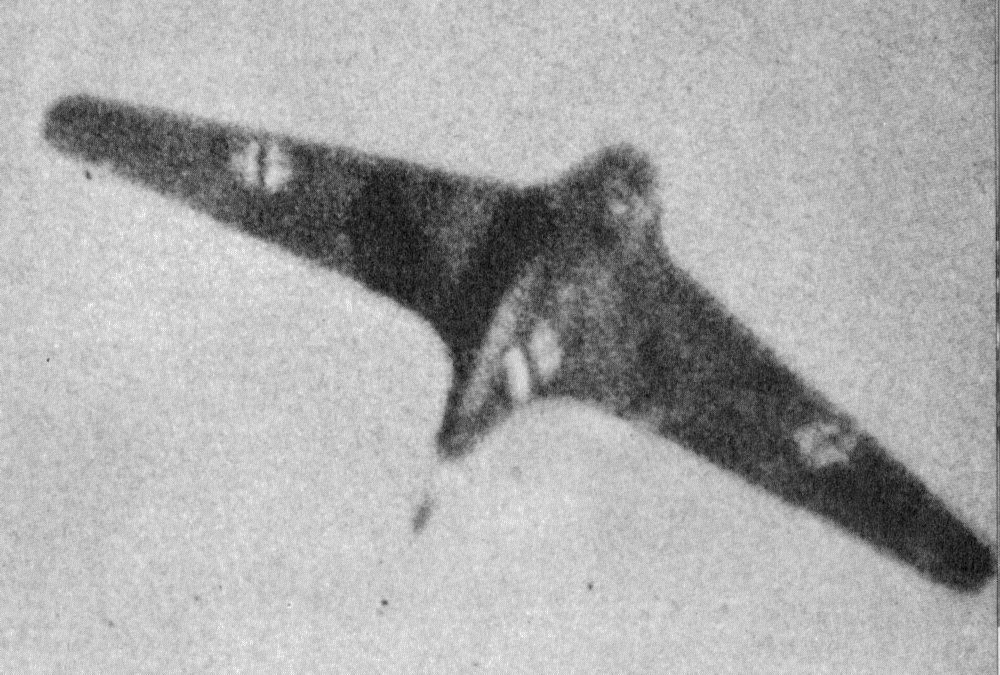
In early March 1945, owing to the proximity of the invading Soviet armies to the Polish border with the Soviet Union, II/JG 400 transferred to Fliegerhorst Bad Zwischenahn in Lower Saxony, which resulted in a rapid departure from Stargard-Klutzow. Komets were either flown or dismantled and transferred by train. Throughout March, II/JG 400’s Me 163s were busily intercepting USAAF air raids, with combat recorded on the 12th, 14th, 15th and 23rd of the month, and on the 15th, USAAF escort fighter pilots attested to encountering 11 Me 163s in combat. Late in the month, the unit and its rocket fighters were ordered to move under threat of occupation once again, this time by British forces, to Nordholz, near Cuxhaven. Pilots flew some of the Me 163s, but some were towed by Bf 110 twin-engined fighters, while others were transported by train. This was not to last, as in mid-April, the wayward unit and its rocket fighters moved once more, this time north to Husum. By then, II/JG 400 had recorded around 80 Komets on its books, with 60 pilots among a total of 450 personnel.
(Image credit: Wikipedia)
Operations at Husum were severely hampered by fuel shortages, which kept the majority of the Komets on the ground, although flights were sparingly made. Tragically, on April 24th, during a test flight after maintenance, Opitz suffered terrible burns when his Komet suddenly stalled and dived into the ground near the airfield. The next day, two aircraft were sent to intercept a high-flying photographic reconnaissance de Havilland Mosquito XV, but the 544 Sqn aircraft, piloted by Flt Lt J. M. Daniels and W/O J Amos, returned to RAF Benson, Oxfordshire, safely. This was the last time that II/JG 400’s Komets were sent into action against enemy aircraft, and two weeks later the war was officially over, the surrender of the unit to the British signed by Opitz, still recovering in Husum hospital.
At the surrender on May 8th, there were some 14 combat-ready Me 163s and around 15 dismantled aircraft at Husum, which arriving personnel from the Royal Aircraft Establishment (RAE) at Farnborough, Hampshire, examined with interest. On the 18th, at 6 am, with the assistance of a handful of German technicians, British test pilot Eric “Winkle” Brown made a powered flight of one of Husum’s resident Komets, a feat he was reluctant to admit to officialdom as he had been given explicit instructions not to fly the aircraft under power. The identity of the Komet Brown he performed his flight in is not known, although he later visited East Fortune and claimed to have 191659 in his flying log book. Could this have been the aircraft he flew on that day? Over the next two weeks, 20 German personnel were instructed to dismantle and pack around 20 Komets and spare parts for shipping to Britain, evidently including 191659.
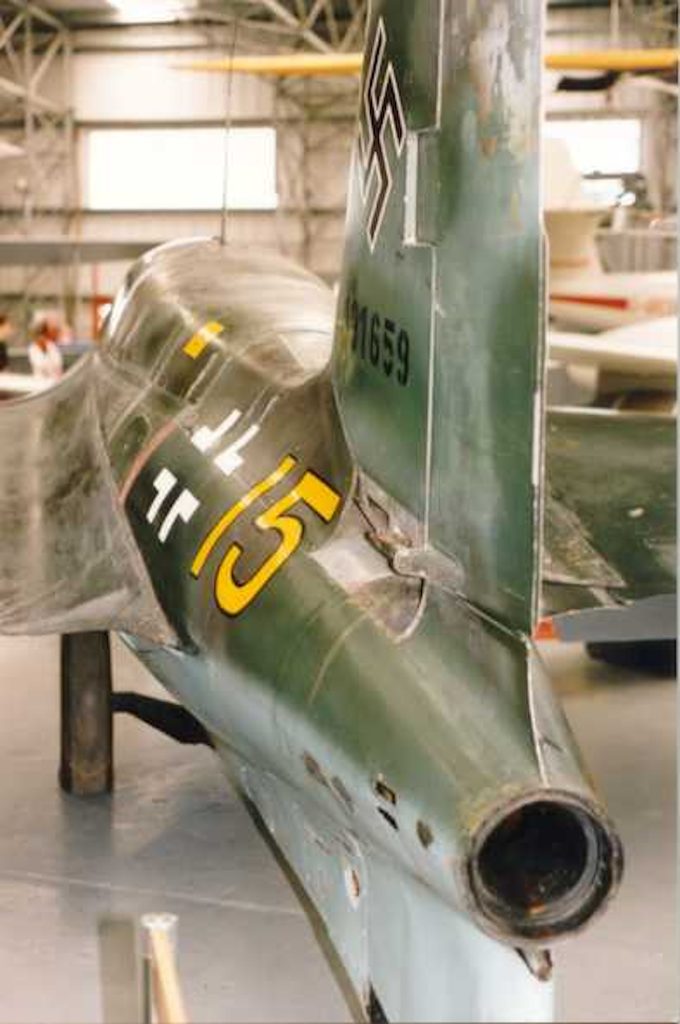
Between May and July 1945, there were some 73 aircraft and thousands of components transported from airfields around Northern Germany to Farnborough. On arrival, 191659 and the other Husum Komets were allocated standard British Air Ministry identification numbers, or Air Min numbers by Grp Capt Allan Hards, commanding officer of RAE Experimental Flying. Originally, Air Ministry personnel allocated Air Min numbers at the aircraft’s place of acquisition as a means of distinguishing them as being assigned for transport to Britain, as opposed to being destroyed where they were captured. Why the Me 163s at Husum curiously escaped this piece of official accounting is not clear, and it was up to the RAE personnel to decide which aircraft resident at Husum were sent to Britain. A total of 22 Air Min numbers were allocated to former Husum-based Komets in the 200 series to distinguish them from site-of-capture Air Min number allocations; 191659 became AM 215.
(Image credit: Grant Newman)
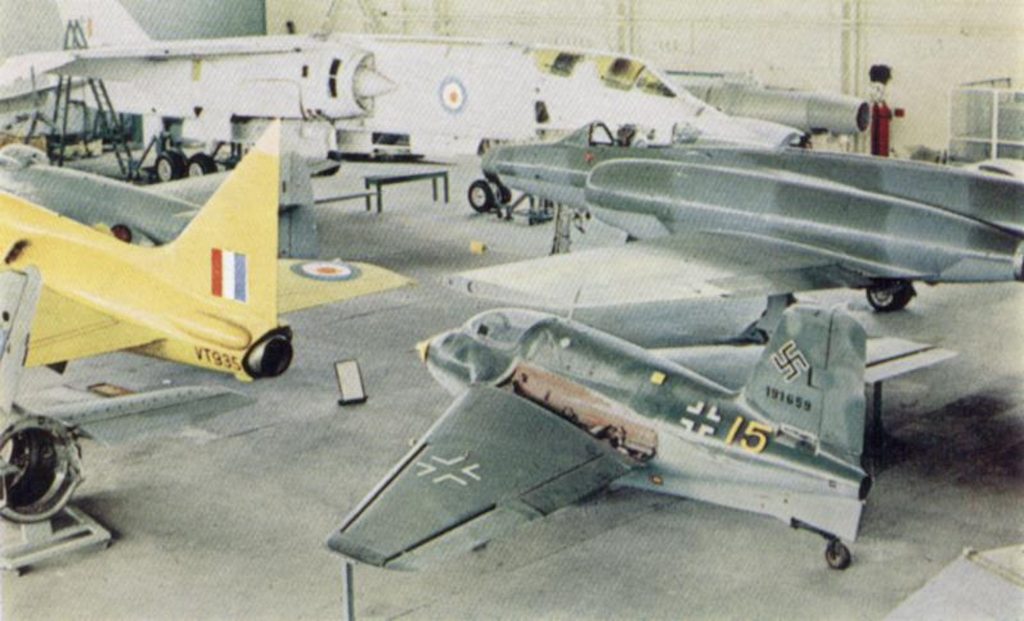
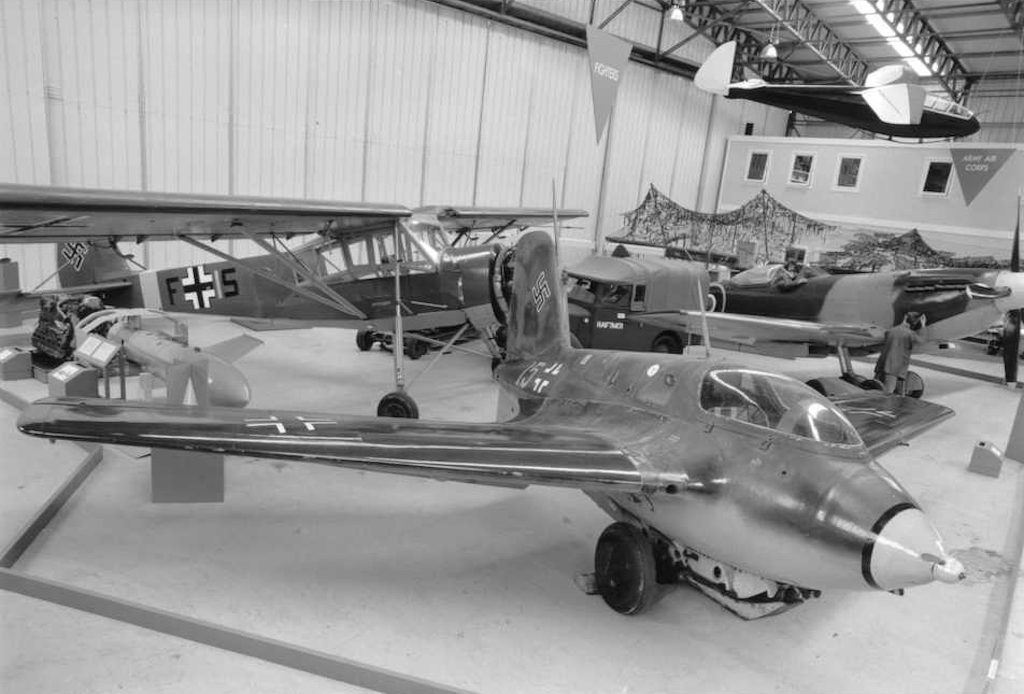
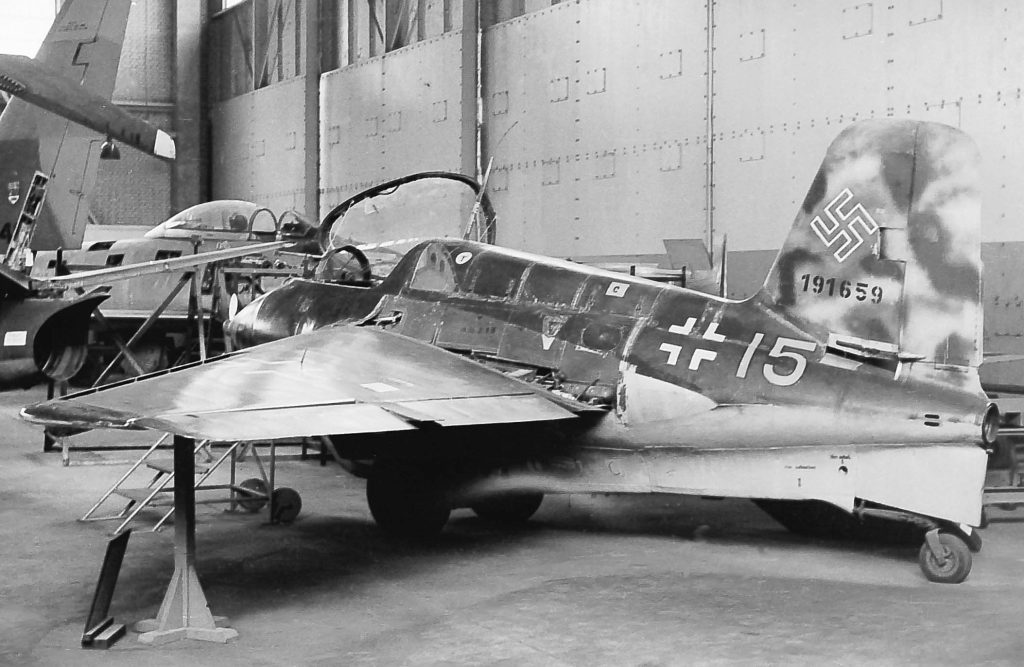
On July 26th, 191659 was one of four Husum Komets transported to RAF Brize Norton, Oxfordshire, under the care of No.6 Maintenance Unit (MU), for whom over the previous week, convoys had been steadily reducing the number of Komets at Farnborough. The movement of the rocket fighters between Farnborough and Brize Norton continued until the last convoy on August 8th, after which all the former Husum Komets had departed Farnborough. Exactly what happened to the 20 or so Komets in stasis with 6 MU has not been recorded, but a census taken on March 21st 1946 recorded that AM 215 was indeed still at Brize Norton, while other Komets had been moved to different locations. It was not for another year that 191659 departed Brize Norton for RAF Cranfield, Bedfordshire, for installation in Britain’s first tertiary education institute dedicated to the study of aeronautical science. This was the College of Aeronautics, formally opened on October 15th, 1946. Over the next 33 years, the Komet sat among a variety of airframes and components of varying types and sizes, everything from captured German technology acquired under Operation Medico in 1945, to examples of British prototype jets that had failed to secure production orders, including an example of the controversial BAC TSR.2. This fascinating assemblage of aircraft was known as the Library of Flight, of which many survive in British aviation museums to this day. While at Cranfield, however, 191659 was subject to the scrutiny of trophy hunters as its two MK 108 cannon were removed from the aircraft, while several panels from around the aircraft went missing, from around its forward undercarriage fairing and upper wing-to-fuselage joins, evident from photographs taken during its tenure at Cranfield. While there, it often departed from its display hangar for public appearances at RAF Battle of Britain Day airshows at air force bases around the country.
(Image credit: Grant Newman)
In 1970, the College of Aeronautics was renamed the Cranfield Institute of Technology, and over the next five years, the Library of Flight airframes were disposed of. It was not until November 1974 that 191659’s fate was secured through a proposed loan agreement with the Edinburgh-based Royal Scottish Museum (RSM), which had begun collecting aeroplanes and storing them in a hangar at an abandoned airfield 20 miles east of the city. Before departing for Scotland, the aircraft was sent to Cambridge Airport for remedial work to its appearance by Marshall Aerospace, until March 25th, 1975, when it departed Cambridge Airport on the back of a lorry on its ten-hour journey to East Fortune Airfield. On arrival there, it was placed within the hangar among the RSM’s other airframes as a feature of the Museum of Flight, which opened to the public for the first time on July 7th and where it remains to this day. At this stage, an analysis of 191659/AM 215’s airframe is appropriate, including remedial work done to the aircraft since its arrival at East Fortune. 191659 is in remarkably original condition, with few things missing, which is surprising given the guns were pilfered while the aircraft was at Cranfield. Remedial work has been done to replace the undercarriage fairing panels that went missing at Cranfield, following complaints from the public about the condition of the aircraft in 1993. In 1995, the missing wing-to-fuselage panels were fabricated out of glass fibre, while a year later a hastily splashed-on refresh of paint was selectively applied to the aircraft, which carelessly obscured the vertical stabiliser’s mottled colour scheme. At some stage, possibly when at Cambridge Airport, the Swastika, originally in white outline only, was blacked in.
191659 is small, only 19.4 ft (5.92 m) long and 10 ft (3.06 m) high, with a 30.5 ft (9.3 m) span. Its fuselage is a teardrop shape in profile of circular cross-section, its lines marred by an upper deck, its vertical fin, a lower undercarriage fairing and its wings. Comprising five individual sections, the Komet’s fuselage was light-weight aluminium alloy stressed-skin construction, with eleven vertical frames from the single-piece nose cone mating with the main fuselage section at Frame 1, while the main fuselage comprised Frames 2 through 7, the propulsion section mating with the main section at Frame 7 and containing Frames 8 through 11, to which the rear fuselage mated. The fifth fuselage section comprised the removable top decking aft of the cockpit.
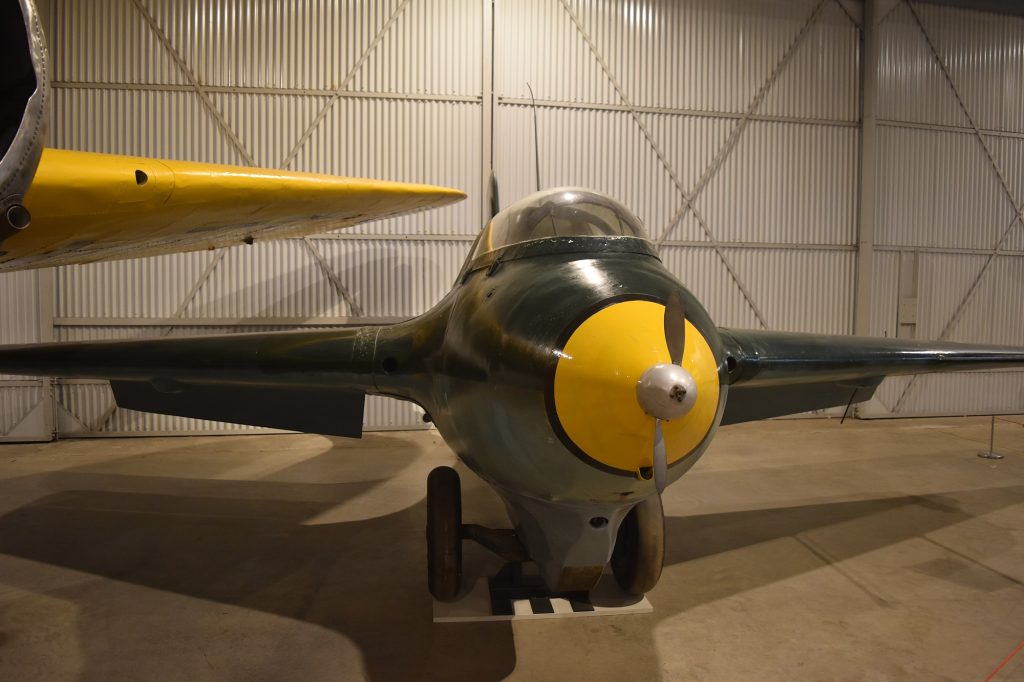
Attached to the front of the 15 mm-thick armoured nose cone was a small propeller, whose blades were offset from one another. This comically small device drove a DC generator in the front of the nose cone, which powered the aircraft’s radios and other electrical systems. Inside the nose cone is an avionics shelf dominated by a FuG16ZE radio transceiver and a 12 V DC battery, although these are missing from 191659, while a compressed air bottle lies to the left of the radio installation. Directly aft of the avionics shelf is the wooden instrument panel, which is hinged at its right-hand edge to enable access to the avionics shelf.
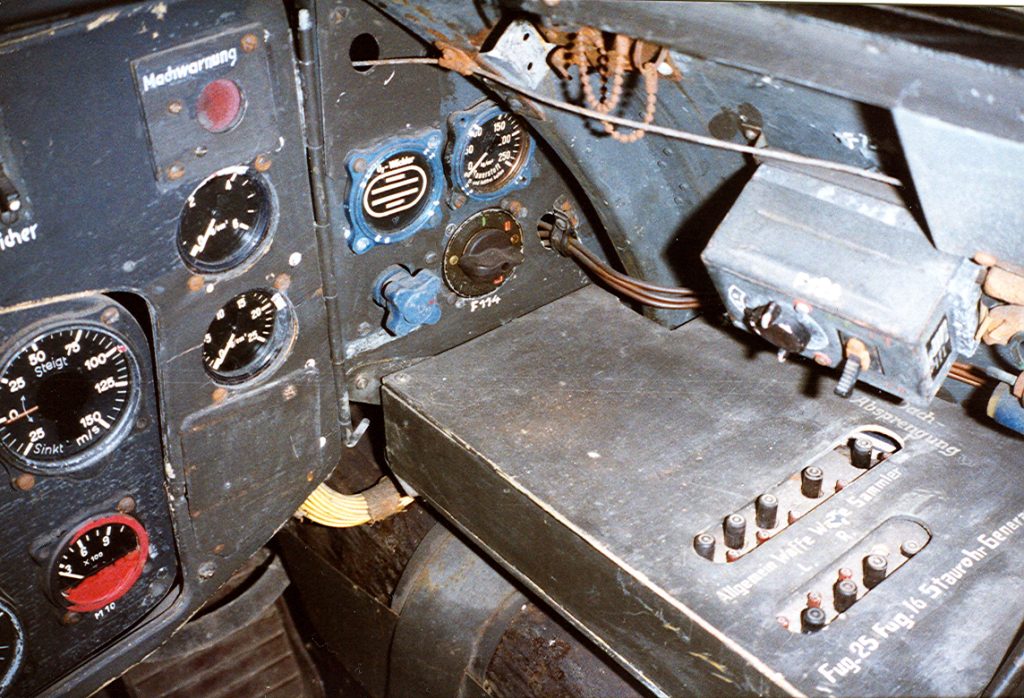
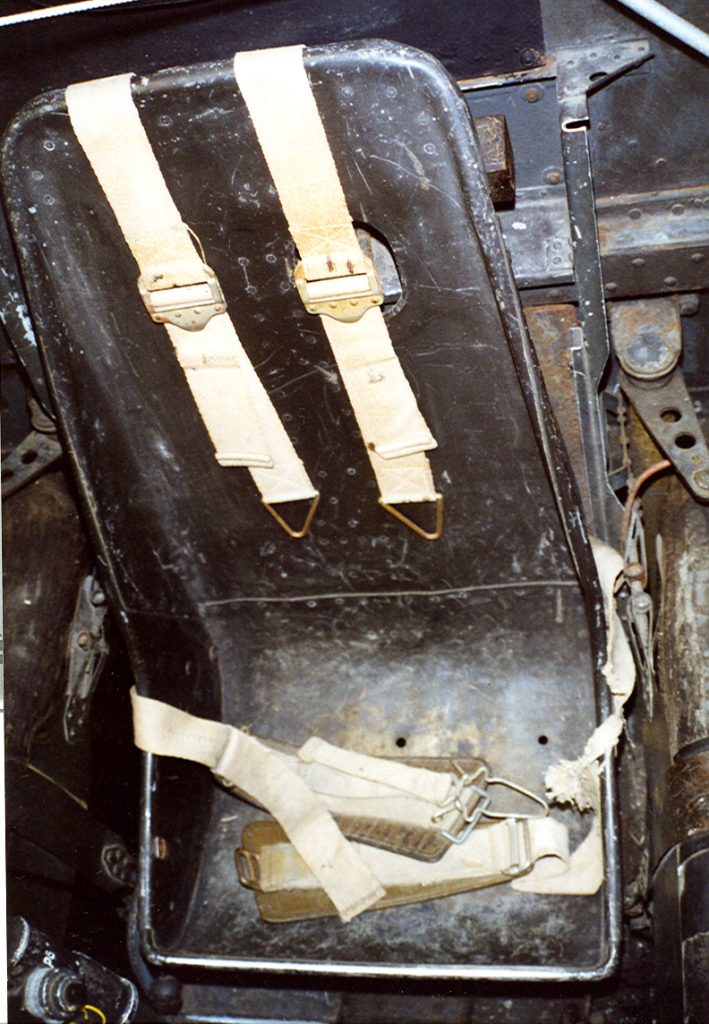
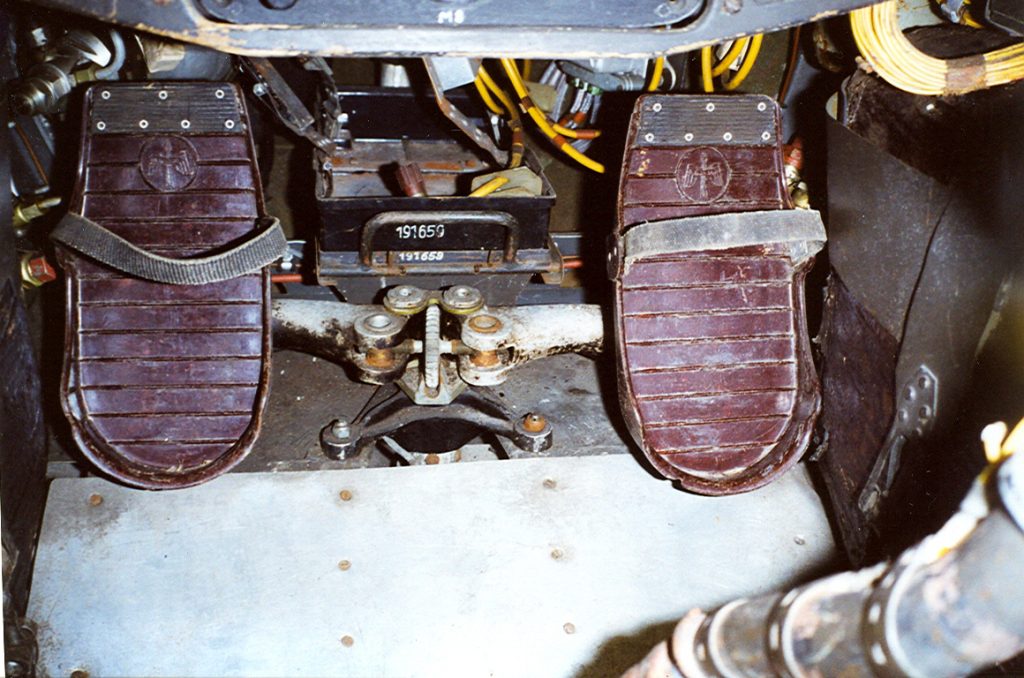
Instrumentation was the standard six flying instruments, with vertical ammunition counters for each gun at upper left, a systems switching box at centre and a red “Machwarnung” light at upper right. The Komet’s flight controls are of standard configuration, with a centrally mounted KG12E control column and Messerschmitt logo-stamped Bakelite rudder pedals. At the control column’s apex is the firing button covered by a spring-loaded cover and a gun charging button on the left side of the shaft. The rudder pedals could be adjusted, while the pilot’s seat is adjustable in height only. The seat is made of aluminium and is contoured to enable the pilot to withstand up to 12 G, with a space for the pilot’s cushion parachute in the base, with a four-point harness keeping the pilot in place. Incredibly, 191659’s cockpit is almost complete; the Revi 16B reflector gun sight normally affixed to the upper cockpit coaming is missing. On the forward cockpit coaming was a 3.54 in (90 mm) thick multi-sided slab of armoured glass supported by two diagonal braces at its front face.
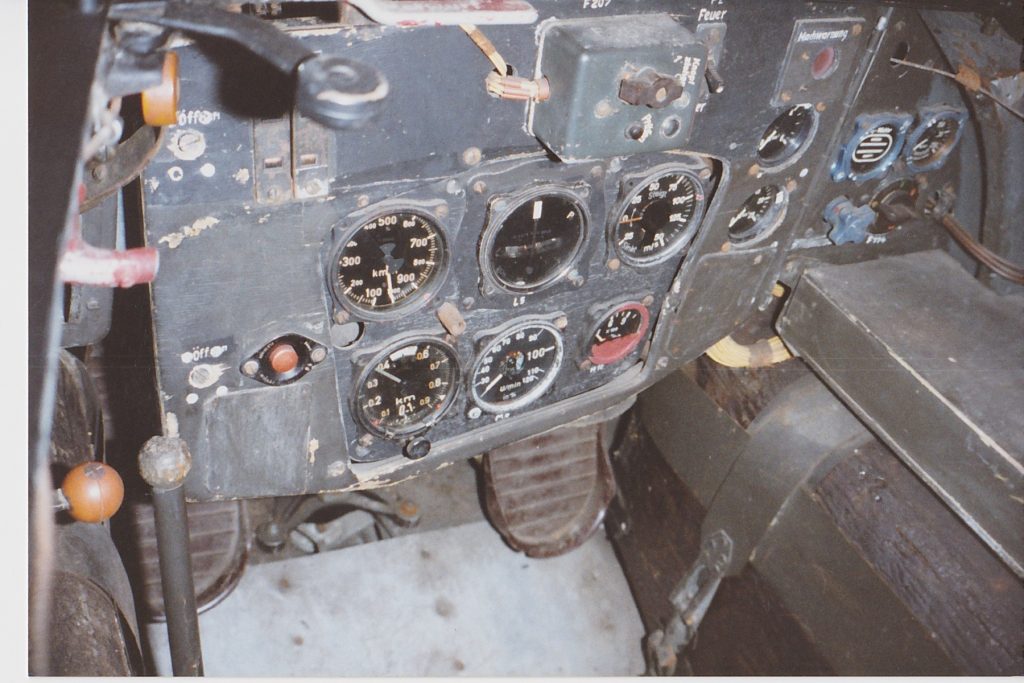
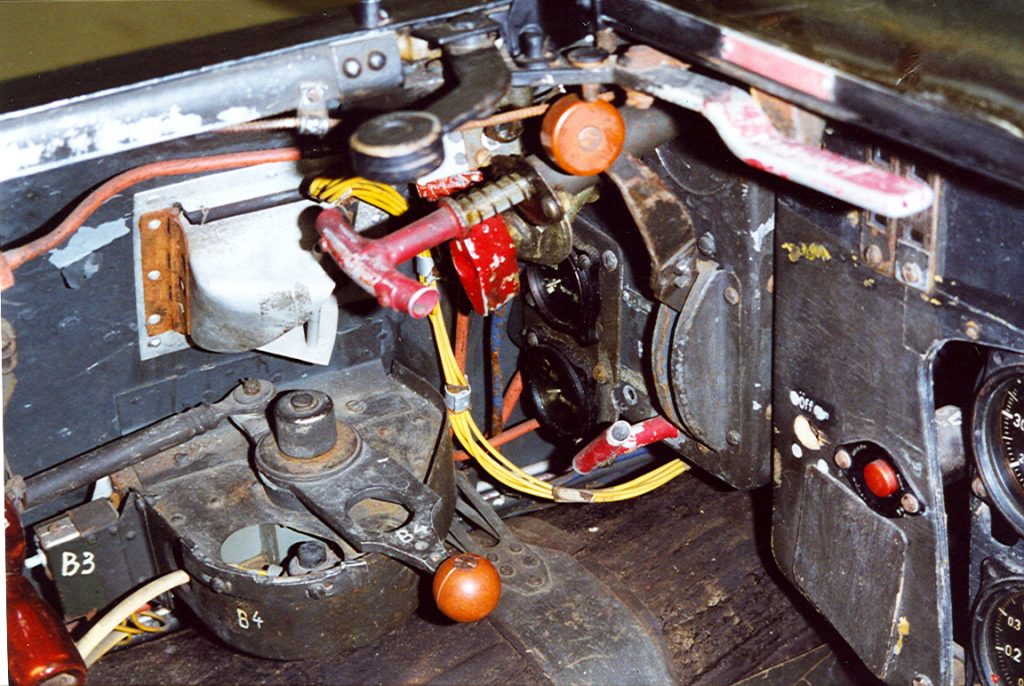
To the left of the instrument panel were various levers and handles for functions such as canopy locking, canopy jettison, undercarriage skid lowering, tow cable release and so on. Aft of this on the side console was the horizontally mounted power lever, which enabled the thrust output of the Walther motor to be regulated, a unique feature for a rocket engine, with the engine start button located aft of the lever. A prominent rotating wheel aft of the power lever box raises and lowers the trailing edge flaps, while a small handle on the floor to the left of the seat lowers the underwing landing flaps, in front of which is a handle to manually do the same. Outside the cockpit are the compressed air and hydraulic fluid filling points behind a circular panel, marked with “Presluft 130 atu” above and “Hydraulik oel” below in sync with its shape, the repaint applied at Cambridge Airport demarcation obvious against the original writing.
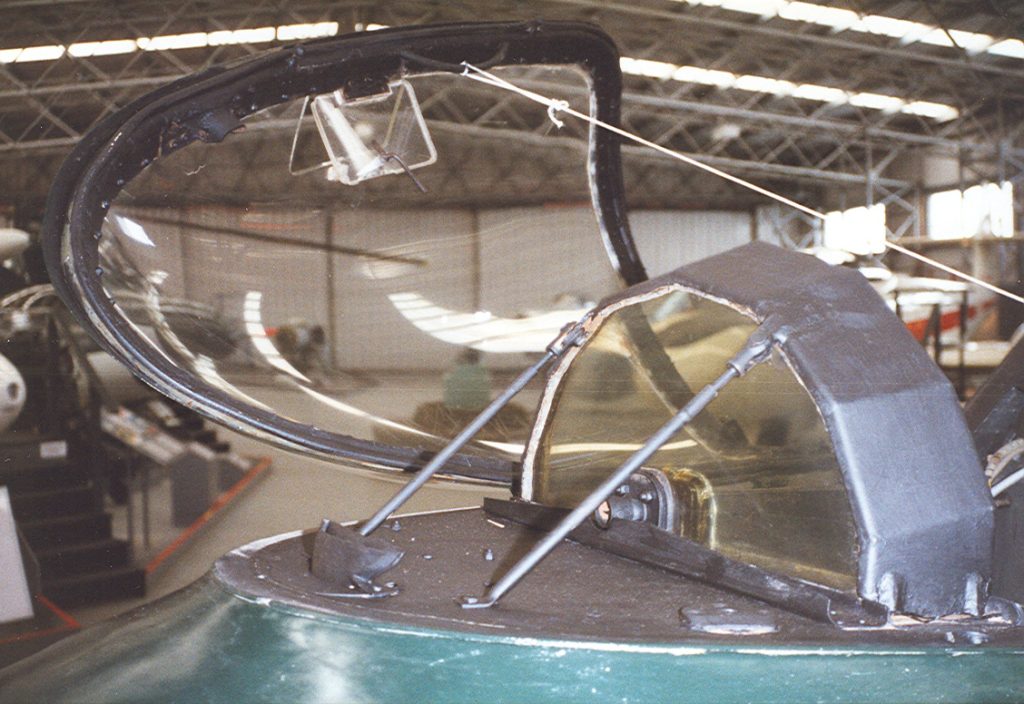
Back inside the cockpit, on the right side of the instrument panel, are oxygen indication gauges and the electrical selection box on the side console, followed by the blue oxygen supply regulator on the cockpit wall. Outside the cockpit on the right side is the ground power connection, which is covered by a spring-loaded cover. The cockpit canopy is a large moulded Perspex hood within a metal frame that is hinged to open to the right. The hood is jettisonable. There is a small Perspex door in the lower left side of the hood that is hinged on its lower edge, opening inward.
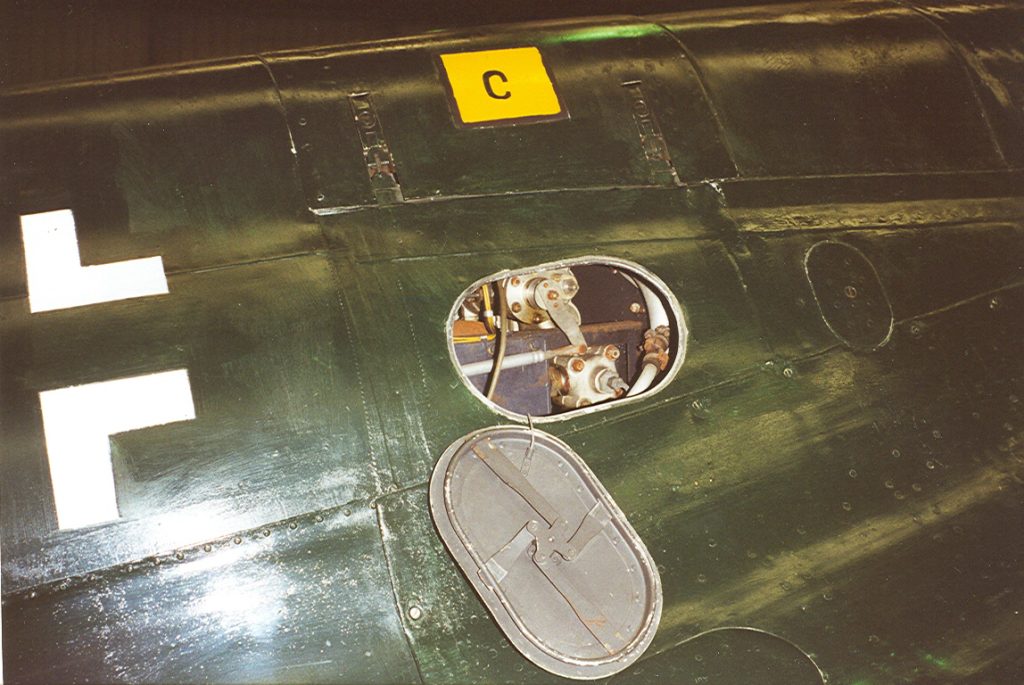
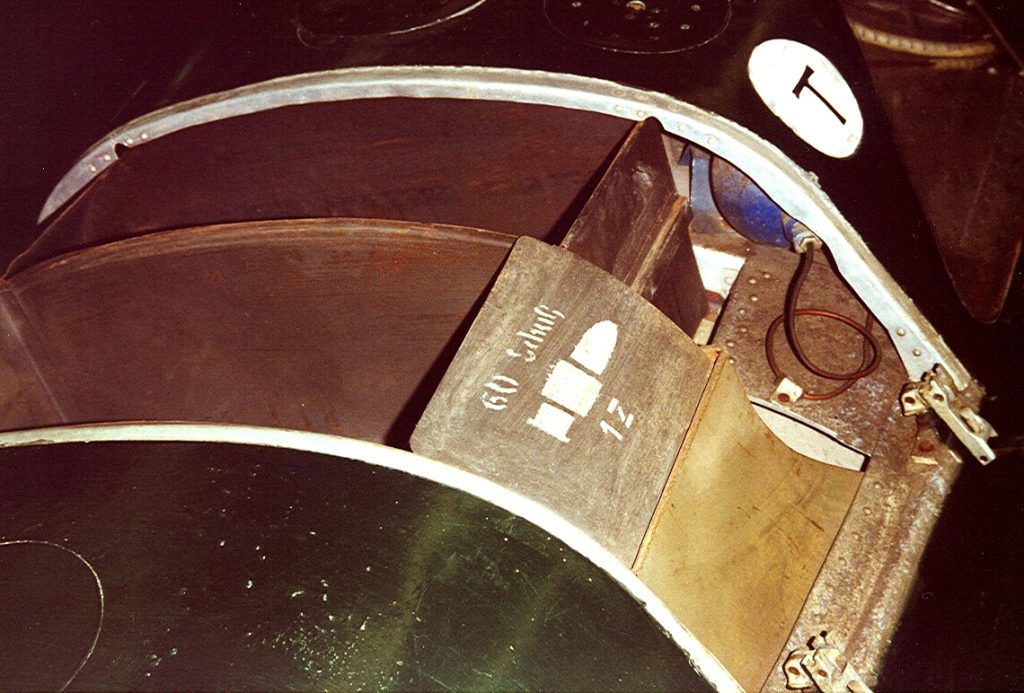
Either side of the seat, covered in a layer of roughly hewn rubberised coating and secured by broad metal straps, are two 60 lt (15.85 US gal) ceramic T-Stoff tanks, with a third 1,040 lt (274.7 US gal) primary tank aft of the cockpit rear bulkhead. Behind the seat are three armour plates, the top one of which is fitted with a headrest cushion. Small quarter light windows aft of the headrest, on either side, enabled a degree of rearward visibility through triangular Perspex windows. Between the two windows on the top coaming is the rear swept FuG16ZE radio antenna with the legend “Nicht anfassen” written on it to warn against grabbing hold of it. Aft of this is a circular panel over the primary T-Stoff filling port, prominently marked with a white circle and black T on both sides, while aft of that, beneath a removable external cover, is the ammunition storage for the Komet’s two 30 mm cannons, each trough containing 60 rounds per gun. Rear of the ammunition chutes is the C-stoff filling port for the wing-mounted tanks beneath a removable cover, which is prominently marked by a yellow square bordered in black, with a black C within on both sides of the fuselage.
(Image credit: Grant Newman)
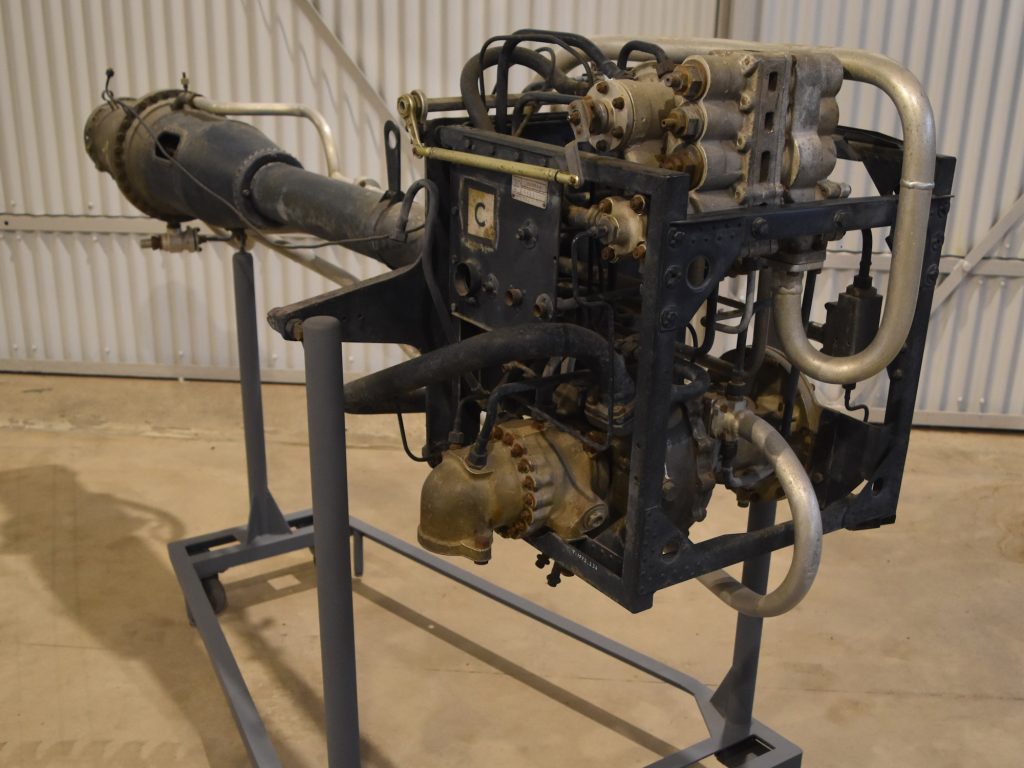
At Frame 7, the rearmost of the centre fuselage section is where the Walther HWK 109-509A-1.0 rocket motor is attached to the aircraft in an open metal box frame, still present inside 191659. This was a compact installation weighing 170 kg (374.8 lbs) and comprised the central box frame containing pumps, control valves, filter, steam generator and other components, while the thrust chamber projected aft at the apex of fuel lines, which was supported below by a single diagonal bracing strut. The propulsion section fuselage could be removed in its entirety to access the motor. The fuel for the motor was C-Stoff; methyl alcohol mixed with hydrazine hydrate, while the oxidiser was T-Stoff, or 80% concentrated hydrogen peroxide and 20% water, with phosphoric acid, sodium phosphate and 8-oxyquinoline additives. This volatile mixture was highly combustible and resulted in temperatures of over 1,850 ºC (3,362 ºF) within the thrust chamber, which C-Stoff aided in cooling through ducting around the chamber to a manageable nominal temperature of 1750 ºC (3,182 ºF). The fuel/oxidiser mix was hypergolic; therefore, it did not require an external ignition source.
At the end of the fuselage is the vertical fin, which is of aluminium alloy construction and is mounted on the fuselage at two points, aligning with its two internal spars. The rudder attached to the stabiliser trailing edge is constructed of aluminium and covered in fabric, which, in 191659, was replaced during refurbishment work carried out in 1993. Actuated by push rods, the rudder has a prominent balance horn centrally fixed to its leading edge, which sits inset into a cutout in the vertical fin. The rudder has a ground-adjustable trim tab on its lower half.
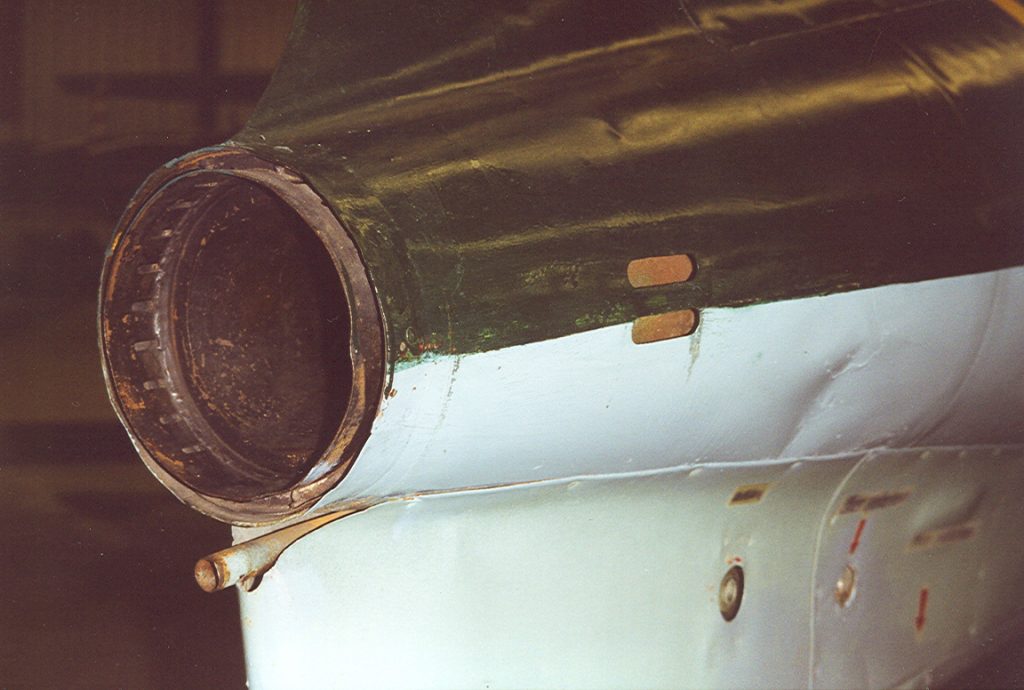
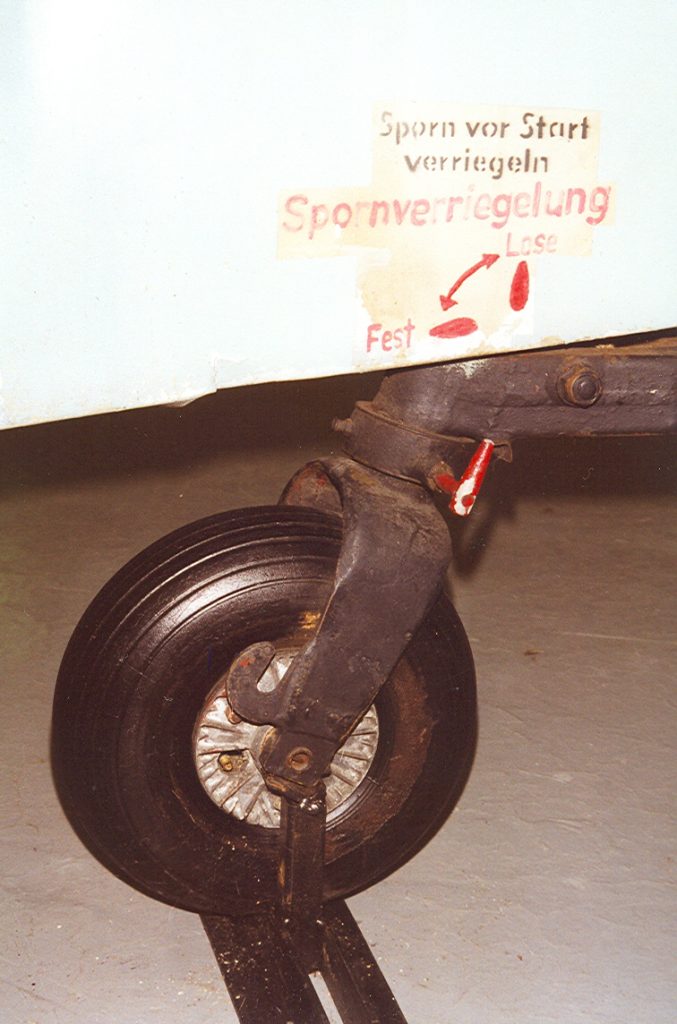
At the extreme of the propulsion section is the after fuselage, which covers the thrust chamber and venting tube below it and provides a fairing for the tail wheel mount. Inset on each side of the thrust chamber are small horizontal breathing slits forward of the exhaust opening. This is a fixed circular orifice that closely encloses the thrust chamber nozzle. Below the thrust nozzle, the tail wheel is attached to a hydraulically dampened leg, which is a y-shaped yoke, hinged at its forward arms to enable retraction. A streamlined fairing is mounted to the yoke to enable it to sit flush with the fuselage. Above the yoke’s forward edge is a circular lifting point, with a flat trestle support forward of that on the lower fuselage, both appropriately marked.
Forward of the tail wheel installation at the aft edge of the centre fuselage frame are two small pipes projecting out of the aircraft, and a circular inset with a pipe within. These are propellant drain points and are appropriately marked with nominal markings. The Komet’s main undercarriage comprised a single hydraulically cushioned two-stepped skid that was braced by three tubular swing-arms, which enabled the skid to remain retracted until landing. The hydraulic actuator was mounted above the forward portion of the skid and lowered the skid when necessary. Pilots were advised never to attempt to land the Komet with the skid retracted. A two-cable attach point is located in the front face of the lower fairing. A forged metal two-wheeled dolly is fitted to the rear skid step, while bracing arms connected to the lower fairing stabilise the dolly when installed. Each wheel has the tyre pressure of “5.5 atu” marked on the hub for filling pressure.
Now to the wings. The Komet’s wings are a single piece and made of plywood and internally were fitted with a thick tapering main spar and a rear spar, the inner edges of which are the fuselage mounting lugs. Forward of the main spar is the leading edge assembly, within which is located a 78 lt (20.6 US gal) C-Stoff tank inboard, while outboard is a fixed aerodynamic slot that enables improved low-speed airflow over the outer wings. These display prominent washout at an angle of 1 degree below the wing’s mean chord line. A prominent bump below the wing tip provided a skid as the aircraft slowed on landing. The centre wing between the spars contains a 177 lt (46.75 US gal) C-Stoff tank, below which is a propellant transfer tube covered by a fairing. Below the wing is an extendable landing flap that sits flush with the lower surface when retracted. A pole-type indicator protrudes from the wing upper surface as a visual cue to the pilot that the flaps were down. The flap angle was not selectable, being either open or closed. Aft of the rear spar, the entire wing trailing edge comprises control surfaces, which are aluminium-framed and covered in fabric. The inboard surfaces are trailing edge flaps, while the outboard surfaces are ailerons. These are fitted with a ground-adjustable tab at their outboard trailing edge. On the underside of the left-hand wing, outboard of the underwing flap, is a FuG25a IFF antenna, while the pitot tube protrudes from the leading edge inboard of the fixed slots; 191659’s being a reproduction as it’s disappeared long ago.
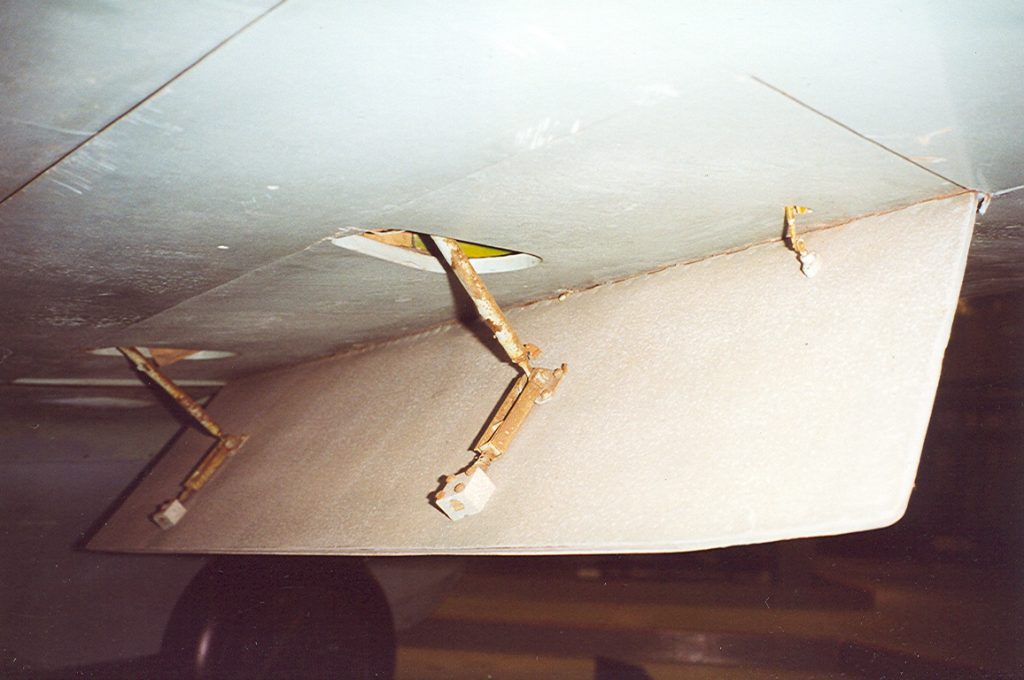
Finally, the Me 163B was armed with two Rheinmetall-Borsig MK 108 30 mm cannons, which were installed in a gap between the wings and the fuselage. These were electrically loaded and armed from the magazines in the upper fuselage decking by compressed air bottles contained aft of the guns in the wing root. The rounds were fired through orifices in the wing leading edge just outboard of the fuselage. An optical tester is mounted inboard of the left-hand gun orifice. This, then, is the story of 191659, the Scottish Museum of Flight’s Komet rocket fighter. A remarkably original surviving example of Alexander Lippisch’s deadly “Floh”, with a fascinating tale to tell.











Exelent right up about komet thank you
really enjoyed this article. knew a guy named “Dieter” who claimed to have flown one in WW2. Can you imagine what a wild ride it must have been to fly this aircraft ? golly. thanks !