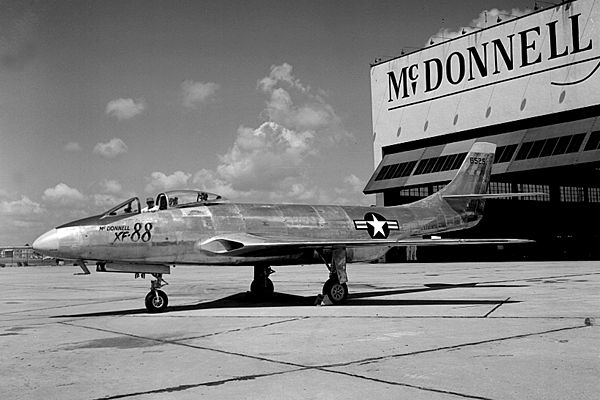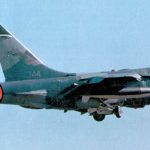
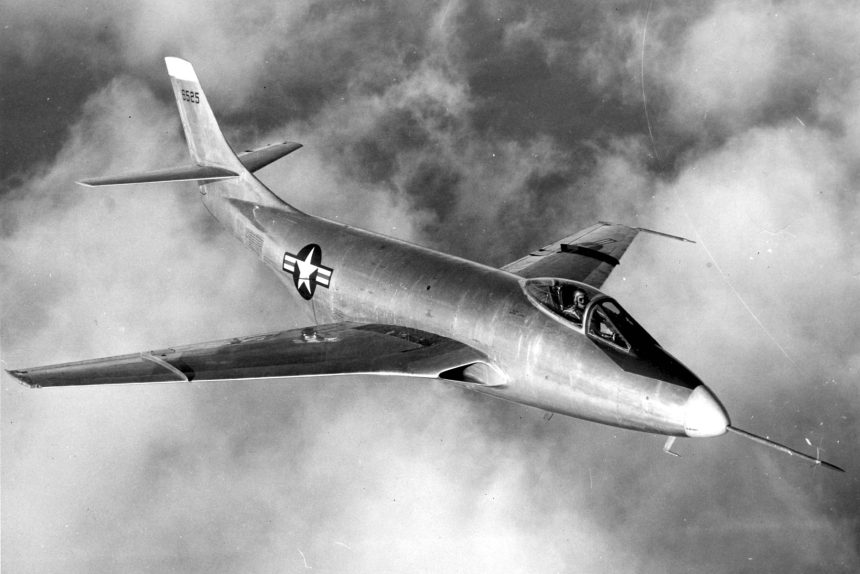


In 1946, the US Army Air Forces sought a jet-powered long-range penetration fighter to replace the wartime P-51 Mustang. As a result, McDonnell began developing a new aircraft, the Model 36, on April 1, 1946. On June 20, the company received a contract to build two prototypes, named XP-88. The initial design of the aircraft had straight wings and a V-shaped tail. But wind tunnel testing showed aerodynamic problems, and the engineers swapped out the tail for a conventional tailplane and swept the wings. The US Army Air Forces confirmed an order for two prototypes on February 14, 1947. A change in designation schemes reclassified the unflown prototypes as XF-88 on July 1, 1948, and the type was nicknamed “Voodoo.” The McDonnell XF-88 Voodoo had a low- to mid-mounted wing swept back at 35 degrees. It was powered by two Westinghouse J34 turbojet engines, each producing 3,600 pounds of dry thrust and 4,825 pounds of thrust with afterburner. The engines drew in air through wing intakes and expelled exhaust beneath the rear fuselage. The design allowed for enough space in the long fuselage to carry the fuel needed for long-range flights. The single-seat fighter was 54.1 feet long, 17.3 feet high, with a wingspan of 39.8 feet and a wing area of 350 square feet. Its empty weight was 12,140 pounds, the gross weight was 18,500 pounds, and the max takeoff weight was 23,100 pounds.
Design of McDonnell XF-88 Voodoo
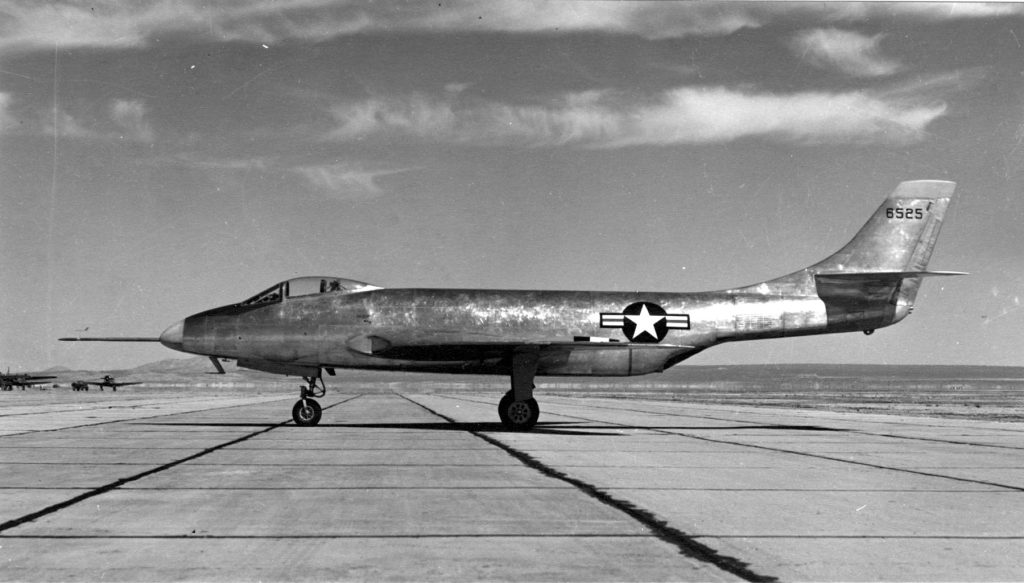
The maximum speed of the McDonnell XF-88 Voodoo was envisioned at 706 mph at 20,000 feet, with a cruise speed of 527 mph, a range of 1,737 miles, a service ceiling of 39,400 feet, and a rate of climb of 8,000 feet per minute. It could be armed with six 20 mm M39 cannon. The first McDonnell XF-88 Voodoo aircraft made its maiden flight from Muroc Field on October 20, 1948. It was unarmed and used non-afterburning J34-13 engines, which produced 3,000 pounds of thrust. Testing showed it handled well, had decent endurance, but was underpowered. Its top speed was 641 mph, slower than the F-86A in production at the time. To improve performance, engineers decided to add afterburners to the engines of the second prototype. These modified engines became J34-22s, producing 3,600 pounds of thrust. The second prototype, the XF-88A, took its first flight on April 26, 1949, and the first prototype was later upgraded to the same standards. The afterburners helped Voodoo reach speeds of 700 mph. However, it also increased the fuel consumption of the aircraft. Despite this, the US Air Force chose the XF-88 over the Lockheed XF-90 and North American YF-93 for its Penetration Fighter program. The planned production models were to use stronger Westinghouse J46 engines. An order for 118 F-93s had been canceled in 1949. Changes in Air Force priorities and a lack of funding led to the cancellation of the penetration fighter in August 1950.
The Cancellation
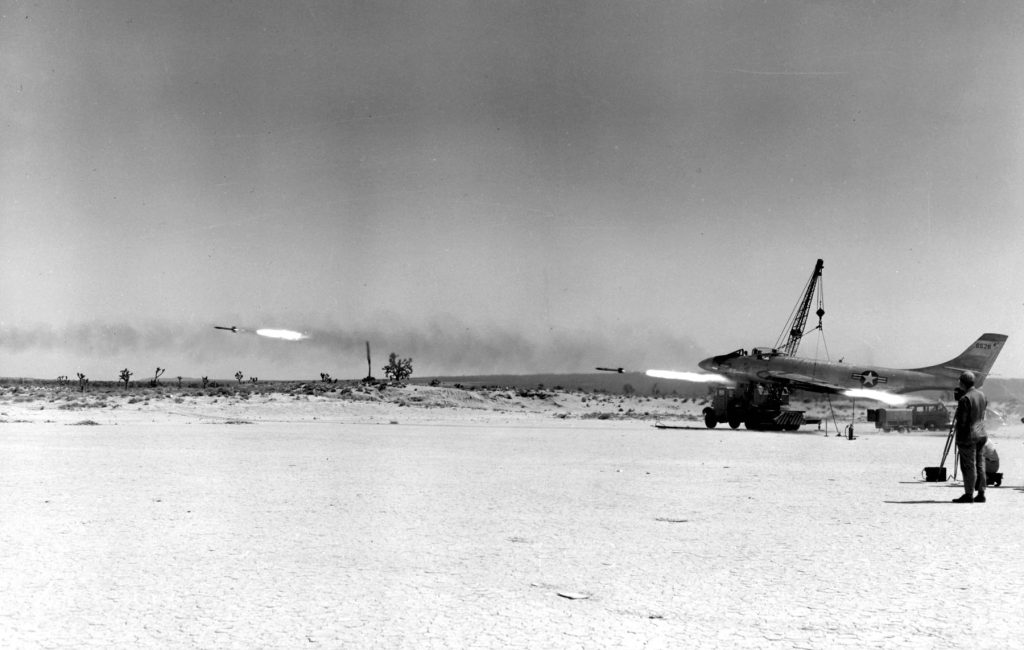
The first McDonnell XF-88 Voodoo prototype was modified to the XF-88B standard to serve as a research vehicle for propeller testing. It had a nose-mounted Allison T38 turboprop engine that helped the aircraft climb and reach testing conditions. The aircraft tested three different propellers through 1956 and was the first propeller-equipped aircraft to exceed speeds of Mach 1.0. It reached about Mach 0.9 in level flight with the help of turbojet afterburners and just over Mach 1.0 during a dive. McDonnell also suggested a naval version of the McDonnell XF-88 Voodoo, a two-seat operational trainer, and a reconnaissance variant, but none were built. Both prototypes were scrapped by 1958. However, the Korean War prompted the US Air Force to rethink its plans for long-range fighter aircraft. In February 1951, the service issued a new requirement called General Operational Requirement (GOR) 101. Later that year, it chose a larger design to meet this requirement, which became the F-101 Voodoo. The first production model of this fighter flew on September 29, 1954. In the Grounded Dreams series, the McDonnell XF-88 Voodoo did not enter production, but its design was used for the later F-101 Voodoo, a supersonic aircraft. Read more Grounded Dreams articles HERE.