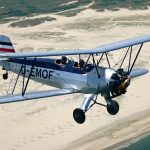

One of America’s early aircraft manufacturers, the Glenn L. Martin Company was founded by aviation pioneer Glenn L. Martin on August 16, 1912. Martin started his company by building military training aircraft in Santa Ana, California. In September 1916, he accepted a merger offer from the Wright Company, which created the Wright-Martin Aircraft Company. However, this merger did not work well, and as a result, Glenn Martin left and, on September 10, 1917, formed a new company, the Glenn L. Martin Company, based in Cleveland, Ohio. In 1913, Mexican rebels from Sonora bought a single-seat Martin Pusher biplane in Los Angeles to attack federal naval forces at the port of Guaymas. They shipped the aircraft on May 5, 1913, in five crates to Tucson, Arizona, using Wells Fargo Express. After that, the rebels moved it across the border to Naco, Sonora. The rebels reassembled the plane there and added a second seat for a bomber. The aircraft, named Sonora, was armed with simple 3-inch pipe bombs. It carried out some of the first aerial attacks against naval ships. Martin’s first major success came during WWI with the MB-1 bomber, a large biplane ordered by the US Army on January 17, 1918. However, the MB-1 entered service only after the end of hostilities. A subsequent design, the MB-2, also proved successful; the Army Air Service ordered 20 units, with the first five delivered under the company designation and the last 15 designated as the NBS-1 (Night Bomber, Short Range). Although the War Department ordered 110 more units, it retained ownership rights to the design and put the production order out for bid. The MB-2 design remained the only standard bomber used by the Air Service for some time. It was operated by seven squadrons of the Air Service, including four in Virginia, two in Hawaii, and one in the Philippines. In 1924, the Glenn L. Martin Company won a contract to produce the SC-1 scout bomber, which was designed by Curtiss. Glenn L. Martin Company built 404 of these bombers. In 1929, Martin sold its Cleveland plant and moved to a new facility in Middle River, Maryland, northeast of Baltimore.

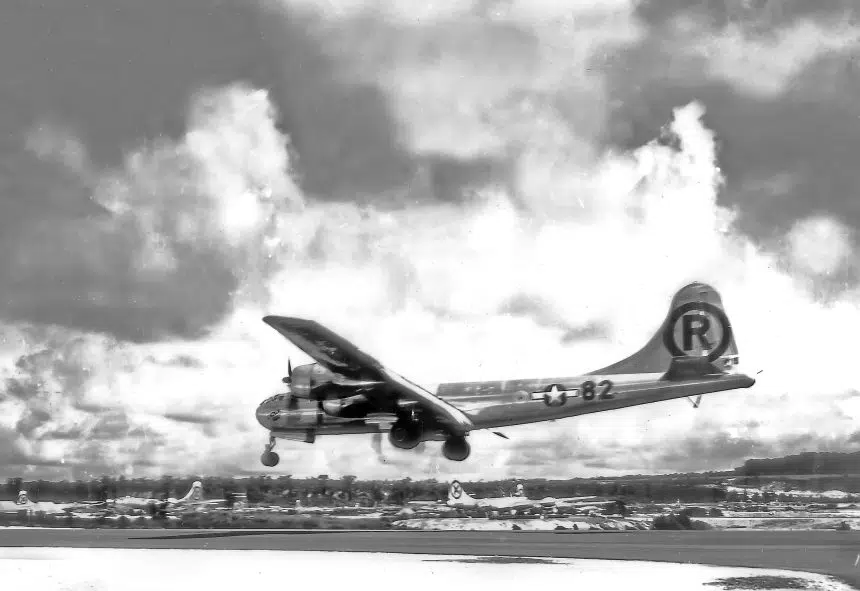
During the 1930s, Glenn L. Martin Company made flying boats for the US Navy and created the Martin B-10 bomber for the Army. The Glenn L. Martin Company also produced the famous China Clipper flying boats, which Pan American Airways used on its San Francisco-to-the-Philippines route. Glenn Martin’s younger cousin, Jonathan Martin, left the company to stay in Ohio and start a new company that became the Martin-Collier-Phillips Corporation. During WWII, Martin produced successful aircraft like the B-26 Marauder and A-22 Maryland bombers, as well as the PBM Mariner and JRM Mars flying boats. These aircraft were important for air-sea rescue, anti-submarine operations, and transport. The film “Bomber,” made in 1941, was shot at Martin’s facility in Baltimore and showed how they made the B-26. Martin was the 14th largest US company in terms of wartime production contracts. Martin built 1,585 B-26 Marauders and 531 Boeing B-29 Superfortresses at its new plant near Offutt Field, Omaha, Nebraska. The B-29 aircraft included all the Silverplate models, such as Enola Gay and Bockscar, the planes that dropped atomic bombs on Japan’s Hiroshima and Nagasaki. On April 22, 1957, the company changed its name to the Martin Company. After WWII, the Martin Company worked on several aeronautics projects. These included two prototype bombers, the XB-48 and XB-51, which were not successful. It also developed the AM Mauler, which was only somewhat successful, and created the B-57 Canberra tactical bombers, the P5M Marlin and P6M SeaMaster seaplanes, as well as the Martin 2-0-2 and Martin 4-0-4 twin-engine passenger airliners. The Martin Company entered the aerospace manufacturing field. They developed the Vanguard rocket, one of the first booster rockets used by the US space program for satellites, as part of Project Vanguard. This rocket was the first to be designed from scratch for space exploration, unlike earlier rockets, which were modified ballistic missiles. Martin also designed and built the Titan I and LGM-25C Titan II intercontinental ballistic missiles (ICBMs). The Martin Company in Orlando, Florida, was the main contractor for the US Army’s Pershing missile.

The Martin Company was one of two finalists to produce the command and service modules for the Apollo Program. However, NASA awarded the contracts for these to North American Aviation Corporation. Martin Company produced larger booster rockets for NASA and the US Air Force with the Titan III series, which included over 100 rockets such as Titan IIIA, Titan IIIC, and Titan IIIE. These rockets played a key role in launching hundreds of Earth satellites and in sending two Voyager Project space probes to the outer planets, two Viking Project probes to Mars, and two Helios probes into low orbits around the Sun. The US Air Force needed a rocket capable of launching heavier satellites than the Titan IIIE or the Space Shuttle, so Martin Company developed the Titan IV series. The rocket could carry more weight into orbit than any other rocket at the time. The Air Force used it for launching heavy reconnaissance satellites. In 1997, a Titan IV with a powerful Centaur upper stage launched the Cassini space probe to Saturn. Cassini orbited Saturn from 2004 to 2017 and returned a wealth of scientific information. Production of the Titan IV ended in 2004, marking the end of the last rocket capable of carrying heavier payloads than the Space Shuttle, which concluded its service in 2011. In 1961, the Martin Company merged with American-Marietta Corporation, a maker of chemicals and construction materials, to create Martin Marietta Corporation. In 1995, Martin Marietta, then the third-largest defense contractor in the US, merged with Lockheed Corporation, the second-largest, forming Lockheed Martin Corporation, the world’s largest defense company.