






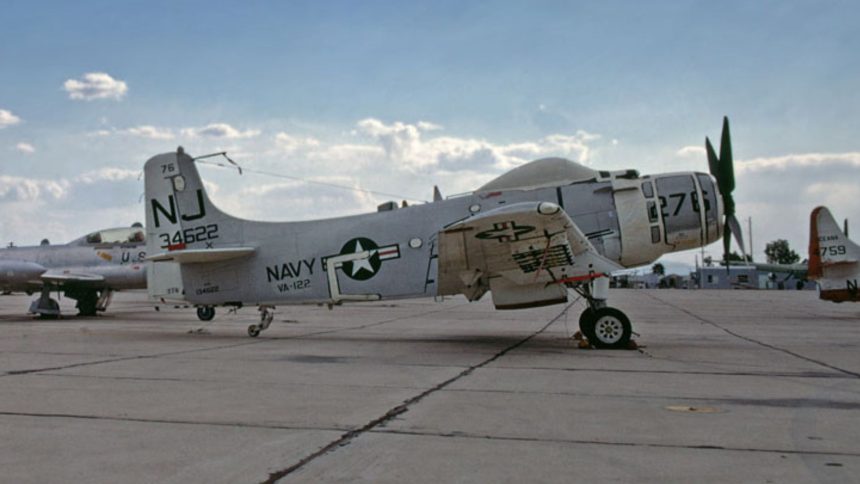

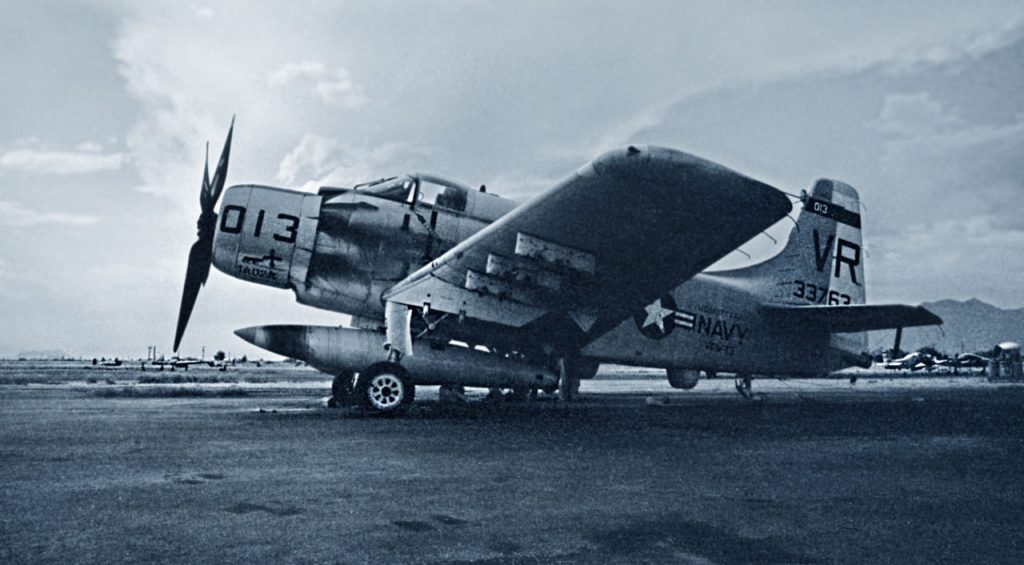
As we continue with the Boneyard Files series, which will showcase some of the retired aircraft resting at US Davis-Monthan Air Force Base in Tucson, Arizona, in the late 1960s, through the lens of Neil Aird’s “Monthan Memories” photos, today’s story features the A-1 Skyraider. In 1941, the US Navy wanted new bombers to replace the aging Douglas SBD Dauntless and the Curtiss SB2C Helldiver. In 1943, the service decided to develop a single-seat aircraft capable of performing dive-bomber and torpedo-bomber missions, instead of the long-standing policy of procuring multi-seat aircraft. In response, the Douglas Aircraft Company developed the BTD-1, a single-seat torpedo/dive bomber, but it was not adopted in favor of more potent aircraft. In late 1943, the Navy ordered prototypes of single-piloted aircraft, such as the Martin XBTM-1, Kaiser-Fleetwing SBTK-1, and Curtiss XBTC-1, to test them as torpedo/dive bombers. In July 1944, Douglas proposed yet another proposal for the new bomber, designated BT2D-1, and the US Navy Bureau of Aeronautics was very impressed by the new design. The bureau contracted Douglas to develop a prototype, with the condition that it be delivered at the same time as Martin, Curtiss, and Kaiser-Fleetwing would deliver their respective prototypes. The BT2D-1 flew for the first time on March 18, 1945, and after multiple tests, it was found to be superior to other contenders. The aircraft was ordered in May 1945.
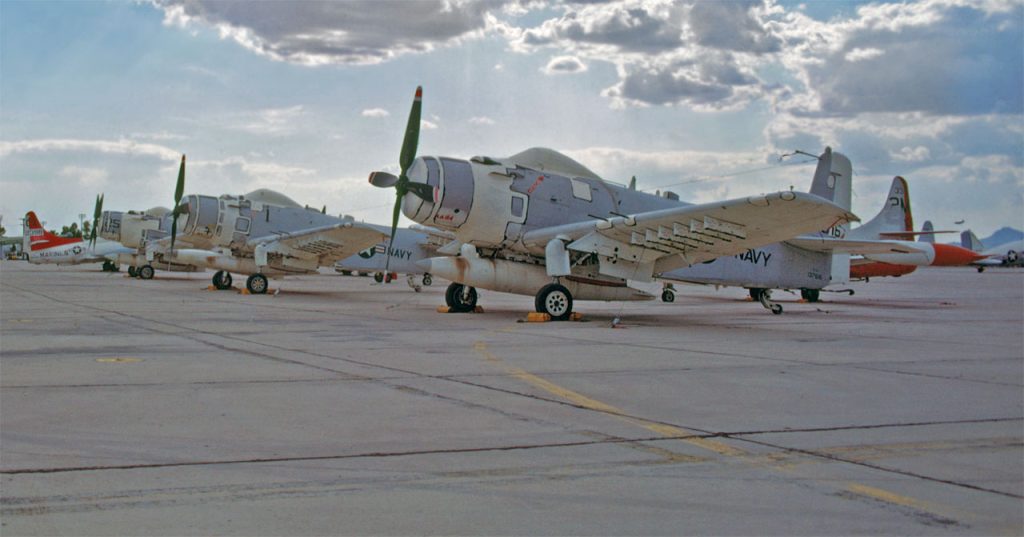
The first production aircraft had its maiden flight on November 5, 1946, and became operational in December 1946. The US Navy received the first aircraft on September 20, 1947. It was called the AD-1 Skyraider, which was later renamed A-1 Skyraider. Douglas built a total of 3,180 Skyraiders over 12 years, across 8 different models, and production ended in September 1957. The eight models were the experimental BT2D-1 and AD-1 to AD-7. With so many models and modifications, the AD-1 was used not only in its dive/torpedo bomber role but also as an Early Warning Radar System, an Electronic Warfare Sensor Platform, a search-and-rescue aircraft, a nuclear delivery system, and even a target-towing vehicle. Initially intended for the US Navy, the aircraft also served with the US Air Force, US Marines, the British Royal Navy, the French Air Force, the Vietnamese Air Force, the Central African Republic, and the Kingdom of Cambodia and Chad. When the aircraft arrived, WWII had already ended; production was reduced, but it continued to be modified into versions to improve the capabilities of the AD-1, or, say, the A-1 Skyraider. In 1950, the AD-4, also called the A-1D, was in production, and it set a new weight-lifting record of 14,941 pounds, exceeding its empty weight of 11,798 pounds. At a similar time, the AD-1 or A-1 Skyraiders saw their first combat in the Korean War.
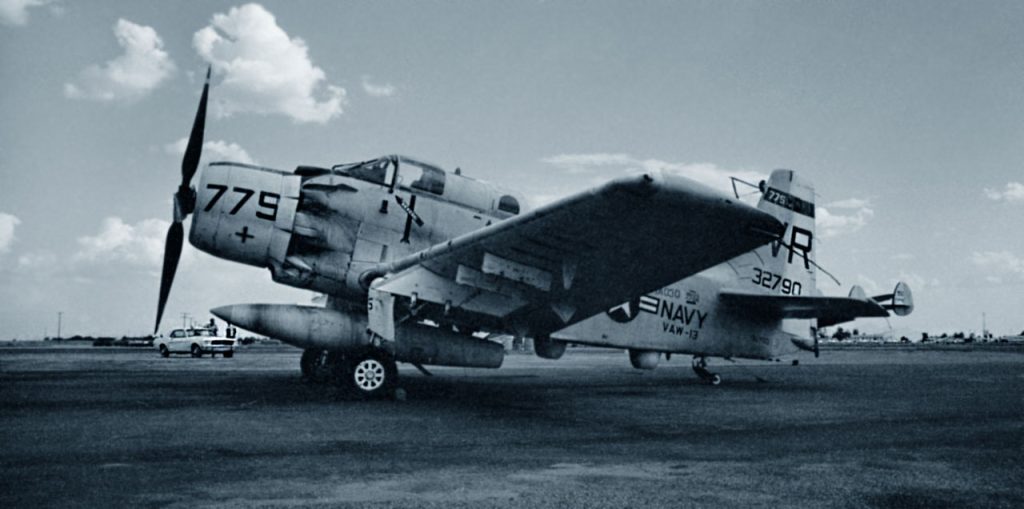
During the Korean War, Skyraiders in Navy and Marine squadrons played an important role in supporting ground troops and disrupting North Korean supply lines. The Skyraider could carry heavy weapon loads, deliver bombs accurately, and was built to last, featuring armor plating on the AD-4 models. Pilots and crews praised it as “the best and most effective close-support aircraft in the world” and “the most versatile, single-engine aircraft ever to go into service.” The last comment referred to the AD-5 or A-1E, which had a wider fuselage and side-by-side seating for pilots, allowing more crew members on board. Such a design made the AD-5 suitable for a variety of missions, including electronic countermeasures and early warning operations. One of the most famous Skyraider variants was AD-6, also called A-1H, which was the primary single-seat attack version used by the Navy and Marines in Vietnam. It had strengthened armor and improved systems for close air support and was known by pilots as the “Spad”. The A-1H Skyraider was 38.10 feet long, 15.8 feet high, with a wingspan of 50 feet and a wing area of 400 square feet. Its empty weight was 11,968 pounds, and its gross weight was 18,106 pounds. The aircraft’s fuel capacity was 380 gallons, and it was powered by a Wright R-3350-26WA Duplex-Cyclone 18-cylinder air-cooled radial piston engine, producing 2,700 horsepower. It was equipped with a four-bladed Aeroproducts constant-speed propeller. The aircraft’s maximum speed was 322 mph at 18,000 feet, with a cruise speed of 198 mph. The range was 1,316 miles, the service ceiling was 28,500 feet, and the rate of climb was 2,850 feet per minute. It had four 20 mm cannons with 15 external hardpoints to carry 10,500 pounds of bombs, torpedoes, mine dispensers, unguided rockets, improvised toilet bombs, and gun pods.
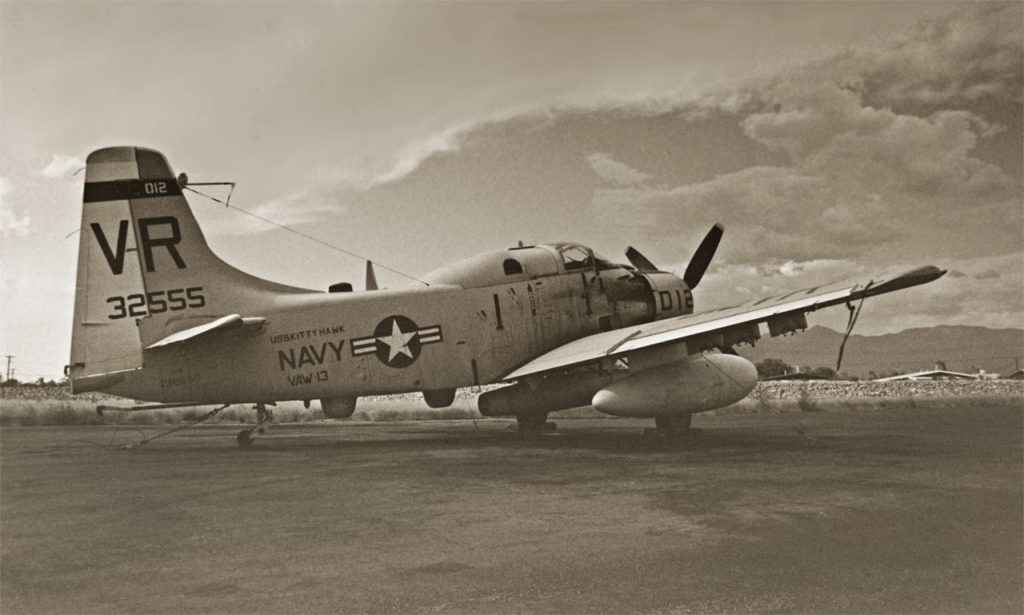
In 1962, the US Department of Defense overhauled aircraft designations, and as a result, AD-1 became A-1 Skyraider. The AD-5s became A-1Es, the AD-6s became A-1Hs, and the AD-7s became A-1Js. While serving in Navy Attack Squadron 145 (VA-145) on the USS Constellation, A-1H planes took part in Operation Pierce Arrow in response to the attacks on the USS Turner Joy and USS Maddox in the Tonkin Gulf. During this operation, the first US Navy pilot was killed in the Vietnam War as Lt. Alvarez, an A-1H pilot, was shot down and captured. He is recognized as the longest-serving prisoner of war from the Vietnam War. The A-1 also participated in Operation Pierce Arrow and was flown by Commander Samuel Caterlin, the Operations Officer of VA-145. In 1960, the Vietnamese Air Force (VNAF) began using A-1E and A-1H planes provided by the US Navy. Later, the US Air Force took over responsibility for supporting and training the VNAF. In 1962, the Air Force acquired 150 A-1E and A-1J aircraft for their own use. These planes were very useful as escorts for the H-53 helicopters, which carried out many daring rescues of downed pilots. On March 10, 1966, Major Bernard F. Fisher, from the US Air Force, landed his A-1E on the airstrip in A Shau to rescue a downed pilot. Despite heavy enemy fire, Major Fisher landed the plane, taxied down the damaged runway, and was struck over nineteen times. He successfully rescued the pilot, and for his bravery, Major Fisher received the Medal of Honor. By the time the Vietnam War ended in 1975, the A-1 Skyraiders had helped wherever they served. In the late 1960s, some retired A-1 Skyraiders were also spotted at Davis-Monthan Air Force Base, known as “The Boneyard.” Read more Boneyard Files Articles HERE.







When I was in high school in the 60’s my dad invited the family to a dependents day cruise on the USS Saratoga. Wow. What a great time. Toured the massive carrier and saw first hand what a war machine looked like. During the cruise that day we went up the island to watch launch and retrieve ops. The jet noise was unreal. Then dad said look there …an A-1 Skyraider just landed. Dad said that’s a famous pilot….why I asked. Because he is the last true enlisted man flying in the navy. And no he was a warrant officer. I met him later in the Chiefs Mess. Do they fly jets too I asked. No son, they gotta be officers first.
Floyd ‘Jim’ Thompson was the longest held POW of the Viet Nam war. He was shot down in an L-19 on March 26, 1964.