






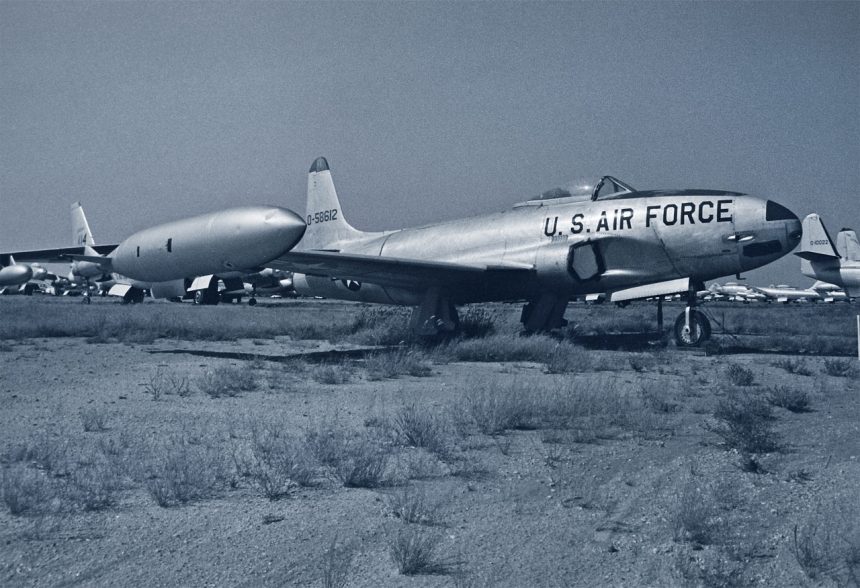

As we continue the Boneyard Files series, which showcases some of the retired aircraft resting at Davis-Monthan Air Force Base in Tucson, Arizona, in the late 1960s, today’s story features the Lockheed P-80 Shooting Star through the lens of Neil Aird’s “Monthan Memories” photos. The Shooting Star was the first American aircraft to fly faster than 500 mph in level flight. It was also the first American jet plane produced in large numbers and the first US Air Force jet to see combat. In the early 1940s, the US Army Air Force asked Lockheed and Clarence “Kelly” Johnson to design a new aircraft powered by the British H-1 turbojet engine. The resulting aircraft was the XP-80, which had its first flight on January 8, 1944. Four YP-80s were sent to Europe to test their service, but WWII ended before the aircraft could see combat.
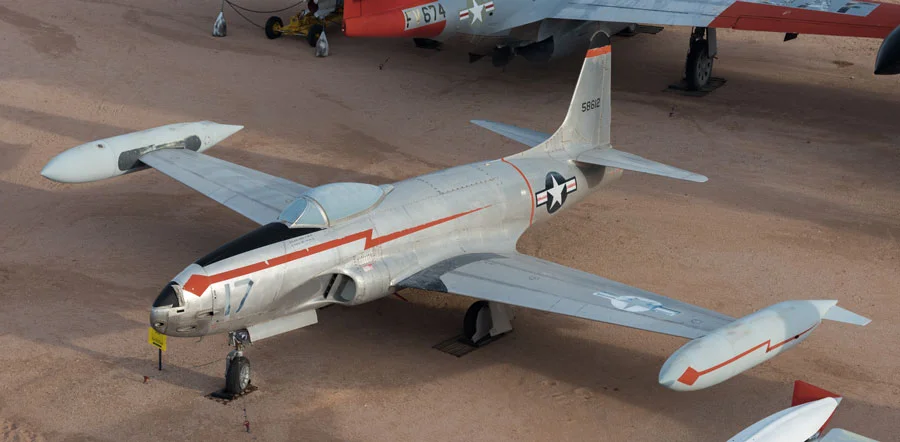
The single-seat Lockheed P-80 Shooting Star was 34.6 feet long, 11.4 feet high, with a wingspan of 38.10 feet. The maximum takeoff weight of the aircraft was 14,000 pounds. It was powered by an Allison J33-A-9 turbojet engine, producing 3,850 pounds of thrust. The aircraft’s maximum speed was 558 mph, with a cruise speed of 510 mph, a range of 540 miles, and a service ceiling of 45,000 feet. It was armed with six 0.50-caliber machine guns & up to 2,000 pounds of bombs. In 1948, the plane was renamed F-80, changing the designation from “P” for “Pursuit” to “F” for “Fighter.” The US Navy also showed interest in the Lockheed P-80 Shooting Star aircraft, leading to the transfer of three planes from the Army Air Force. The first P-80A arrived at Naval Air Station Patuxent River, Maryland, on June 29, 1945. Although these planes received Navy serial numbers, they kept the P-80A name. One Navy P-80A was equipped with an arresting hook and underwent catapult and landing tests at Patuxent River. It was then lifted onto the aircraft carrier Franklin D. Roosevelt (CVB-42) in Norfolk, Virginia, on October 31, 1946. The next day, Marine Major Marion Carl made four takeoffs from the deck and two catapult launches, completing eight successful landings without issues. Carl also performed additional takeoffs and landings on the same carrier on November 11. Although the Navy was already developing carrier-based turbojet aircraft, it decided to buy P-80 Shooting Stars for training and land-based fighter roles. In 1949, the Navy began purchasing 698 two-seat TF-80C/T-33 variants of the Shooting Star, initially called TO-2 and later TV-2.
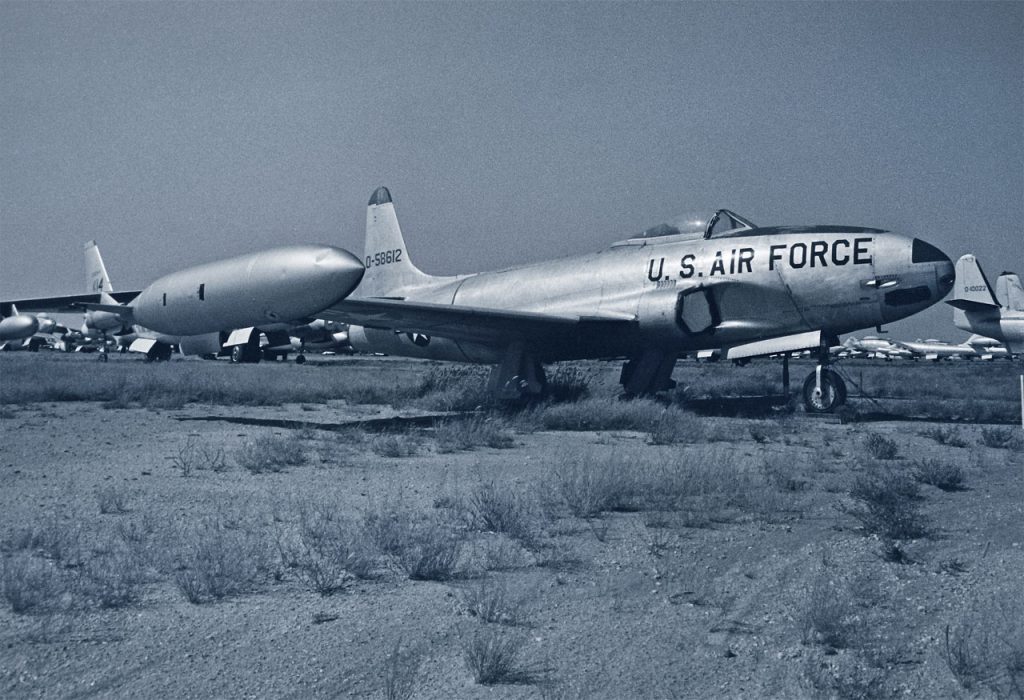
The Lockheed P-80 Shooting Star did not fight in WWII, but Lockheed delivered the Shooting Star on time, making it America’s front-line fighter during the Korean War. By the time the war started in Korea, F-80s were already in squadrons on the Japanese Islands. During the first months of the Korean War, air attacks by Shooting Stars caused about 75 percent of enemy losses. In 1950, Lt. Russell Brown piloted a P-80 and shot down a North Korean MiG-15 in the world’s first jet-versus-jet air battle in history. These victories led to improvements in the P-80, including the P-80B, the first US production aircraft to feature an ejection seat. Other developments included the F-94 all-weather interceptor and the fast T-33 trainer, which remained in use until 1997. After initial success against the MiG-15, it became clear that the F-80 was not as advanced as its competitor. A total of 1,714 Lockheed P-80 Shooting Stars were built before production stopped. These planes were withdrawn from front-line fighter duty but continued to serve as fighter-bombers. Soon after the Korean War ended, America’s first combat-tested jet fighter was replaced by the F-84 and the F-86. After the Lockheed P-80 Shooting Stars were retired, they were sent to Davis-Monthan Air Force Base, known as “The Boneyard.” Read more Boneyard Files Articles HERE.





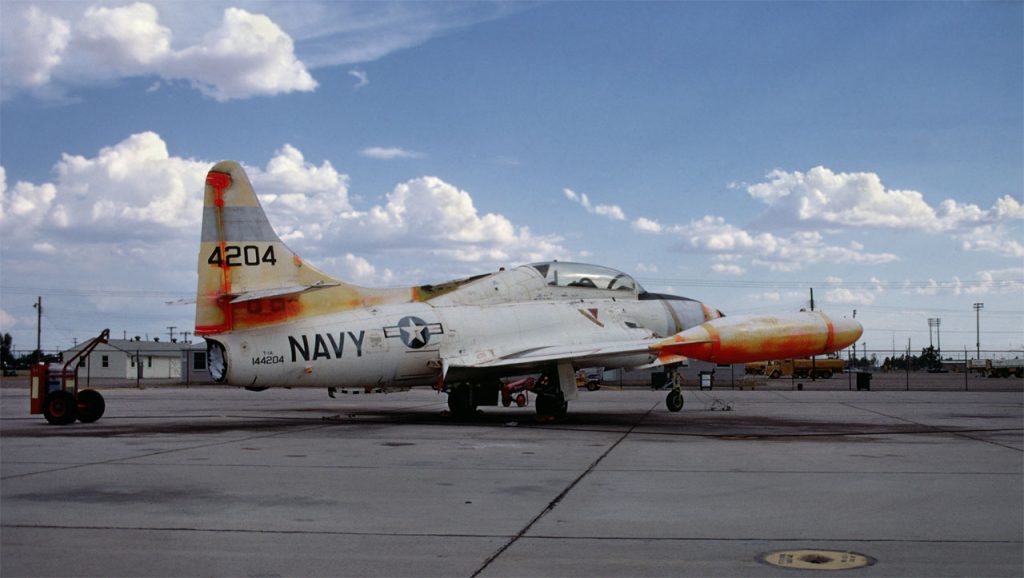
The Navy never used the F-80 as a land based fighter, instead, they used it as a transition trainer, in order to gain experience with jet powered aircraft. Only the F3D, and F4D were the only actual naval land based fighters to see service.
John, five comments today and they were all wrong. You need more studying… Yes, the U.S. Navy and Marine Corps evaluated the Lockheed F-80 Shooting Star (and its T-33 trainer variant) and used it for land-based jet training and specialized evaluation. However, the Navy opted against adopting it for regular fleet combat or carrier operations. Ref. https://www.usni.org/magazines/naval-history-magazine/2001/august/lots-shooting-stars