






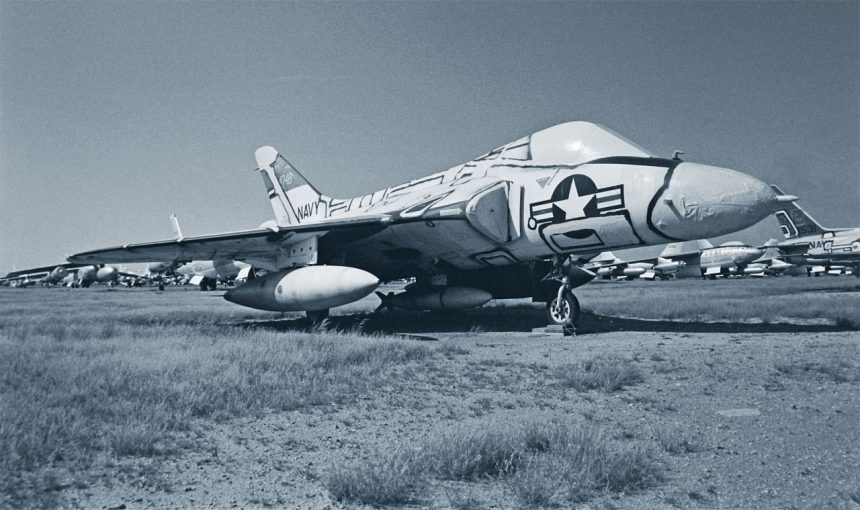

As we continue the Boneyard Files series, which showcases some of the retired aircraft resting at Davis-Monthan Air Force Base in Tucson, Arizona, in the late 1960s, today’s story features the Douglas F4D Skyray through the lens of Neil Aird’s “Monthan Memories” photos. The Douglas F4D Skyray, named for its rounded, stingray-like wings, was developed from a Navy design study that started in 1947. The goal was to create an aircraft using delta-wing technology. While the final design did not use a true delta wing, the expected performance was impressive, including speeds over Mach 1.0 and a climb rate of more than 18,000 feet per minute, which convinced the Navy to order two prototypes.
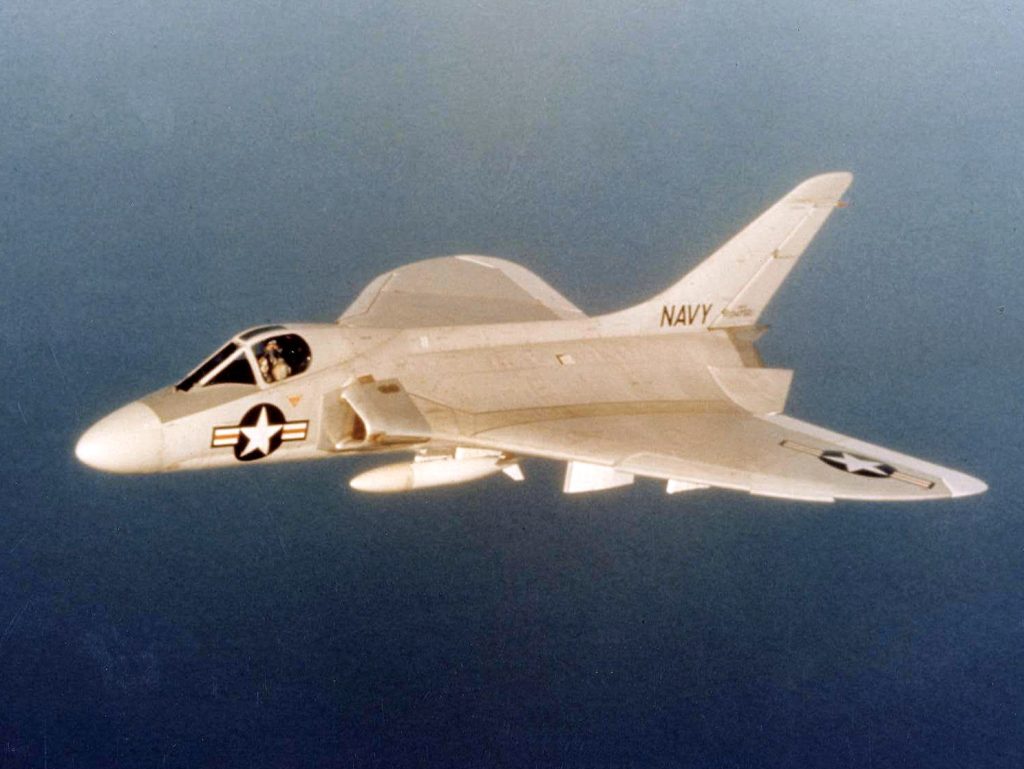
The Douglas F4D Skyray made its first flight on January 23, 1951, and entered service with squadrons in 1956. Early tests showed its extraordinary performance. In October 1953, it became the first carrier aircraft to set a world speed record, reaching 752.943 mph over a three-kilometer (nearly 1.9 miles) course. In 1958, the Skyray also achieved five world time-to-climb records over two days. The single-seat Douglas F4D Skyray was 45.3 feet long, 13 feet high, with a wingspan of 33.6 feet and a wing area of 557 square feet. The empty weight of the aircraft was 16,024 pounds, the gross weight was 22,648 pounds, and the maximum takeoff weight was 27,116 pounds. It was equipped with a Pratt & Whitney J57-P-8 afterburning turbojet engine, producing 10,200 pounds of dry thrust and 16,000 pounds with afterburner. The Douglas F4D Skyray was armed with four 20 mm Colt Mk 12 cannons, two on each wing just aft of the leading edge, mid-wing, underside, with 65 rounds per gun. It also had provisions for unguided rockets, four AIM-9 Sidewinder air-to-air missiles, and two 2,000-pound bombs. During the Cold War, there was a fear of a nuclear attack by Soviet bombers.
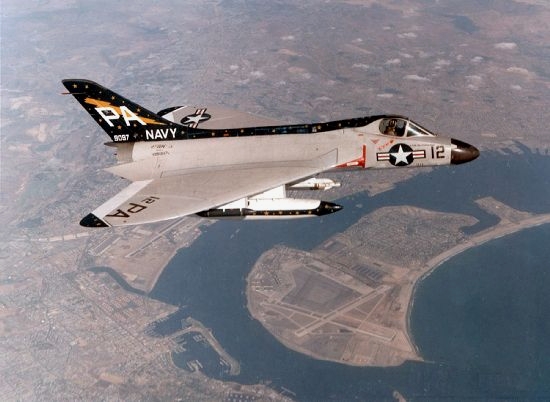
The Douglas F4D Skyray, with its 20mm cannon and AIM-9 Sidewinder missiles, was well-suited for the North American Air Defense Command (NORAD). The All-Weather Fighter Squadron 3 was the only Navy squadron under this predominantly Air Force command, and the unit won an award as the top squadron in NORAD for two years in a row. Douglas Aircraft Company made a total of 420 F4Ds, and at its peak, the Skyray was used by 17 Navy and Marine Corps squadrons. The National Advisory Committee for Aeronautics (NACA), which later became NASA, also used four Douglas F4D Skyray aircraft for experiments until 1969. The Douglas Aircraft Company also developed the F5D Skylancer, a faster successor to the Skyray capable of reaching Mach 2. Although four prototypes were built and flown, the project was canceled. It was deemed too similar to the F8U Crusader, and the decision aimed to reduce reliance on Douglas Aircraft, which was also making several other planes for the US Navy. This choice actually ended Douglas’s active role in fighter development. The production of the Douglas F4D Skyray ended in 1958, and the aircraft were retired in 1964, after which they were sent to Davis-Monthan Air Force Base, known as “The Boneyard.” Read more Boneyard Files Articles HERE.
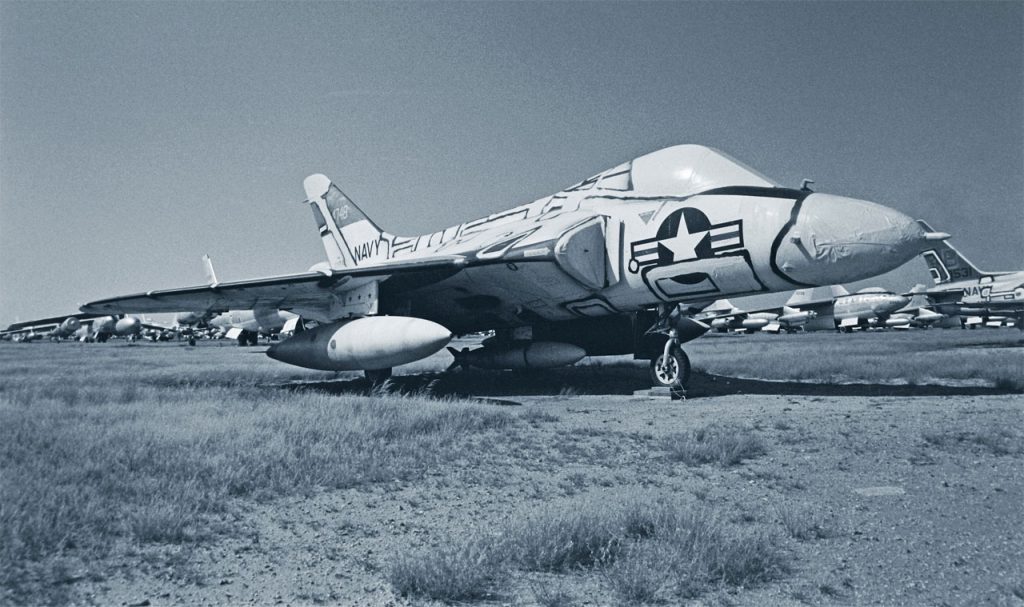
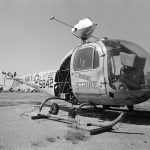
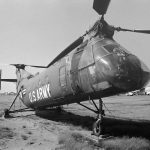
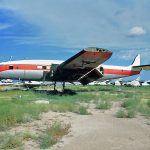
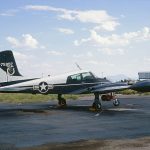




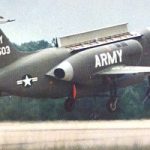

F4Ds flew in the reserves till 1969.
Interesting. Those pictures were probably taken by my father who was one of the original founders of the Pima Air Museum. My father was Tom Barrette.
That Skyray isn’t really lost in the desert. The tail number 4748 would indicate that it’s the same aircraft now on display at the Pima Air & Space Museum. Fairly restored and appreciated by thousands. That black and white picture intrigued me since I was 10 or 11 years old, and built my first model plane, a Hawk F4D-1 Skyray. I thought the black stripping was some special camouflage pattern. I’m glad the plane in the picture from my fading memory is still around, just across the highway from where it was.