







In the mid-1960s, the United States Army initiated the Advanced Aerial Fire Support System (AAFSS) program to convert the Lockheed AH-56 Cheyenne into an anti-tank gunship. The Army also employed the AH-1G HueyCobra as a stopgap measure for jungle warfare. However, their main concern was protecting Western Europe from the many Warsaw Pact tanks. In 1972, the Army tested the Bell 309 King Cobra, the Lockheed Cheyenne, and the Sikorsky S-67. The competition began in spring 1972 and ended in July. In August, the Army shocked everyone by rejecting all three helicopters. Development of the AH-56 Cheyenne faced delays, and the Army canceled the program in August 1972. There was controversy over the Cheyenne’s combat role, along with political issues related to military spending. As a result, the Army changed its attack-helicopter requirements to focus on simpler, more survivable helicopters. The Army needed a new aircraft for anti-armor attacks. The service wanted an aircraft that was more powerful, faster, and had a longer range than the AH-1 Cobra. It also needed to fly low to the ground, which is called nap-of-the-earth (NoE) missions.
Design of Bell YAH-63

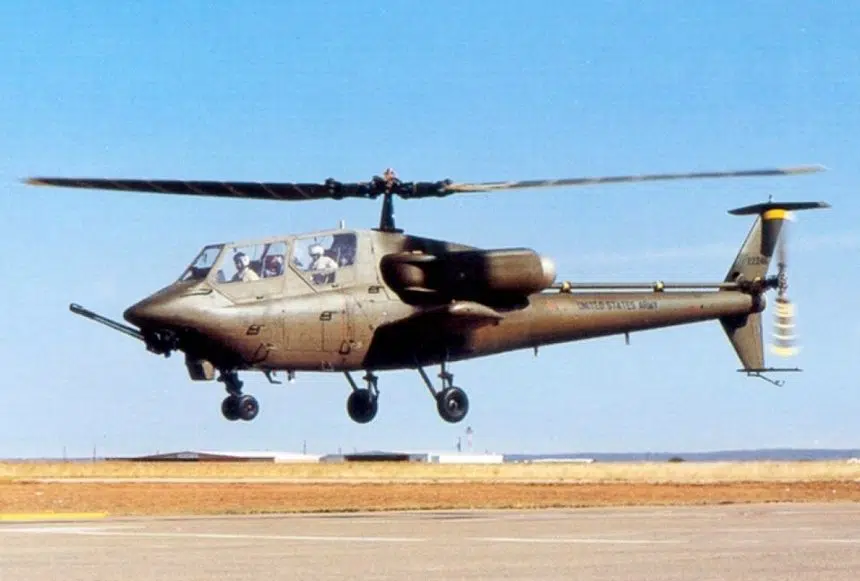
In 1972, the US Army issued requests for proposals (RFP) for an Advanced Attack Helicopter (AAH). The Army required the AAH to have two General Electric T700 turboshaft engines, each producing 1,500 shaft horsepower (shp). It used the same engine as the new Army utility helicopter competition, which the Sikorsky S-70 Black Hawk won. The AAH was to be equipped with a 30-millimeter cannon and could carry 16 BGM-71 TOW anti-tank missiles. Later, the specifications changed to allow for an alternative load of sixteen laser-guided AGM-114 Hellfire anti-tank missiles. The Hellfire missile was still being developed and offered greater range and effectiveness than the TOW. Companies like Bell, Boeing-Vertol (with Grumman), Hughes, Sikorsky, and Lockheed all submitted proposals for the AAH program. In June 1973, the Army chose Bell and Hughes as finalists and gave each a contract to build two prototype aircraft. The Bell Model 409, also known as the Bell YAH-63, used technology from the Cobra helicopter. It had a typical gunship design, with a sleek fuselage, two seats in a line for the crew, and stub wings for carrying weapons. However, the Bell YAH-63 was mostly a new aircraft. The Bell Bell YAH-63 had several unique features. It had a tricycle landing gear with wheels, flat canopy windows, an unusual “tee” tail, a large fin underneath, and a three-barreled General Electric XM-188 30 mm cannon.
The Cancellation

Its rotor mast could be lowered, and the landing gear could kneel, making the aircraft shorter for transport. One less obvious feature was that the pilot sat in the front seat instead of the back, unlike the AH-1. The design was thought to be safer because the Bell YAH-63 was meant to fly low among the trees, and the pilot needed a clear view of the surroundings. The first Bell YAH-63 prototype (serial number 73-22246) first flew on October 1, 1975. The helicopter crashed in June 1976, but a static-test prototype was updated and made ready for flight. Along with the second prototype (73-22247), it entered a competition against the Hughes Model 77 (YAH-64). In December 1976, Hughes selected the YAH-64 and developed it into the production version, the AH-64 Apache. The Army preferred the Apache’s four-bladed rotor because the service thought the Bell YAH-63’s two-bladed rotor was easier to damage. The service also found the Apache’s “taildragger” landing gear to be more stable than the Bell YAH-63’s tricycle landing gear. Some people believed the Army wanted to keep Bell focused on making the AH-1 and not divert them to another project. Bell used its experience with the T700 engine to create the AH-1T+ design and later the AH-1W. Read more Grounded Dreams articles HERE.





I’m sorry but the AAFSS Program was not about turning the AH-56 into an anti tank attack helicopter, because that was already in the AAFSS Requirements from the beginning.