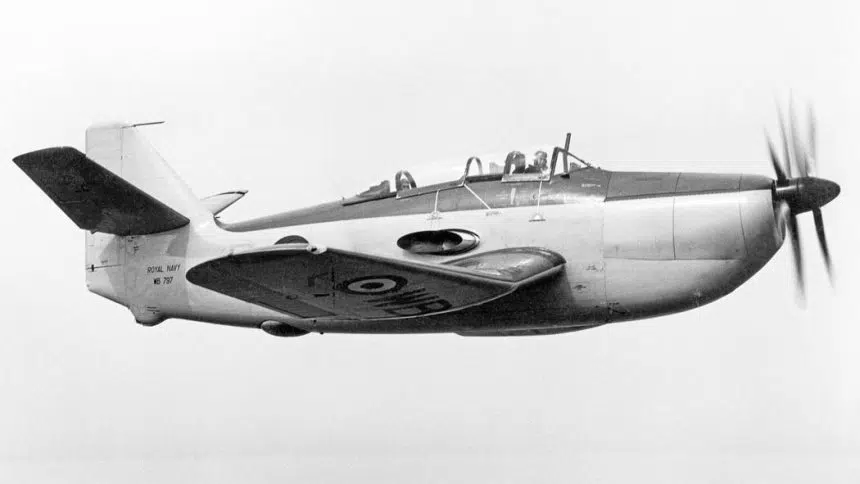

After WWII, the Royal Navy wanted a new aircraft designed specifically to find and attack submarines. The new anti-submarine carrier aircraft also aimed to detect U-boats, which had snorkels and had been introduced by Germany near the end of the war. As a result, Blackburn Aircraft designed the B-54. The original plan was to use a Napier Double Naiad turboprop engine to power this aircraft, but that engine was canceled. As a result, the B-54 had to use a 2,000hp Rolls-Royce Griffon engine and became a flying test bed for the future turboprop version. Three prototypes of the B-54 were built, designated Y.A.7 and Y.A.8. The aircraft made their first flights on September 20, 1949, and May 3, 1950.
Design of Blackburn B-88

However, the third prototype was fitted with the Armstrong Siddeley Double Mamba turboprop engine and was designated the Blackburn B-88. The Double Mamba engine consisted of two gas turbines mounted side by side to power a contra-rotating airscrew. The port turbine drove the front airscrew, while the starboard turbine drove the rear airscrew. In flight, it was possible to shut off one turbine and feather its airscrew to extend the aircraft’s range. The Blackburn B-88 looked very similar to the B-54. It had a deep fuselage and a high cockpit, allowing the crew of three to have a good view. The aircraft featured an inverted gull wing, which created space below the center for a long weapons bay. The bay could carry various anti-submarine weapons. It could also hold rockets, depth charges, or fuel tanks below the wings. The Blackburn B-88 was 42.8 feet long, 16.9 feet high, with a wingspan of 44.2 feet. Its gross weight was 13,091 pounds, and its engine produced 2,950 shaft horsepower. The maximum speed of the Blackburn B-88 was envisioned at 320 mph.
The Cancellation

The B-88 is Blackburn’s first turboprop aircraft, and it flew for the first time on July 19, 1950, in Brough. Soon after, Blackburn B-88 caught public attention at the Naval Air Display in Lee-on-Solent on August 26, 1950, and at the Farnborough Air Show from September 6 to September 10, 1950. After these events, the aircraft returned to Brough, where its wings were modified. The new longer wing tips could fold down when the wings folded up, creating a Z shape. In the autumn of 1950, the Blackburn B-88 participated in competitive trials against the Short S.B.3 and Fairey 17. The competition included deck landings on HMS Illustrious on October 30. The Fairey design won the competition and was ordered for production as the Fairey Gannet on March 14, 1951. The lone B-88 then went to Armstrong Siddeley, where it was used to test the Double Mamba engine, later used in the Gannet as well. It was scrapped at Bitteswell in July 1955. In the Grounded Dreams series, the Blackburn B-88 was a good aircraft but became a testbed for a new engine, which hurt its performance, and it eventually lost to the Fairey Gannet. As a result, neither variant of the B-54 nor the Blackburn B-88 entered production. Read more Grounded Dreams articles HERE.