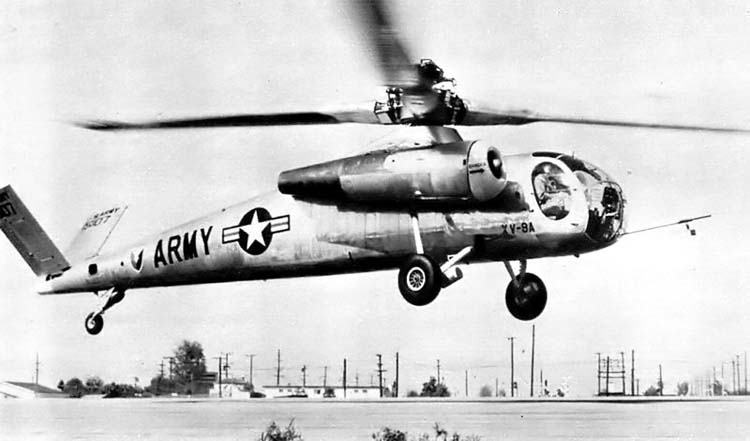


In the 1960s, the US Army wanted to test a new concept called “hot-cycle propulsion.” According to the US Defense Technical Information Center, hot-cycle propulsion uses high-pressure, high-temperature gases from a turbojet engine located in the fuselage to create thrust. These gases flow through the rotor blades and exit at the tips to drive the rotor. The US Army contracted Hughes Aircraft Company to develop a high-speed research helicopter to test the new concept. As a result, the Hughes XV-9 was developed, with the company designating it the Model 38 and the US Army calling it XV-9A, serial number 64-15107.
Design of Hughes XV-9
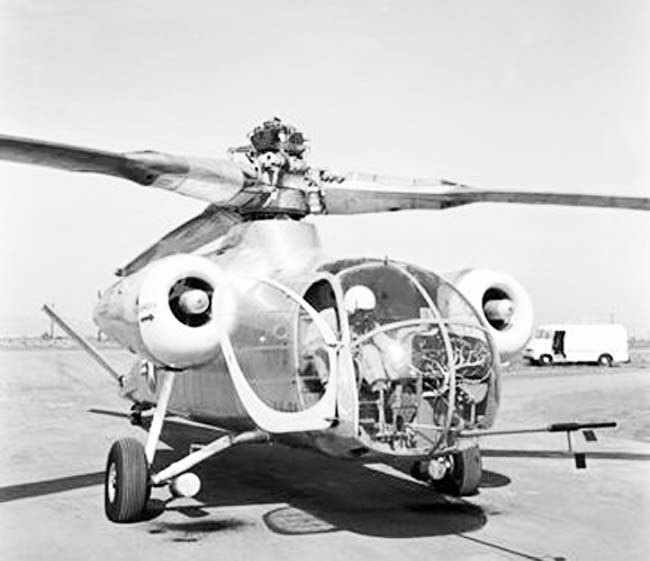
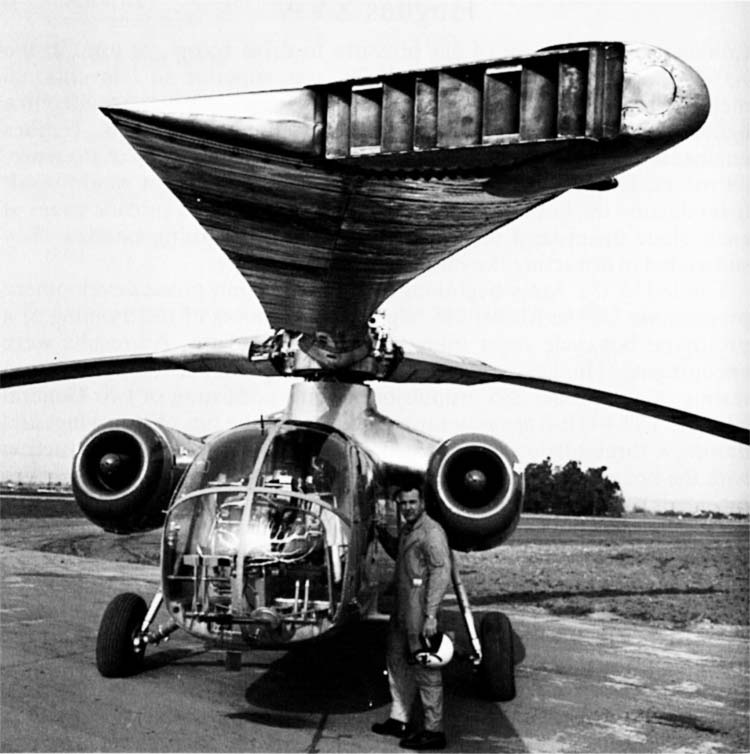
To prove the hot-cycle propulsion concept, the Hughes XV-9 helicopter was equipped with jet nozzles at the tips of its hollow main rotor blades. Two General Electric YT64-GE-6 gas turbine engines, each producing 2,850 horsepower, were used as gas generators to supply compressed hot gas to power the main rotor. The pilot controlled directional movement by operating valves in the cockpit that directed the gas to outlets at the tail of the aircraft. To keep costs low, the design used the cockpit from an OH-6A, which has two side-by-side seats, and the landing gear from a Sikorsky H-34. The Hughes XV-9 helicopter first flew on November 5, 1964. After a test flight at the Hughes factory in Culver City, California, the helicopter was sent to Edwards Air Force Base for further military testing. The helicopter was 45 feet long, 12 feet high, with an empty weight of 8,500 pounds and a gross weight of 15,300 pounds. The main rotor diameter was 55 feet, and its area was 2,375 square feet. The maximum speed of the Hughes XV-9 was 173 mph, with a cruise speed of 150 mph. Its range was 165 miles, and the service ceiling was 11,500 feet.
The Cancellation
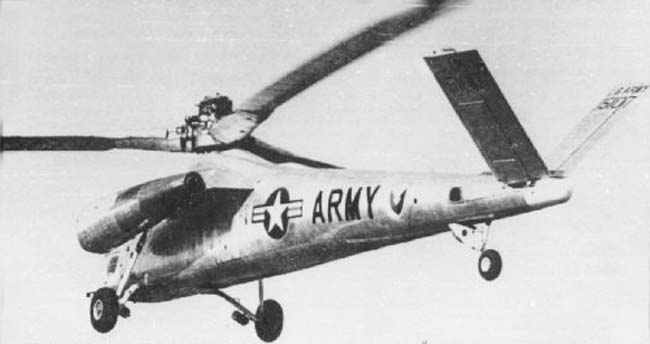
The tests went well, with both the US Army and Hughes believing the hot-cycle system could be widely used. However, the Hughes XV-9 helicopter was noisy and had a high fuel consumption. The military advised Hughes to fix these problems, and in August 1965, after completing testing with the US Army, the helicopter was sent back to the developer. But Hughes decided it was not practical to continue working on it, and the project was canceled. Though it was canceled, the Hughes XV-9 proved many important concepts and performed better than previous aircraft. The Hughes XV-9 had a specific fuel consumption (SFC) of approximately 1.0, compared to the early ramjets and pulsejets, whose SFC was between 5 and 10. In the 1950s, the British Rotodyne program, which used a tip-burning pressure jet, was canceled due to noise concerns. In that case, the jet velocity was around 3000 feet per second (fps). However, the hot-cycle Hughes XV-9 aircraft had a jet velocity of about 2000 fps. At the time, some new concepts demonstrated even lower SFC and jet velocity than the Hughes XV-9, prompting the US Army to request further improvement; however, Hughes was unable to resolve these issues. In the Grounded Dreams series, the XV-9 was not a bad aircraft, but a helicopter that arrived late. Read more Grounded Dreams articles HERE.