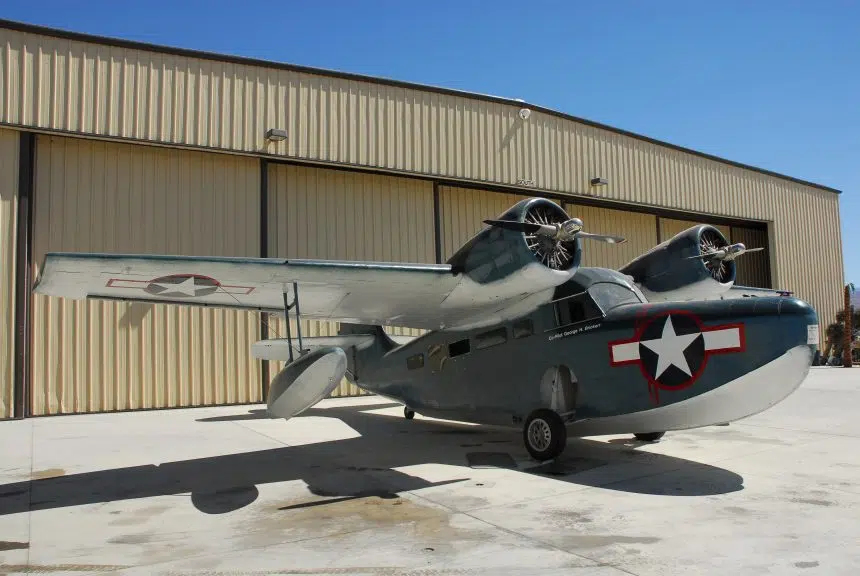


In 1936, a group of wealthy Long Island residents, including E. Roland Harriman, asked Grumman to create an aircraft for flying to New York City. Grumman responded by designing the Model G-21, a light amphibious transport. The aircraft was a high-wing monoplane mostly made of metal. The back half of the main wing and all flight control surfaces, except for the flaps, were covered with fabric. It used two Pratt & Whitney R-985 Wasp Junior engines, each with 450 horsepower. These engines were mounted on the leading edges of the wings. The fuselage also acted as a hull and had hand-cranked retractable landing gear. The prototype had its first flight on May 29, 1937. The flexible fuselage offered plenty of interior space to accommodate either a transport or luxury airliner. Its amphibious design let the G-21 land almost anywhere, and plans called for marketing it as an amphibious airliner. Many changes were made to the Goose aircraft, but the most significant were by McKinnon Enterprises in Sandy, Oregon. The company held 21 supplemental type certificates (STCs) for modifying G-21 series planes and had manufactured four different conversions that got new FAA type certificates as “McKinnon” airplanes.
The McKinnon G-21C

The first conversion was the McKinnon G-21C. It was upgraded with four Lycoming GSO-480-B2D6 piston engines, each producing 340 hp. The McKinnon G-21C also had retractable wingtip floats, a fiberglass radar nose, a one-piece wraparound windshield, and larger cabin windows. As a result of internal structural reinforcements, the gross weight increased to 12,499 lbs. The change received approval under TC 4A24 on November 7, 1958. Between 1958 and 1959, two aircraft models were converted. However, the first McKinnon G-21C prototype quickly returned to the shop for modifications. McKinnon added a 36-inch radar nose extension and extra cabin windows to fit more passengers. In 1960, it was re-certified as the G-21D. The main reason four-piston engine conversions stopped was the fast development of reliable, lightweight turboprop engines in the 1960s. McKinnon saw that instead of managing four complicated, supercharged piston engines, they could get better performance and reliability by using two Pratt & Whitney Canada PT6 turboprops.
The Cancellation
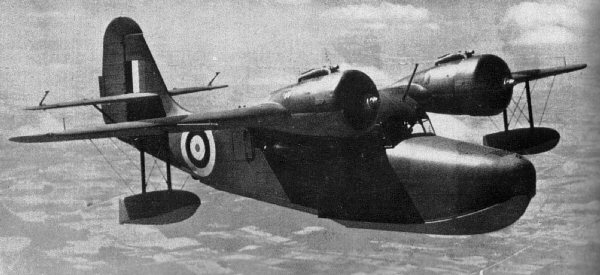
Later, in 1968, two additional airframes were converted. These were called McKinnon G-21C Hybrids and were equipped with two Pratt & Whitney Canada PT6A-20 turboprops, each producing 550 shp (410 kW). At the time, the aircraft did not fully meet the G-21C standards in areas unrelated to the engine swap. Specifically, it lacked important internal structural reinforcements needed for operating up to the G-21C’s maximum weight of 12,499 lbs. As a result, it was certified to operate only up to 10,500 lbs. The plane, known as “McKinnon serial no. 1203,” was sold to the BC Division of Highways and re-registered in Canada as CF-BCI. In 1984, Lind Air Services Ltd of Richmond, BC, supposedly upgraded it to meet the specifications of the McKinnon model G-21G according to Master Drawing List no. MPD-90995. When Pen Air bought it in 1991, it was re-registered in the US as “McKinnon G-21G serial no. 1203.” In the Grounded Dreams series, the aviation industry’s rapid progress led to continuous upgrades to the G-21C and its re-designation. Read more Grounded Dreams articles HERE.